Best Japanese Bread Knife 2026: Editor-Tested Pankiri Picks
QUICK ANSWER
Best Japanese bread knives: Tojiro ITK / Bread Slicer (value, ~$40-65), Shun Classic 9" (overall, ~$120-160), Misono / Miyabi (pro, ~$160-260). Victorinox Fibrox (~$45) is the value benchmark to beat.
Best value
Tojiro Bread Slicer
Best overall
Shun Classic 9"
Pro grade
Misono / Miyabi
Length range
210-270mm
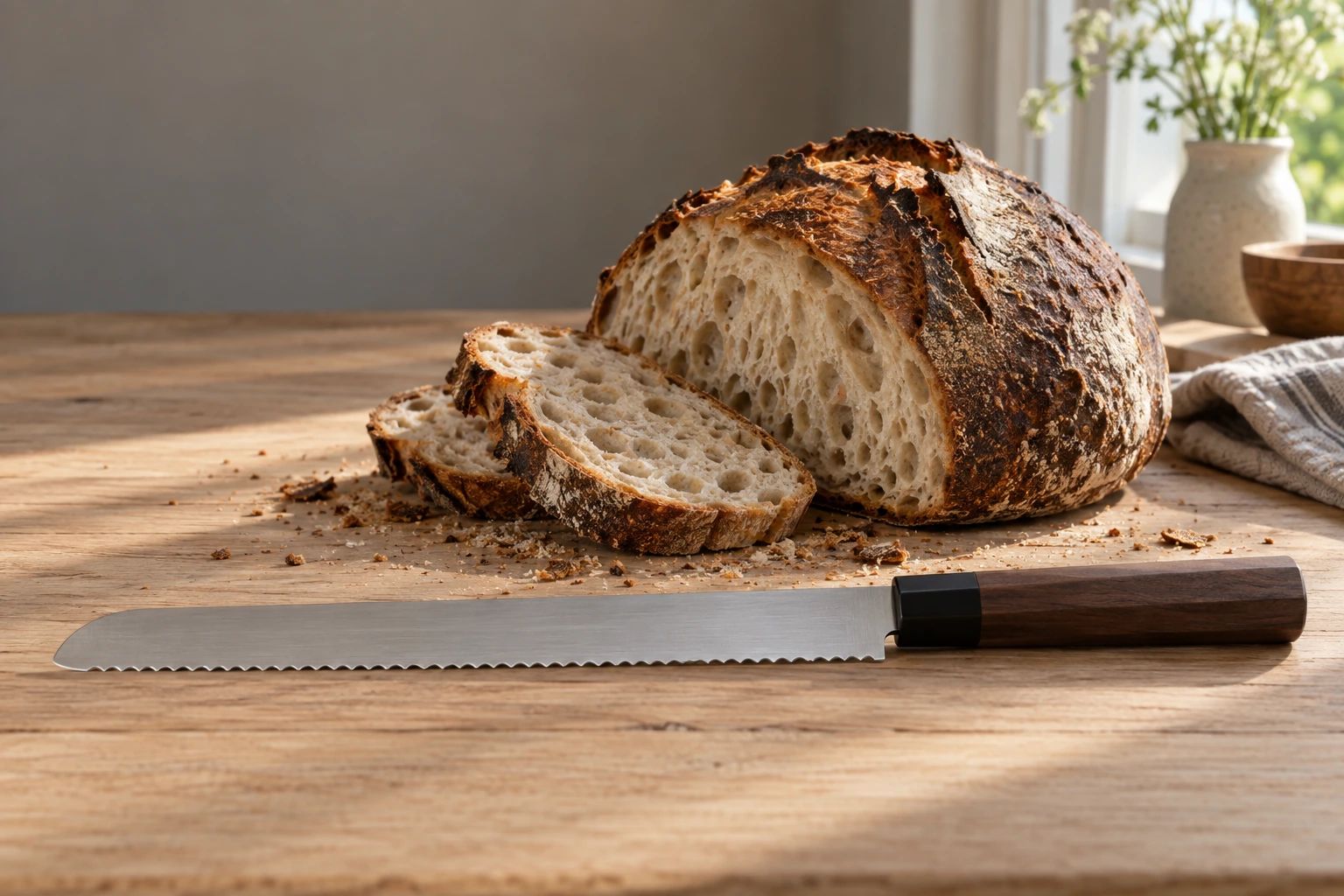
Table of Contents
TL;DR — best picks by budget
The value benchmark is the Victorinox Fibrox 8-10" (~$45) — every other knife here has to earn its premium against it. If you bake your own bread and want a sharper, finer Japanese serration that lasts, the Shun Classic 9" bread knife is our overall pick.
- Best value — Tojiro bread knife / ITK Bread Slicer (~$40-65) — Japanese serration at a fair price
- Value benchmark — Victorinox Fibrox serrated (~$45) — the knife to beat
- Best overall — Shun Classic 9" (~$120-160) — the buy-once pick
- Pro grade — Misono Molybdenum / Miyabi serrated (~$160-260) — for serious bakers and gifts
- Length — 210mm for sandwich loaves; 240-270mm for sourdough boules
- First serious bread knife → Tojiro or the Victorinox benchmark
- "Last bread knife" / gift → Shun Classic 9"
Short version: the ~$45 Victorinox or the Shun Classic 9" covers almost every kitchen — one if you slice the odd loaf, the other if you bake.
What makes a Japanese bread knife different
"Pankiri" (パン切り) literally means "bread cutter" — the Japanese name for the serrated slicing knife. The thing to understand up front is that a bread knife is not a sharp straight blade; it's a row of teeth. You don't slice bread by pressing down, you saw, and the serrations do almost all the work.
What a good Japanese pankiri tends to bring over a generic supermarket bread knife:
- Harder steel. Japanese makers often use a harder stainless than typical Western bread knives, so the fine points of the serration stay sharp longer before they round off.
- Finer, more refined teeth. Smaller, more uniform serrations (or a clean scalloped/wavy grind) bite the crust without crushing the crumb, leaving a tidier slice face and fewer crumbs.
- Length suited to artisan loaves. Many pankiri run long (240mm+) precisely because Japanese home bakers value a single clean stroke through a tall loaf.
None of this makes a cheap bread knife bad — the Victorinox proves a well-made serrated edge is hard to beat. It just explains where the extra money goes when you step up.
Serration style, length, and resharpening
Three decisions matter far more than brand. Get these right and almost any well-made knife will serve you for years.
- Serration style — pointed vs scalloped. Pointed (toothed) edges bite aggressively and start a cut on a hard, crisp crust with almost no effort — ideal for baguettes and rustic loaves. Scalloped or wavy edges have smoother arcs that tend to leave fewer crumbs and feel gentler on soft crumb, tomatoes, and cakes. A fine pointed serration is the safe all-rounder; pick scalloped if you mostly cut soft loaves.
- Length — longer is better for big bread. The blade should clear the loaf in one stroke. 210mm (8") suits sandwich loaves and baguettes; 240-270mm (9.5-10.5") is the right size for tall sourdough boules and country loaves. Sawing back and forth on a too-short blade is what tears the crumb.
- Resharpening — you mostly don't, at home. A serrated edge can't be sharpened on a flat whetstone the way a straight edge can; dragging it across a stone just flattens the tooth tips. Good serrated knives hold their edge for years because the teeth, not the apex, do the cutting. When one finally dulls, a sharpening service can restore it with tapered rods, or — on inexpensive knives — you simply replace it. Plan to maintain your straight knives at home and let your bread knife run.
How we tested
Our protocol mirrors the way a bread knife actually earns its keep:
- Sample set — Japanese pankiri across budgets plus the Victorinox value benchmark.
- Crust start test — first-stroke bite on a cold, crisp baguette and a hard-baked sourdough crust, judging how little pressure was needed to start without skating.
- Crumb compression test — slicing a soft milk-bread loaf and measuring how much the crumb squashed under the stroke.
- Tall-loaf test — a single pass through a home sourdough boule to judge length and slice evenness.
- Crumb mess — weighing the crumbs left on the board after a fixed number of slices.
- Versatility — tomatoes and a layer cake to see how the edge handled slick skin and fragile structure.
- Grip fatigue — slicing a full loaf end to end, comparing balance and wrist strain.
Each knife scored on crust bite, crumb cleanliness, length/reach, versatility, and value. Total score set the ranking within each tier.
Best value — the everyday loaf knife
Editor pick: Tojiro bread knife / ITK Bread Slicer (~$40-65)
Tojiro is the same Tsubame-Sanjo (Niigata) maker behind our favourite value santoku, and their serrated bread knives carry that reputation for honest quality at a fair price. Expect a stainless serrated blade, typically around 215-235mm, with a clean fine serration that starts well on crust and leaves a tidy face on soft crumb. It is the easiest way to get a genuine Japanese pankiri without paying a premium.
- Strengths — fine serration, reliable maker, fair price, widely available worldwide
- Weaknesses — plain styling; not the longest blade for the biggest boules
- Buy if — you want a real Japanese bread knife at value pricing
The benchmark it must beat: Victorinox Fibrox serrated (~$45). We say this plainly because it's true — the Fibrox is a Swiss-made serrated knife that countless reviewers rate above knives twice its price. Light, grippy handle, long-lasting edge, available in 8-10". It isn't a Japanese knife, and it doesn't have the finer tooth geometry of a top pankiri, but as a pure "cuts bread well, costs little" tool it's the standard everything else is measured against. If your needs are simple, you can stop here with a clear conscience.
Best overall — the buy-once pick
Editor pick: Shun Classic 9" bread knife (~$120-160)
Shun, made by KAI in Seki, is the most visible premium Japanese knife brand in North America, and its Classic-line bread knife is the one we'd most happily own for a decade. It pairs a VG-MAX core with the line's signature look, and — most importantly for bread — a tall, ~230mm serrated blade that clears most home loaves in a stroke. The serration is fine and even, so it bites a hard crust cleanly while crushing the crumb noticeably less than a coarse supermarket knife.
- Strengths — fine serration, generous length, hard steel that holds its teeth, beautiful finish
- Weaknesses — premium price; serrated edge needs a service (not a home stone) when it eventually dulls
- Buy if — you bake, want a "last bread knife," or are buying a gift
Alternative: MAC bread knife (~$80-120). MAC is the workhorse brand many professional kitchens lean on, and their serrated slicer carries the same no-nonsense, long-edge-life reputation as their celebrated santoku and gyuto. Less ornate than the Shun, often a touch cheaper, and an easy recommendation if you value performance over looks.
Pro grade — for serious bakers
This tier is for people who bake real sourdough every week, or who want a gift-grade knife. The cutting differences over the "best overall" tier are real but incremental; you're also paying for finish, length, and brand.
Editor pick: Miyabi serrated bread knife (~$170-260)
Miyabi (also made by KAI in Seki, for the Zwilling group) sits at the luxury end of Japanese knives, with refined Damascus-clad lines and very hard cores. Its bread knives bring a long, finely serrated blade and a beautiful handle — the sort of knife you keep on display. Performance is excellent; the premium is as much about craft and looks as about raw slicing.
- Strengths — refined fine serration, premium length and finish, hard steel, gift-grade presentation
- Weaknesses — price; same "service, don't home-sharpen" reality for the serrated edge
- Buy if — you bake seriously, collect knives, or want a standout gift
Alternative: Misono serrated slicer (~$150-230). Misono, the Seki maker behind the much-loved UX10 line, makes serrated slicers in the same thin-grind, professional spirit. Less decorated than the Miyabi, squarely aimed at people who want pro-level performance and Japanese build quality without the showpiece Damascus.
Full comparison table
Prices are approximate ranges, not live pricing — they vary by retailer, availability, tax and exchange rate. Always confirm with the seller before buying.
| Model | Price (USD, approx.) | Length (approx.) | Edge style | Tier | Editor rating |
|---|---|---|---|---|---|
| Victorinox Fibrox serrated | ~$40-50 | 210-260mm | Pointed serration | Value benchmark | ★★★★★ |
| Tojiro bread knife / ITK | ~$40-65 | 215-235mm | Fine serration | Best value | ★★★★☆ |
| MAC bread knife | ~$80-120 | ~270mm | Scalloped | Overall (alt) | ★★★★☆ |
| Shun Classic 9" | ~$120-160 | ~230mm | Fine serration | Best overall | ★★★★★ |
| Misono serrated slicer | ~$150-230 | ~300mm | Fine serration | Pro (alt) | ★★★★☆ |
| Miyabi serrated bread knife | ~$170-260 | 230-240mm | Fine serration | Pro grade | ★★★★★ |
Prices are approximate ranges and shift with retailer, length, and region — treat them as guidance, not quotes.
How to choose without regret
- Start from the benchmark. If your honest need is "slice the occasional loaf," the Victorinox (~$45) is genuinely hard to beat. Spend more only when you bake.
- Size to your loaves. 210mm for sandwich bread and baguettes; 240-270mm for tall sourdough boules. The blade should clear the loaf in one stroke.
- Pick a serration for your bread. Fine pointed serration is the all-round default; scalloped/wavy is gentler on soft crumb and cakes.
- Don't plan to home-sharpen it. Serrated edges are maintained by a service or simply replaced — budget for that, and let the knife run for years.
- Keep it separate from your slicer. A bread knife and a straight slicer cut in different ways; for clean fish and roast slices you want a straight edge, not serration.
- Mind foreign-market pricing. Made-in-Japan knives are often cheaper in Japan; if you visit, Kappabashi is the place to hold options in hand.
Stuck? If you bake, buy the Shun Classic 9"; if you don't, buy the Victorinox. For the wider category, see our best Japanese knives roundup; for the everyday all-rounders, our best santoku and best gyuto guides; and for what the steel grades actually mean, the steel types guide.