We Bought 6 Japanese Knives Around $150 in Kappabashi — Then Cut Tomatoes, Onions, and Daikon (2026 Field Test)
Table of Contents
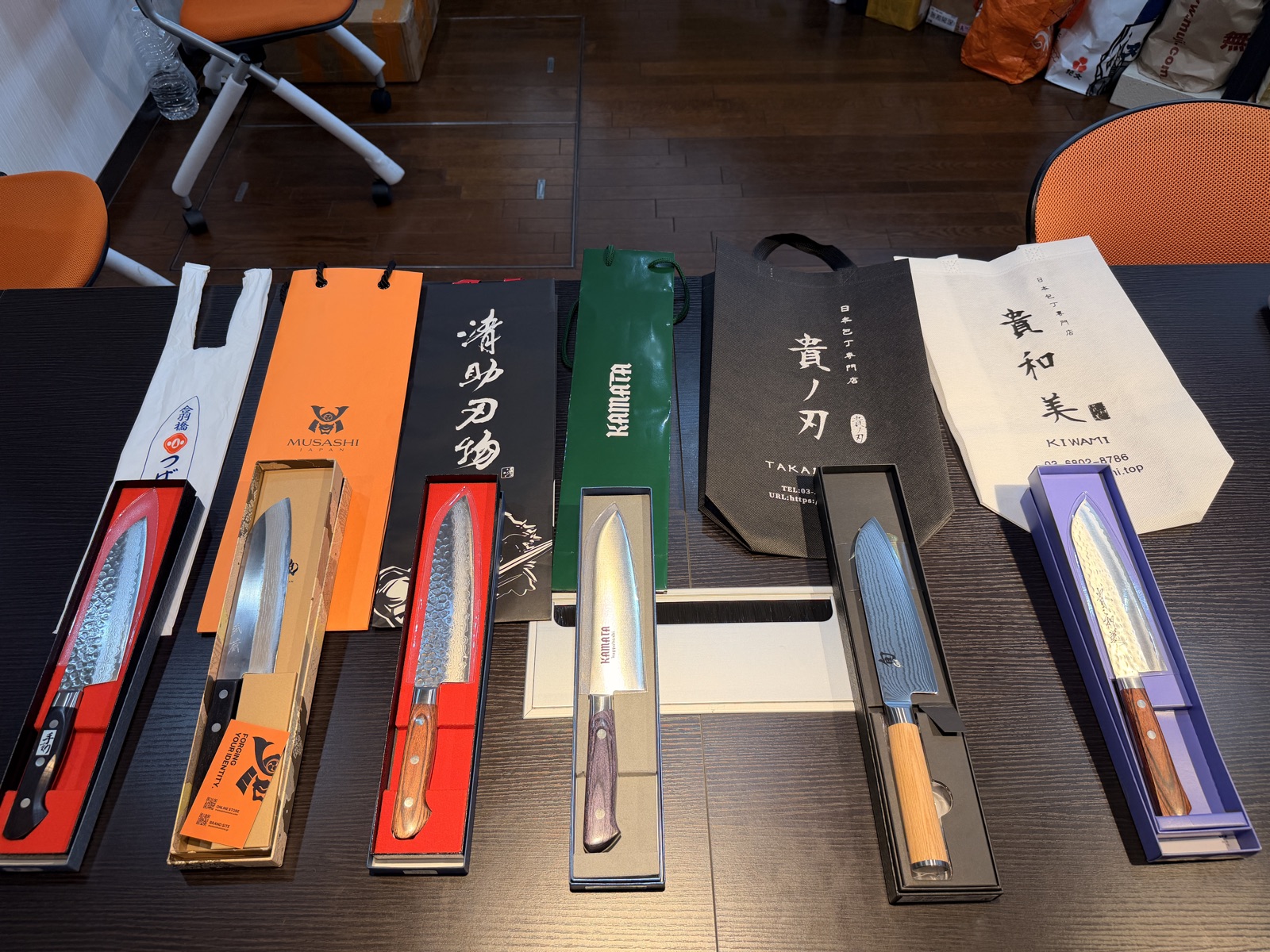
Verdict: The Best Japanese Knife Around $150
What this ranking is: one knife bought at each shop, all six cut on a single day in April 2026. It ranks the six knives we bought — not each shop's full range.
The 2026 update. Across three foods — tomato, onion, daikon — cut with six santoku knives we bought in person at six Kappabashi specialists in the around-$150 range (¥17,800-23,100), the three knives that finished on top by total points were:
- 1st overall: Kiwami — 1st on tomato, 1st on onion, 3rd on daikon. 16 points total. Dominated the precision-slicing tests with extraordinary edge sharpness; the ZDP-189 specialist's sensibility shows even at the entry tier.
- 2nd overall: Takanojin — 1st on daikon, 2nd on tomato, 3rd on onion. 15 points total. Outstanding bite into dense ingredients, and the clear winner when the food has thickness.
- 3rd overall: Kamata Hakensha — 2nd on onion, 2nd on daikon, 3rd on tomato. 14 points total. The all-rounder built on a sharpening specialist's finishing precision, never out of the top three on any food.
That said, "first place overall" does not automatically mean "best for you." Each of these six knives plays to different strengths, and the right knife depends on your cooking style, budget, and the kind of support you want. The recommendations by buyer type below match each profile to the right shop.
For anyone hunting for an authentic Kappabashi santoku at an around-$150 budget (¥17,800-23,100), this is our record of that day — six shops, six knives, every cut on video.
Steel and Price — What the Grades Mean, and What We Did Not Measure
The core steel — the metal the edge itself is ground from — split into three modern grades across the purchases where we recorded it: VG MAX, VG10, and VG1. Anyone shopping in this price tier should know what those grades are, and what a single day of cutting can and cannot tell you about them.
VG MAX, VG10, VG1 — what the grades are, and what a one-day test cannot show
- VG MAX (Takanojin only, ¥22,000) — a steel Kai developed in-house and positions above VG10 for hardness and toughness. That is the maker's positioning, not a result of ours: this test did not measure edge retention.
- VG10 (Seisuke ¥20,900 / Tsubaya ¥23,100) — the long-standing standard for high-end Japanese stainless.
- VG1 (Kiwami ¥19,910 / MUSASHI JAPAN ¥17,800) — a tier below VG10 on paper.
What our cutting showed, for three foods on one day: the VG10-vs-VG1 spec gap did not decide the ranking. Sharpening precision and edge geometry — the things each shop adds on top of the steel — moved our results more than the grade did. Whether the grades separate over months of use is a question a single session cannot answer, and we have not run that test.
Damascus: the layers touch the food, the pattern is appearance
Three of the six knives (Seisuke, Takanojin, Tsubaya) use a damascus (multi-layer) construction, and shop displays tend to leave the mechanics vague. Here is what is actually happening: in a laminated blade, the patterned outer layers form the sides of the blade, and they do touch the food as you cut. What they do not form is the edge. The cutting edge is ground from the core steel at the center — the VG MAX or VG10 — and that core is what governs sharpness and how long the edge holds. The outer layers do real work of their own, contributing corrosion resistance and toughness; the swirl on top of them is appearance.
Our cuts pointed the same way. On tomato and onion, Kiwami's mono-clad VG1 out-cut the damascus VG10 knives from Seisuke and Tsubaya. On one day's cutting, "damascus" was not a predictor of the result; the core steel and the sharpening done on it were what showed.
What one day of cutting showed: the shop's sharpening carried as much as the grade
Takanojin's VG MAX won the daikon test outright — the result you might predict from the highest-positioned core steel meeting the densest food, though with one knife per shop we cannot separate the steel from the grind behind it. And Kiwami's VG1 won tomato and onion, which says Kiwami's house sharpening is doing real work — enough to come out ahead on the precision tasks despite a one-tier steel gap on paper.
The most expensive knife in the test — Tsubaya at ¥23,100, VG10 damascus — did not win overall. Price ≠ performance is the cleanest takeaway. In this tier, choose on core steel grade × sharpening reputation × match to your cooking, not the price tag or the pattern on the sides of the blade.
The Project and Its Strict Conditions
Knife reviews are everywhere on the internet. The problem is that almost all of them compare different sizes, different steels, and different price tiers across shops — so the results reflect the spec gap between knives rather than the actual character of the shops. Japanese Knife Lab set out to fill that gap.
Why we did this
Kappabashi is Tokyo's mecca of kitchen tools, with sixteen-plus dedicated knife shops in a single neighborhood (full directory: Kappabashi knife shop guide). With the surge in international visitors, demand for "a real santoku in the ¥20,000 range" has only grown. But until now, no one had compared shops on truly equivalent terms.
The strict conditions we held constant
- Price: around $150 (¥17,800-23,100, roughly $119-$154)
- Knife type: santoku
- Steel: stainless — VG MAX, VG10, or VG1 (prioritizing home-kitchen practicality)
- Blade length: 165-180 mm
- Shops: six Kappabashi specialists
- Acquisition: bought at full retail by the editorial team — no review samples, no loaners
- Test date: a single day in April 2026, all six visited in one walk
The team
Japanese Knife Lab is a small editorial team. For this test, one person made every cut, so that hand and technique stayed constant across all six knives, while filming and record-keeping were handled by one other person. All six knives were bought at list price with our own budget — no review samples, no loaners, nothing provided by manufacturers or retailers.
One commercial relationship does exist, and it belongs here rather than in the small print: we earn a referral commission on purchases made through links to Kiwami's online store, and Kiwami is one of the six shops below. It came after the fact — the scores on this page were fixed on the test day in April 2026, affiliate tracking for kiwami.top was set up on 22 May 2026, and the purchase buttons were added on 1 June 2026. The dated disclosure is on our team page and in our editorial standards.
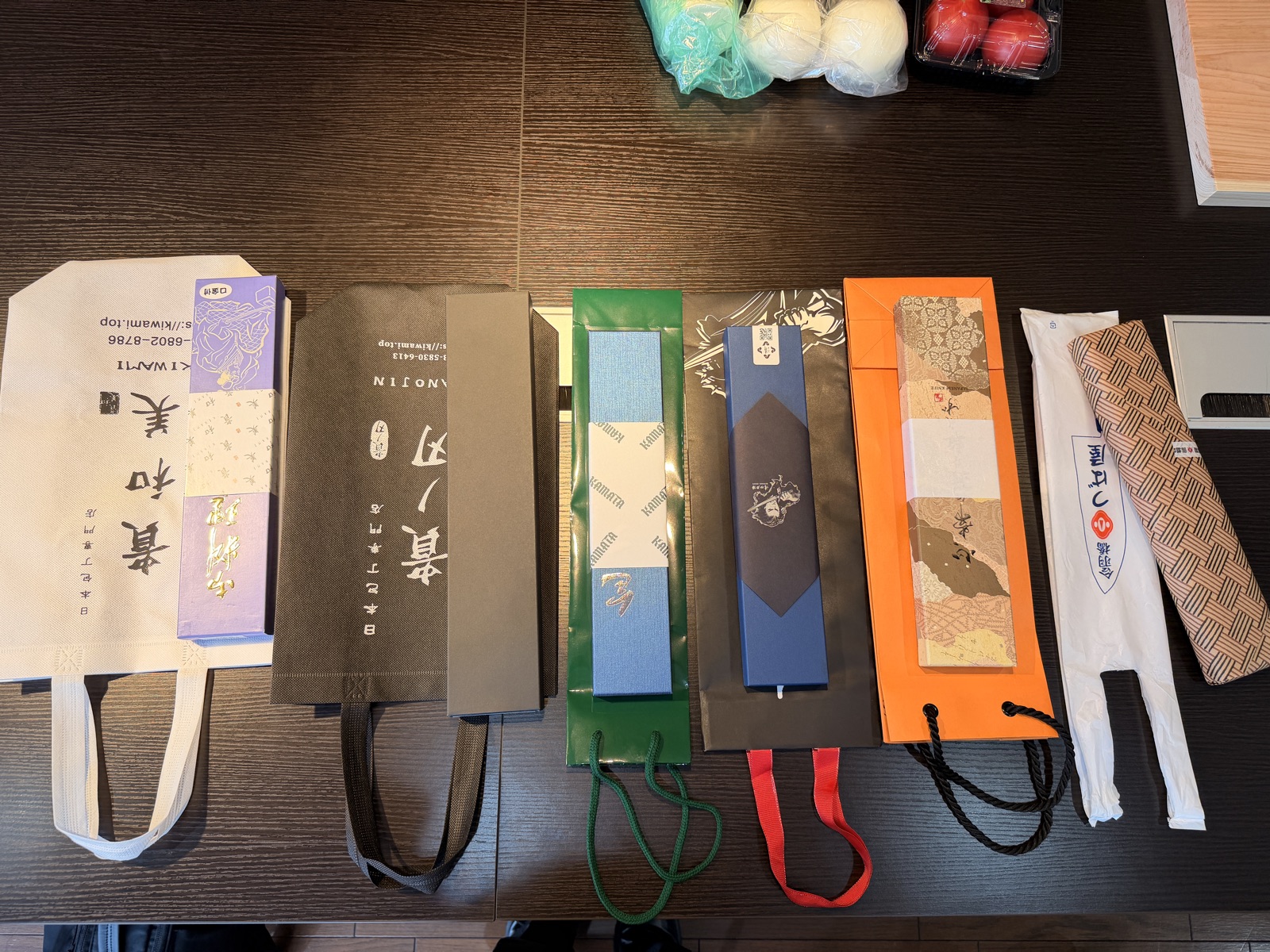
The Six Shops (Alphabetical)
To avoid biasing readers toward the eventual ranking, we introduce the shops in alphabetical order. For each, we cover the knife we bought, the in-store experience, the service, and the distinct strengths the shop brings.
Kamata Hakensha — Sharpening Specialists
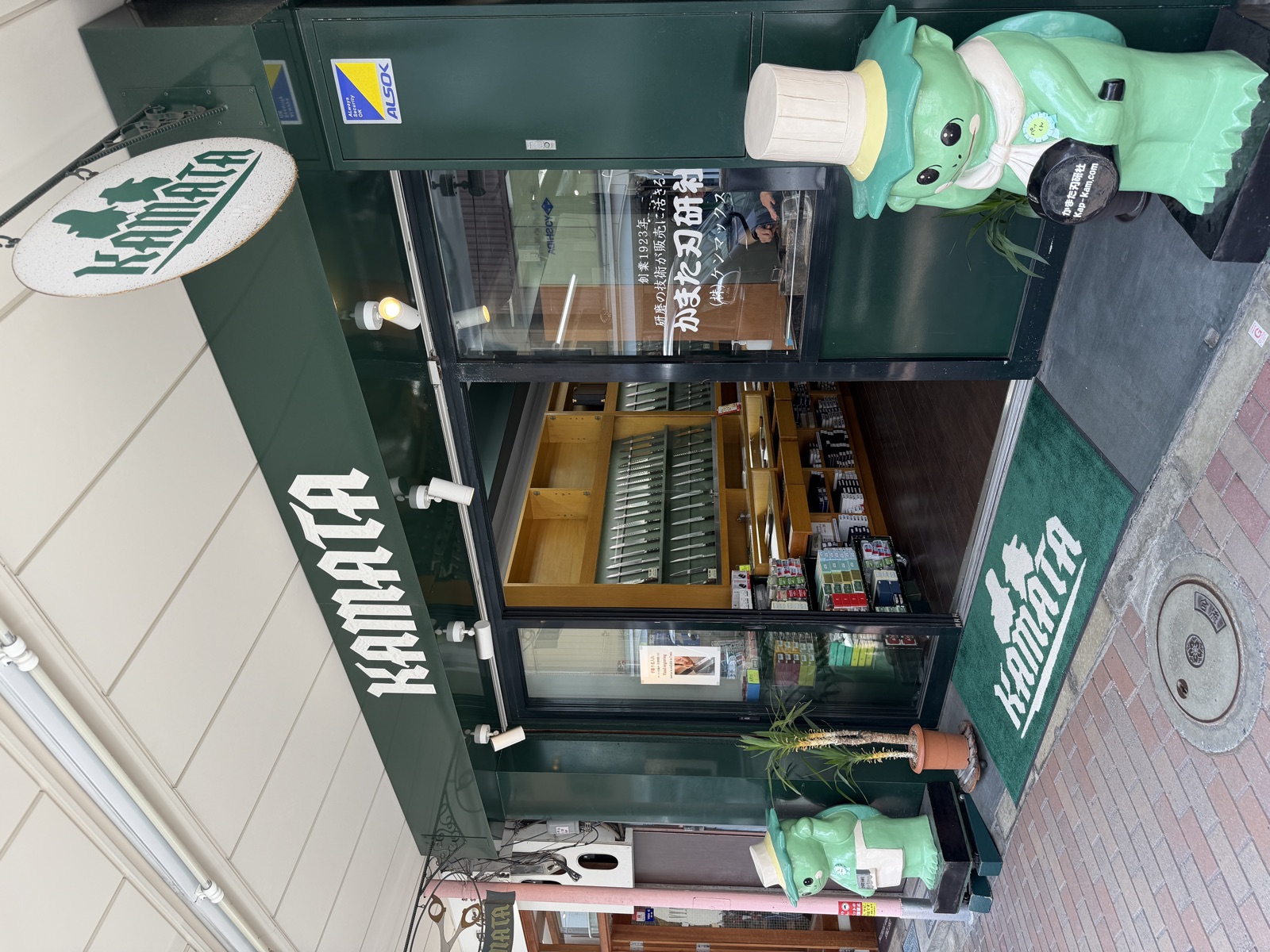
- Location: Taito, Tokyo (Kappabashi Dougu Street)
- Hours: 10:00-18:00 (closed irregularly)
- What we bought: stainless santoku, 165 mm — bought inside the same around-$150 band (¥17,800-23,100) as the other five. We did not record the price we paid, or the core steel, at the counter.
House style: Kamata Hakensha started as a sharpening shop, and that lineage shows in everything they do — diagnosing a blade and coaxing the right edge out of it is the headline skill. They sell knives too, but the sharpening philosophy underneath is the genuine differentiator. They take the time to understand your hand size, your grip, and the food you cook most before recommending a blade — what they call "knife fitting," and what regulars love them for.
Service: When we visited, a veteran staff member asked us, in turn, "Which vegetables do you cut most?" and "Right-handed?" before pulling out blades. They handed us thin paper to test the edge in person and let us feel the angle directly. Mention sharpening and the conversation deepens — there is real craftsmanship pride here in talking blade geometry. This is a shop you will want a long relationship with.
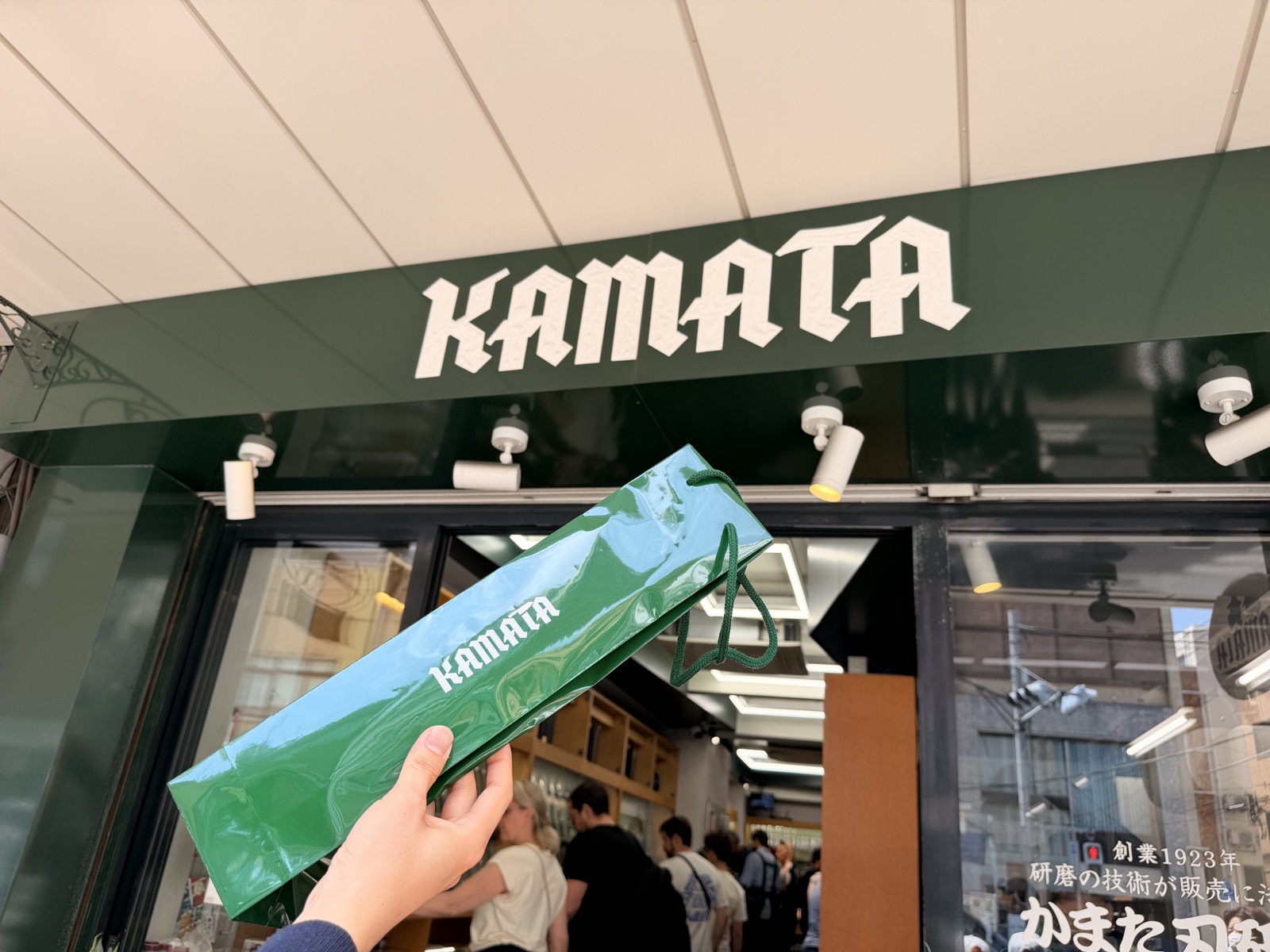
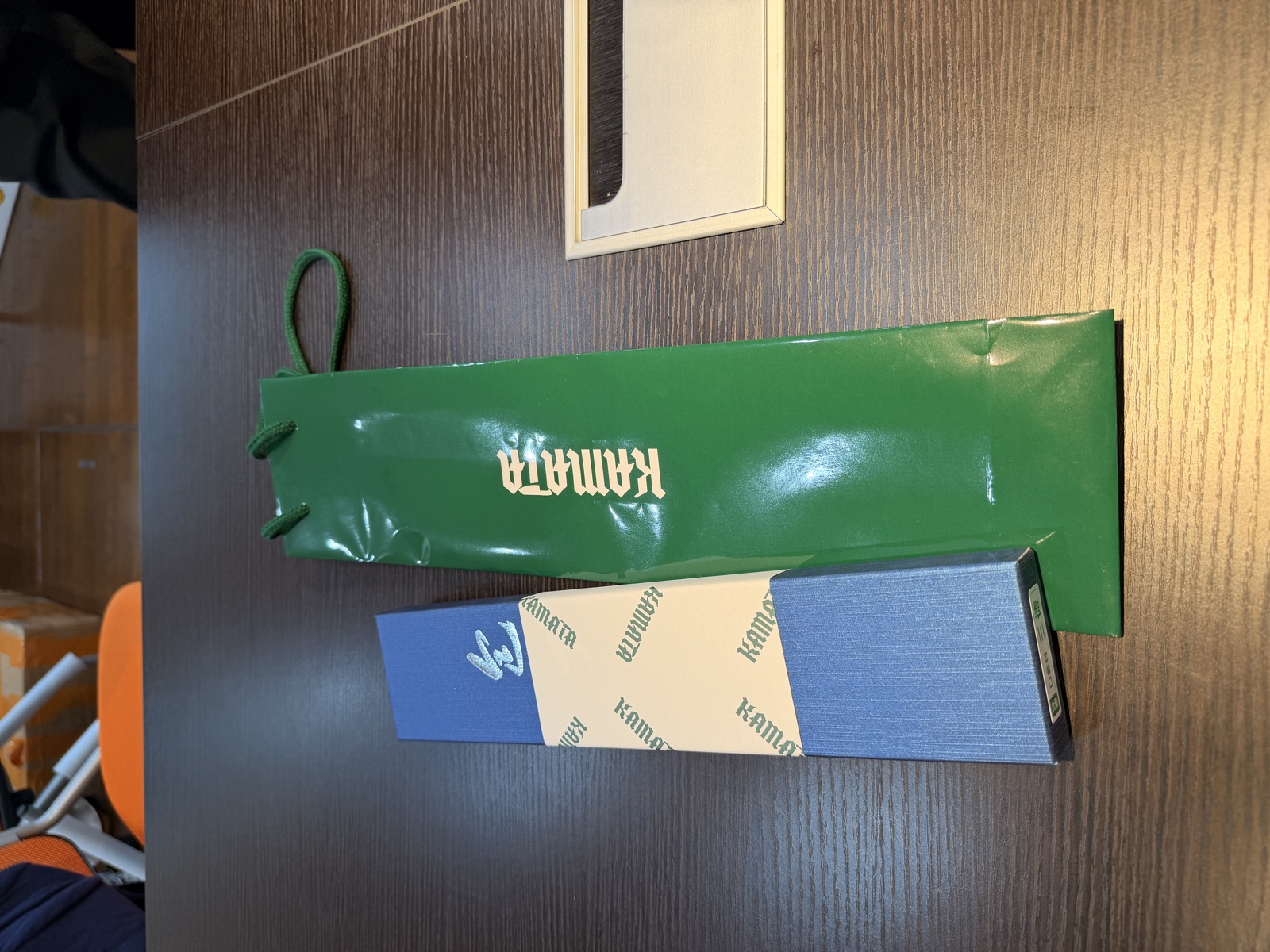
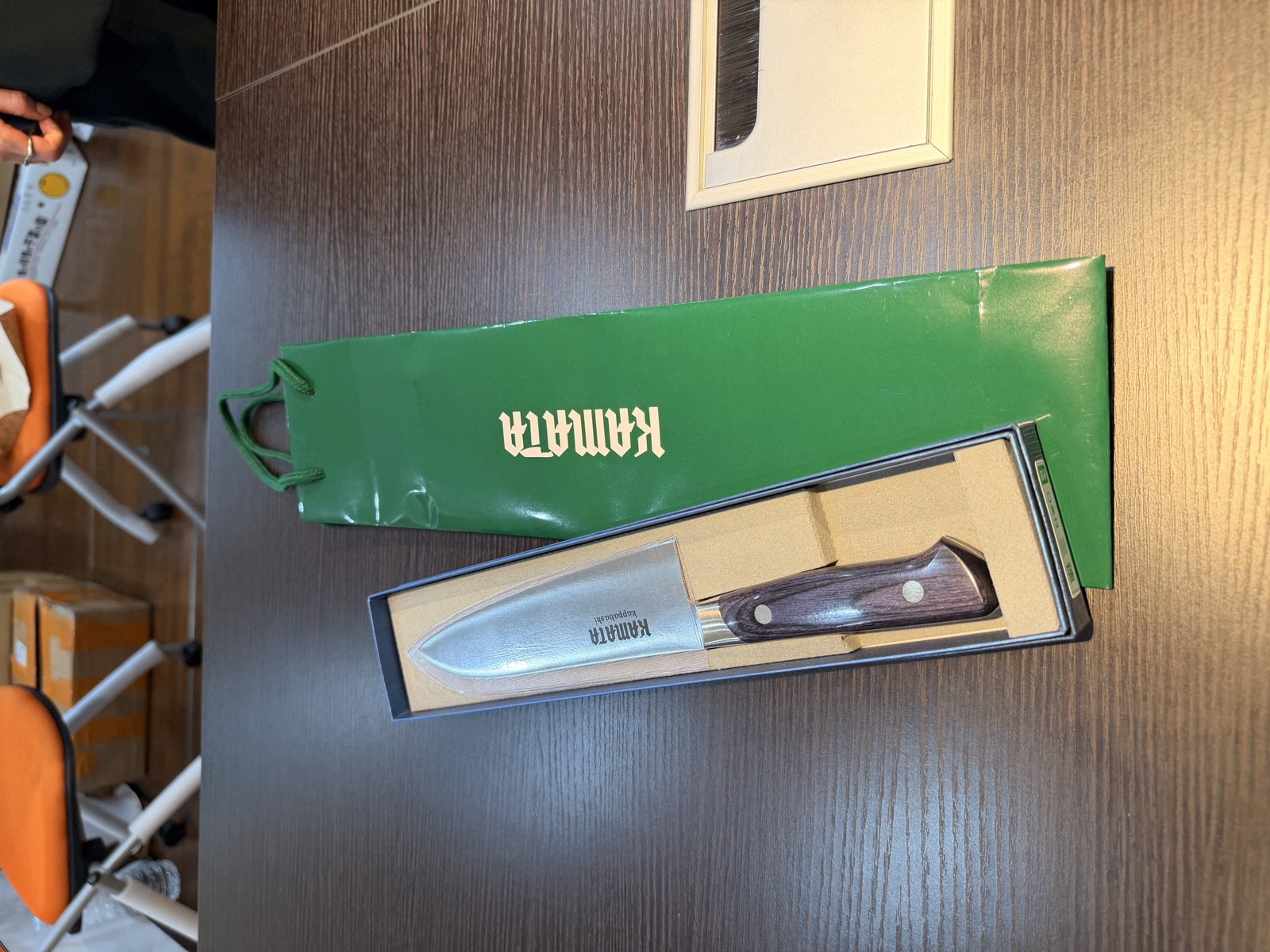
Distinct strengths: (1) the finishing precision of a shop that began as a sharpening specialist, (2) post-purchase resharpening service, (3) personal fitting to your hand and your cooking, (4) the only knife in our test to place top-three on all three foods.
Kiwami (貴和美) — The ZDP-189 Specialist
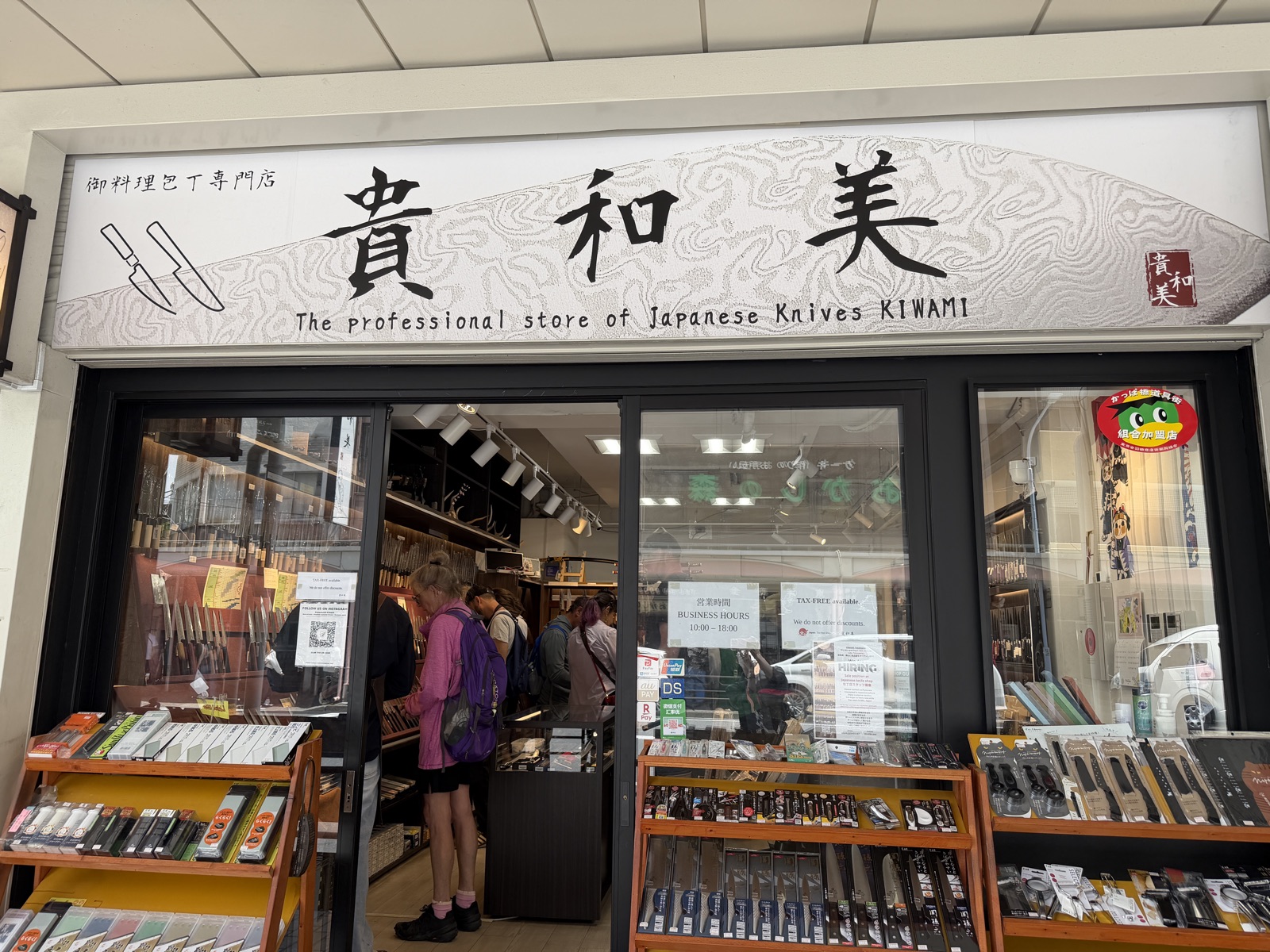
- Address: 1-5-17 Nishi-Asakusa, Taito, Tokyo
- Phone: 03-6802-8786
- Hours: 10:00-17:30 (open year-round, closed New Year)
- Web: kiwami.top
- What we bought: VG1 stainless santoku, 170 mm (¥19,910 / ~$133, mono-clad)
House style: Kiwami is internationally known as a specialist in ultra-high-hardness ZDP-189 steel (HRC 65-67). For this test we stayed in the around-$150 range (¥17,800-23,100) and bought their VG1 mono-clad santoku at ¥19,910. The clean, single-layer construction puts the focus where it belongs — on the core steel and the shop's sharpening — and the philosophy of a shop that lives and breathes ZDP-189 runs through the whole inventory, the entry tier included.
Service: An English-capable staff member greeted us almost immediately. Asked about budget and intended use, we said "around $150, santoku, home cooking" and three candidates appeared on the counter without hesitation. The team also offers an in-store cutting demo on the spot, so you can feel the edge through stiff paper and copy paper before committing. Kiwami also makes a point of mentioning up front that photography is welcome — a small but meaningful courtesy that international visitors will appreciate.
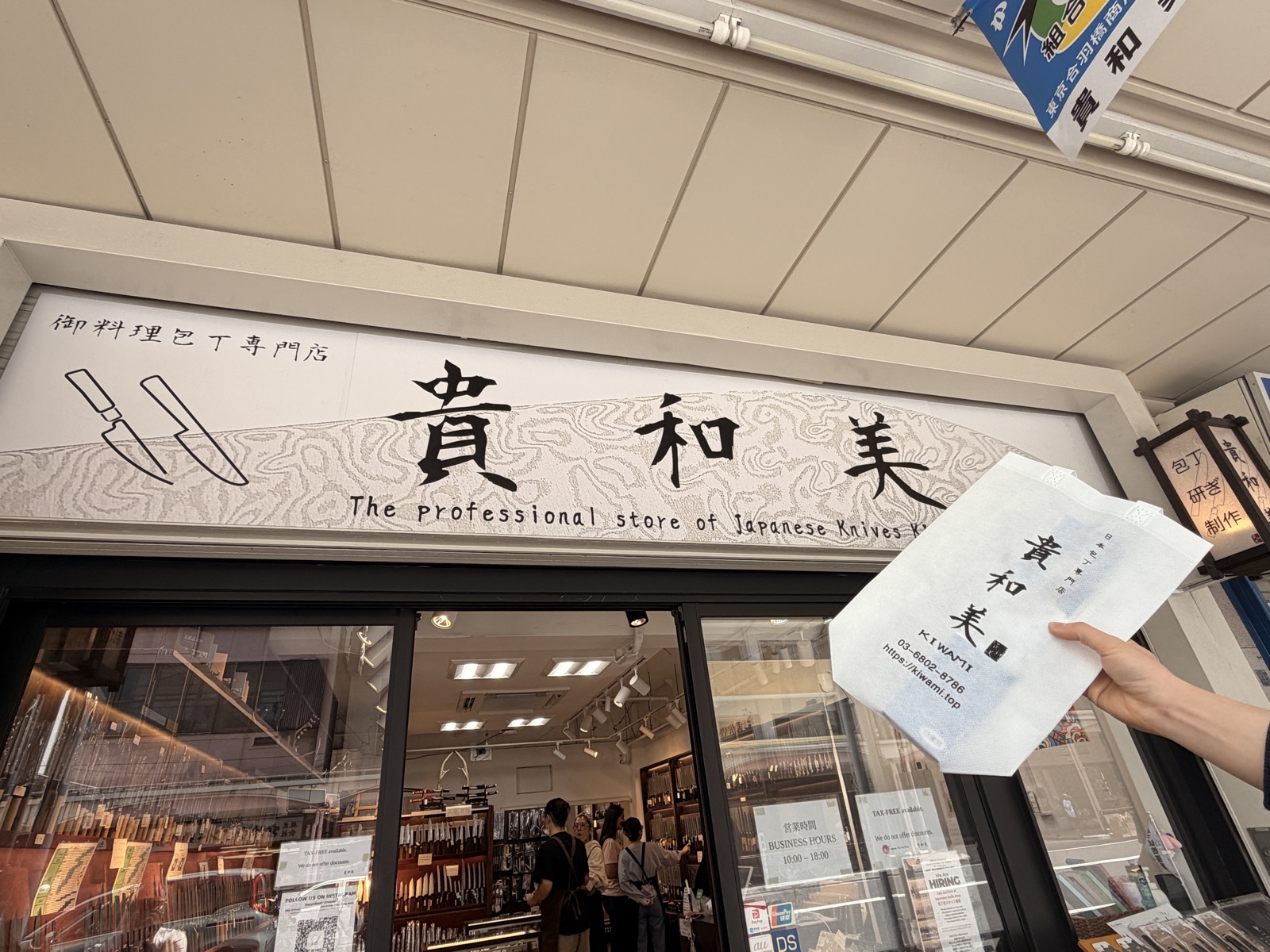
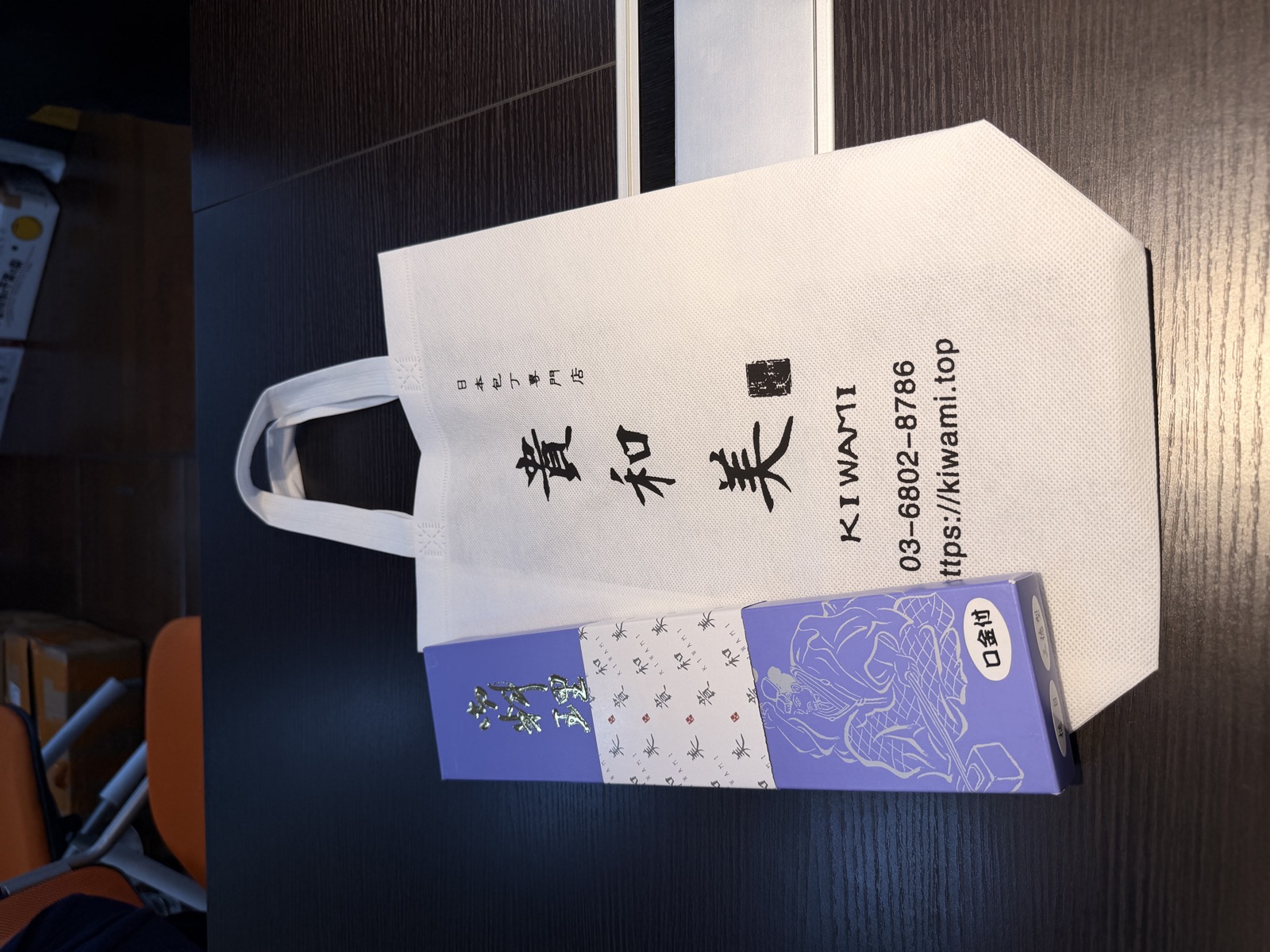
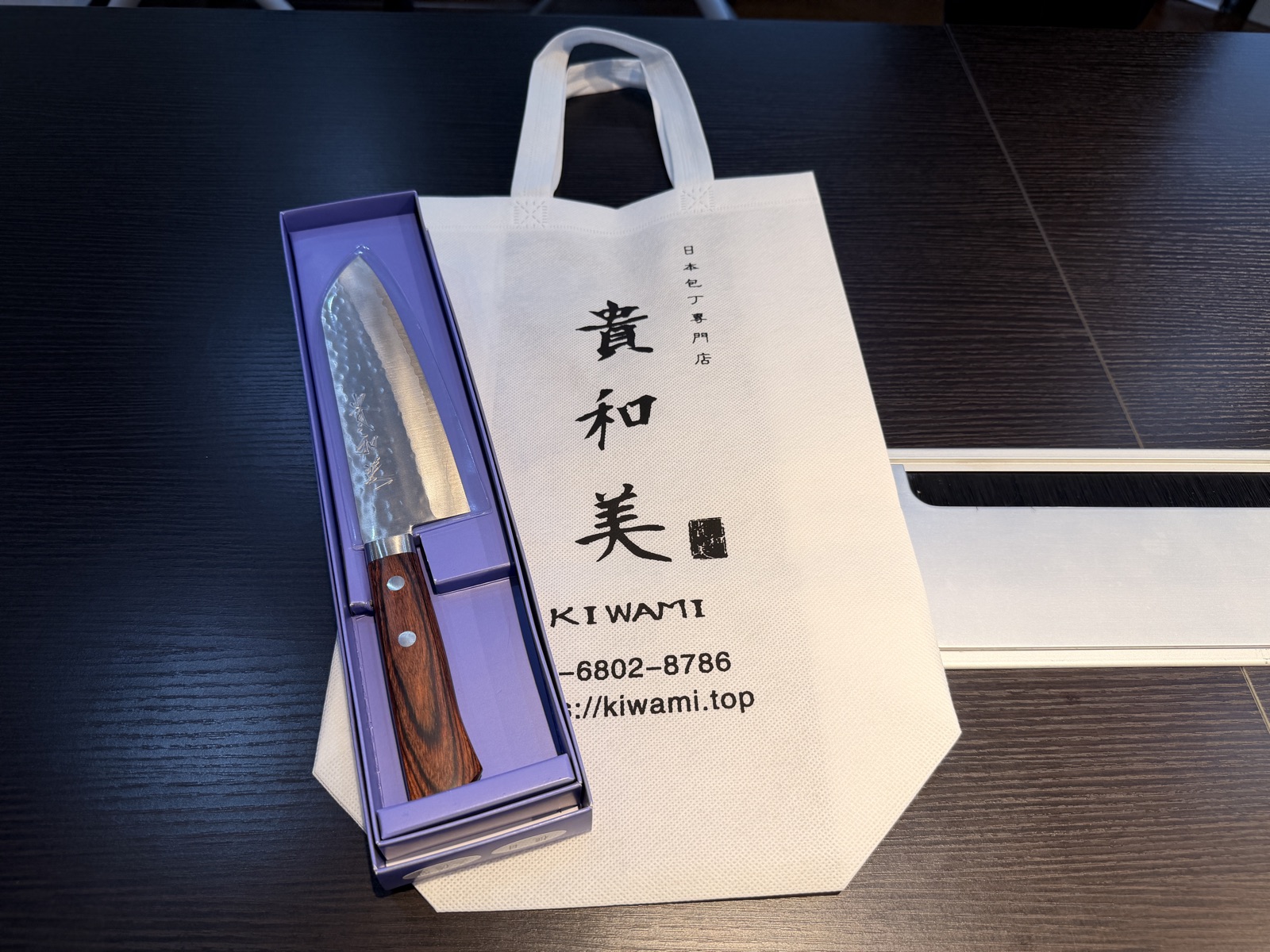
Distinct strengths: (1) deep expertise in high-hardness steels as a ZDP-189 specialist, (2) on-site cutting demos before purchase, (3) thorough English service, (4) international online shop with overseas shipping, (5) initial sharpening service for first-time buyers.
MUSASHI JAPAN — Experiential Flagship Store
- Address: 3-8-4 Nishi-Asakusa, Taito, Tokyo
- Hours: 10:00-18:00
- What we bought: VG1 stainless santoku, 170 mm (¥17,800 / ~$119, mono-clad)
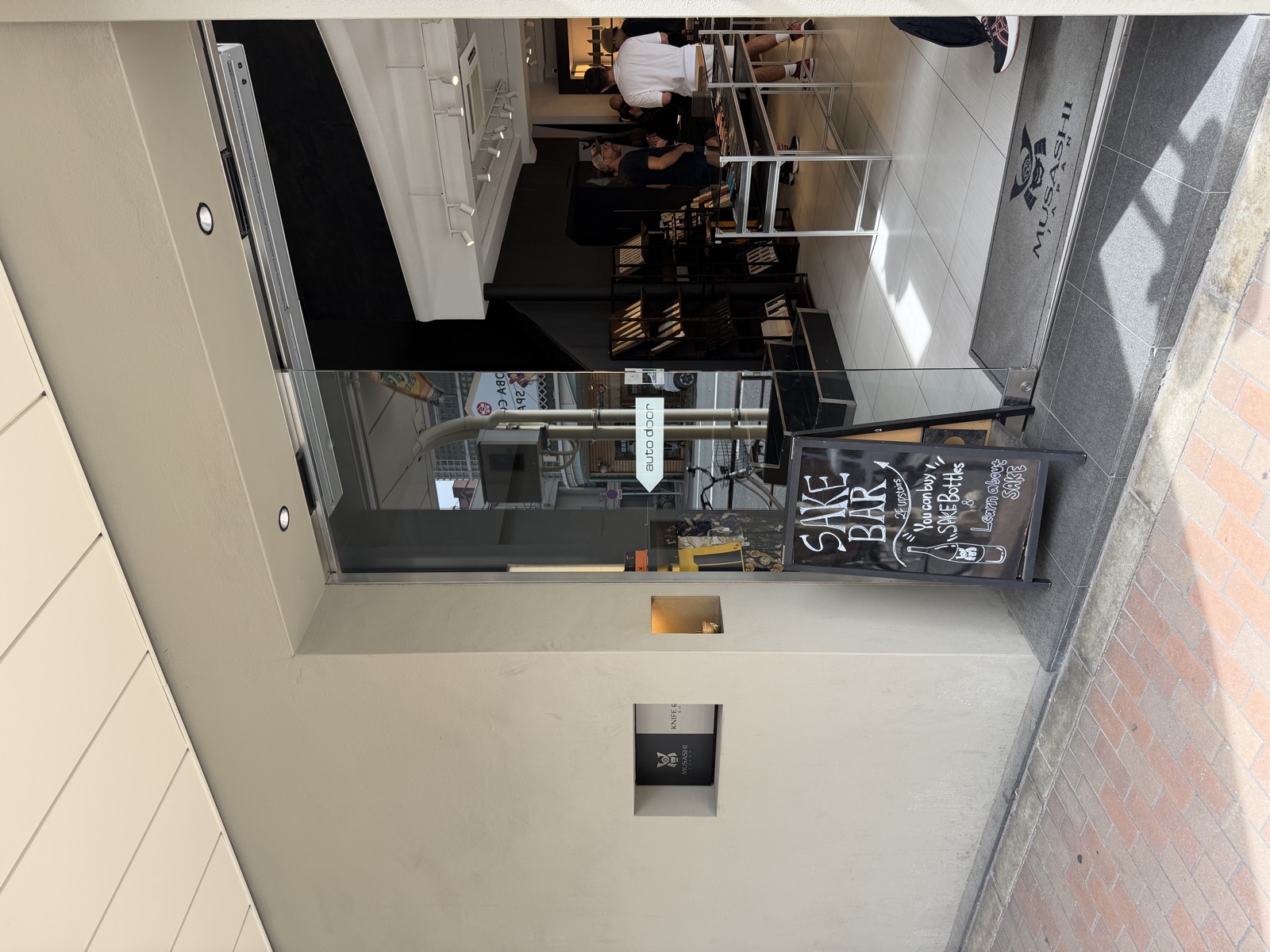
House style: MUSASHI JAPAN is an experiential, large-format store built to introduce people to knife culture. The ground floor stocks blades from makers across Japan, and they run regular sharpening workshops. Opened in spring 2023, the modern, well-lit interior is genuinely welcoming for newcomers — the easiest of the six to walk into cold. The price range covers everything from entry to mid-tier, with a deep selection in the around-$150 band. The knife we bought — a VG1 mono-clad santoku at ¥17,800 — was the most affordable of the six, but its core-steel grade matches Kiwami's.
Service: Despite the size, service is attentive — a young staff member asked us up front whether we were buying for home or professional use. With so much floor space, the comfortable rhythm is to browse on your own and flag a staff member when something catches your eye. We also got an invitation to one of their sharpening workshops, the kind of long-term-customer attention that signals the shop wants you back. We saw plenty of families with kids being treated kindly here, too.
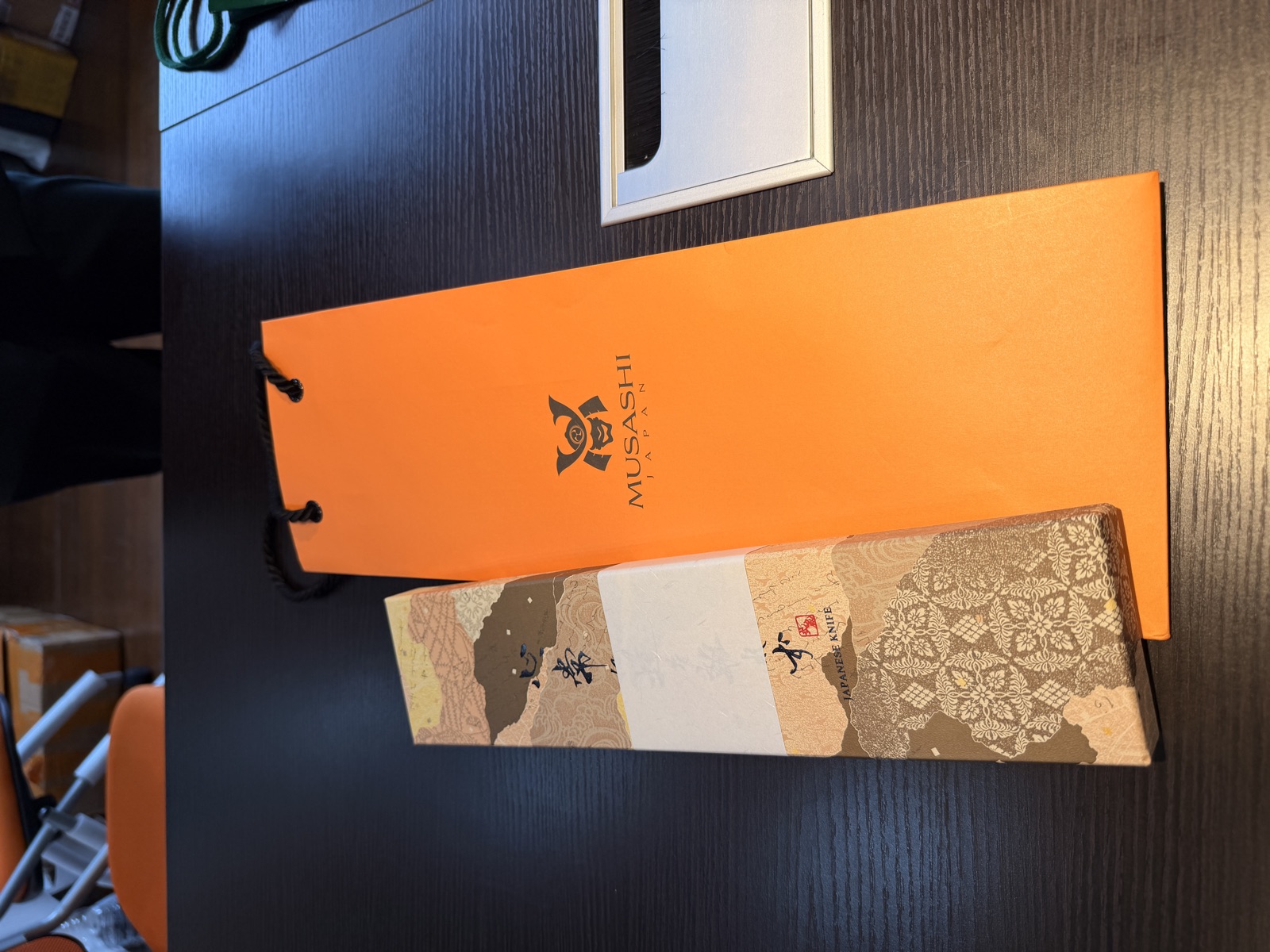
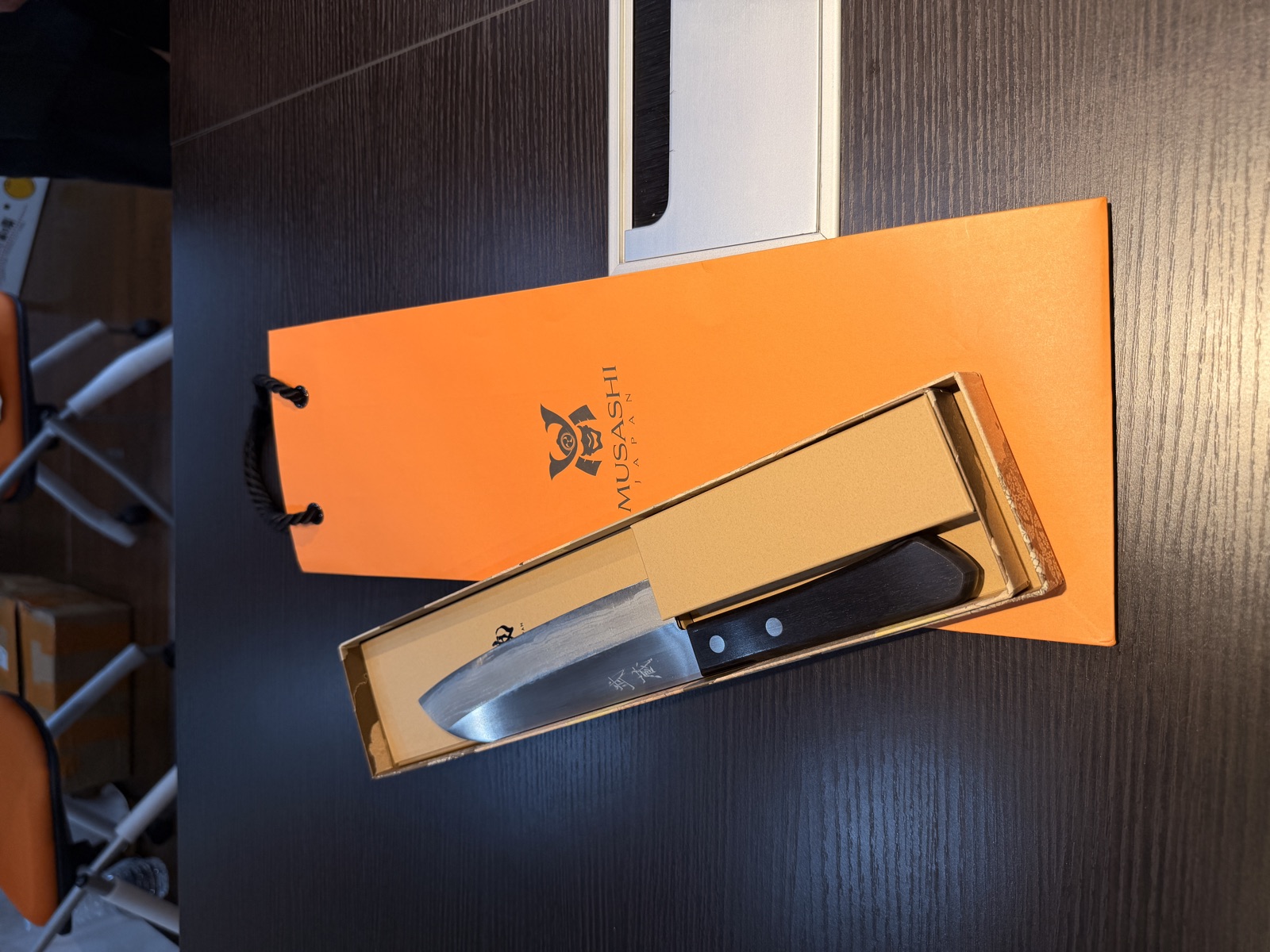
Distinct strengths: (1) a large, unhurried shopping floor, (2) deep selection in the entry price tier, (3) regular sharpening workshops, (4) genuinely welcoming for first-time buyers, (5) experienced with international visitors.
Seisuke Knife — Multilingual Service
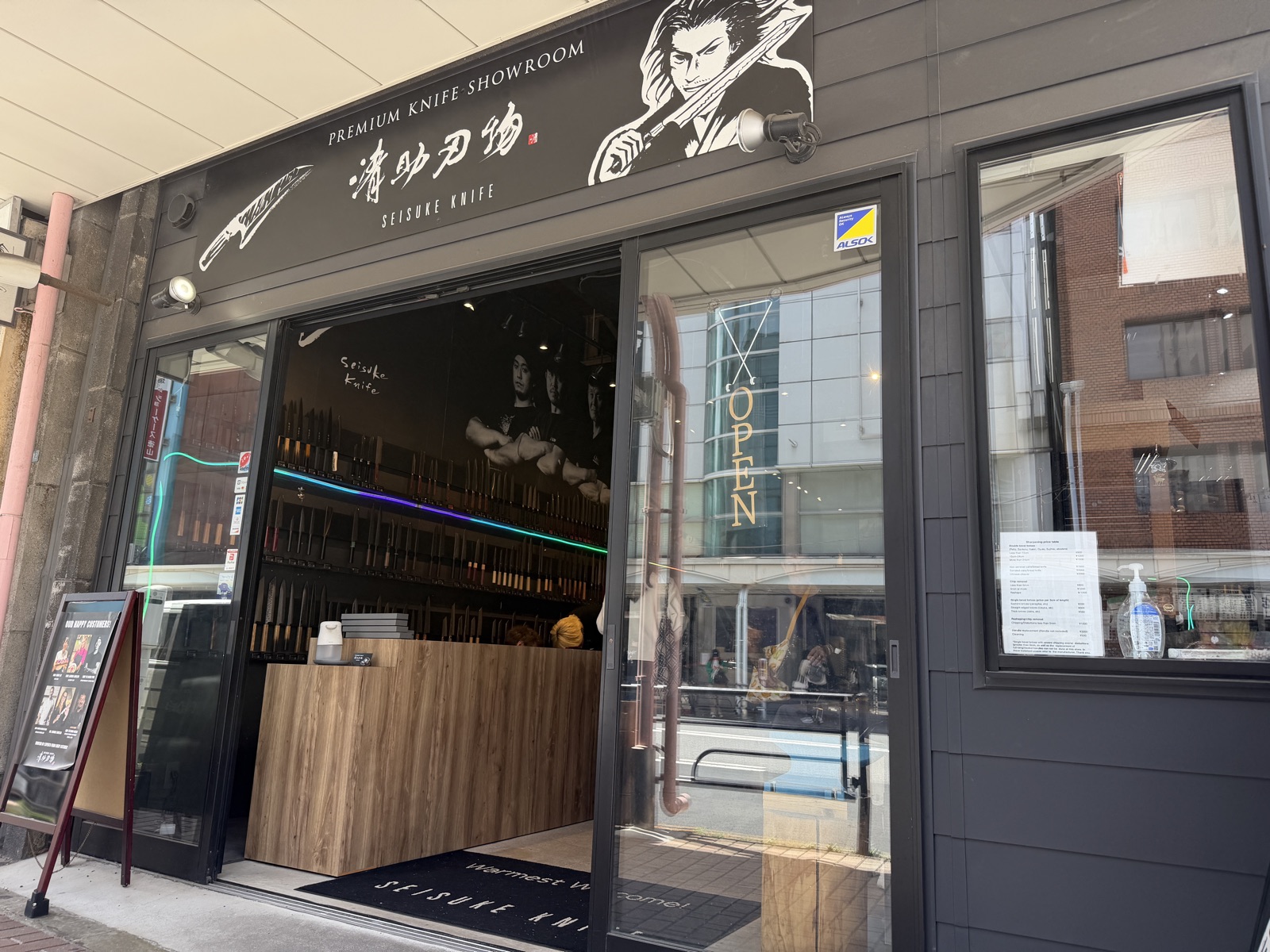
- Location: Taito, Tokyo (Kappabashi Dougu Street)
- Hours: 10:00-17:30
- What we bought: VG10 damascus santoku, 165 mm (¥20,900 / ~$139)
House style: Seisuke Knife is a curated select shop featuring handmade knives from multiple Japanese knife-making regions (Echizen, Sakai, etc.), and is enormously popular with overseas buyers. English menu booklet, English price tags, and an English website with online ordering — for an international visitor, this is one of the lowest-friction shops in Kappabashi. The store layout is meticulously organized, with use case, blade length, and price visible at a glance for every knife. The knife we bought is a VG10 damascus santoku, 165 mm (¥20,900); the patterned outer layers form the sides of the blade, while the edge itself is ground from the VG10 core.
Service: When we visited, the English-speaking staff switched to fluent, friendly Japanese for the editorial team without missing a beat. They walked us through the Echizen tradition — "a tenacious, supple edge with balanced weight" — and demonstrated each point as they made it. The staff even showed us proper cutting form by hand, which is rare and enormously useful for someone buying their first Japanese knife while traveling.
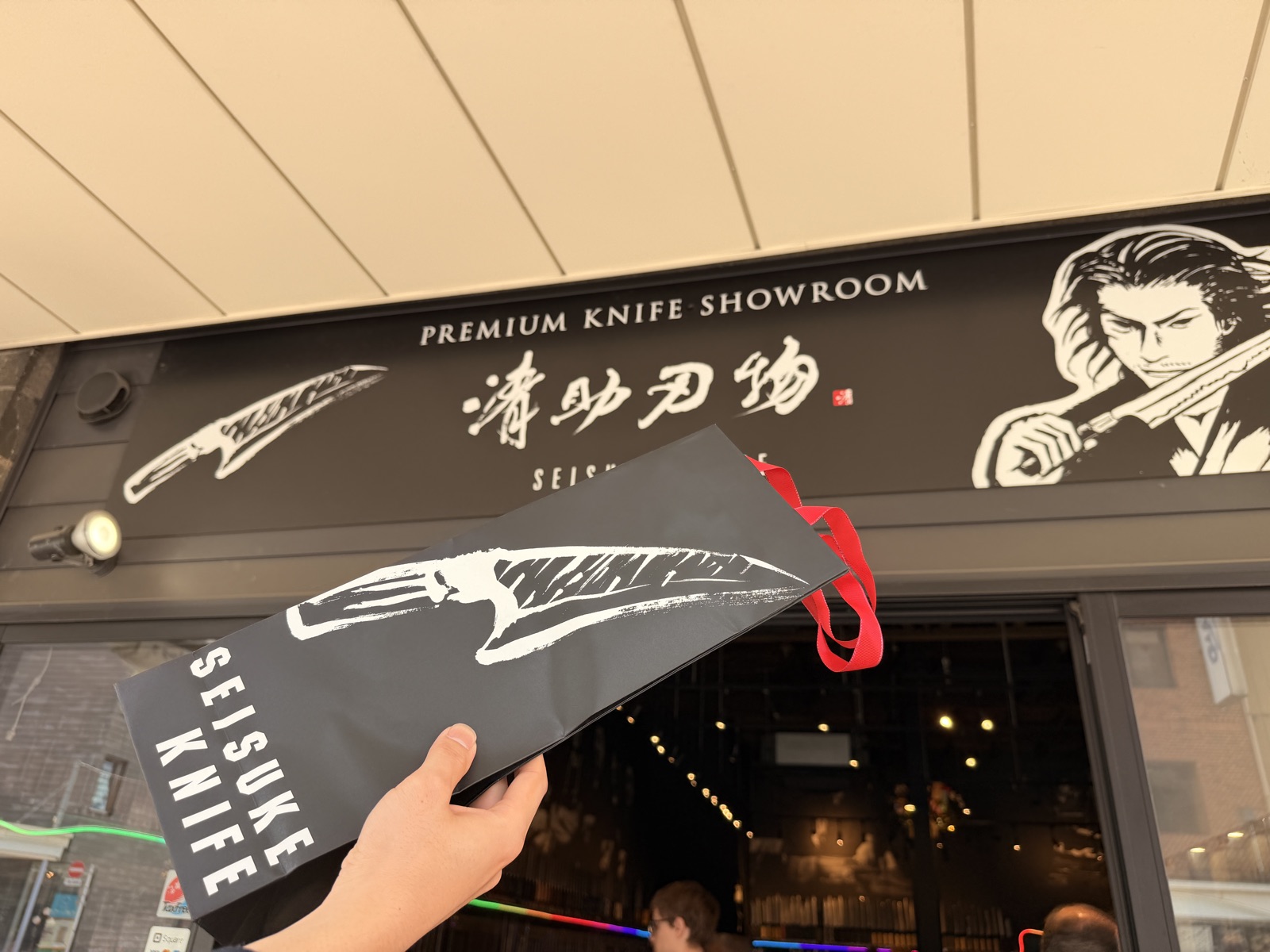
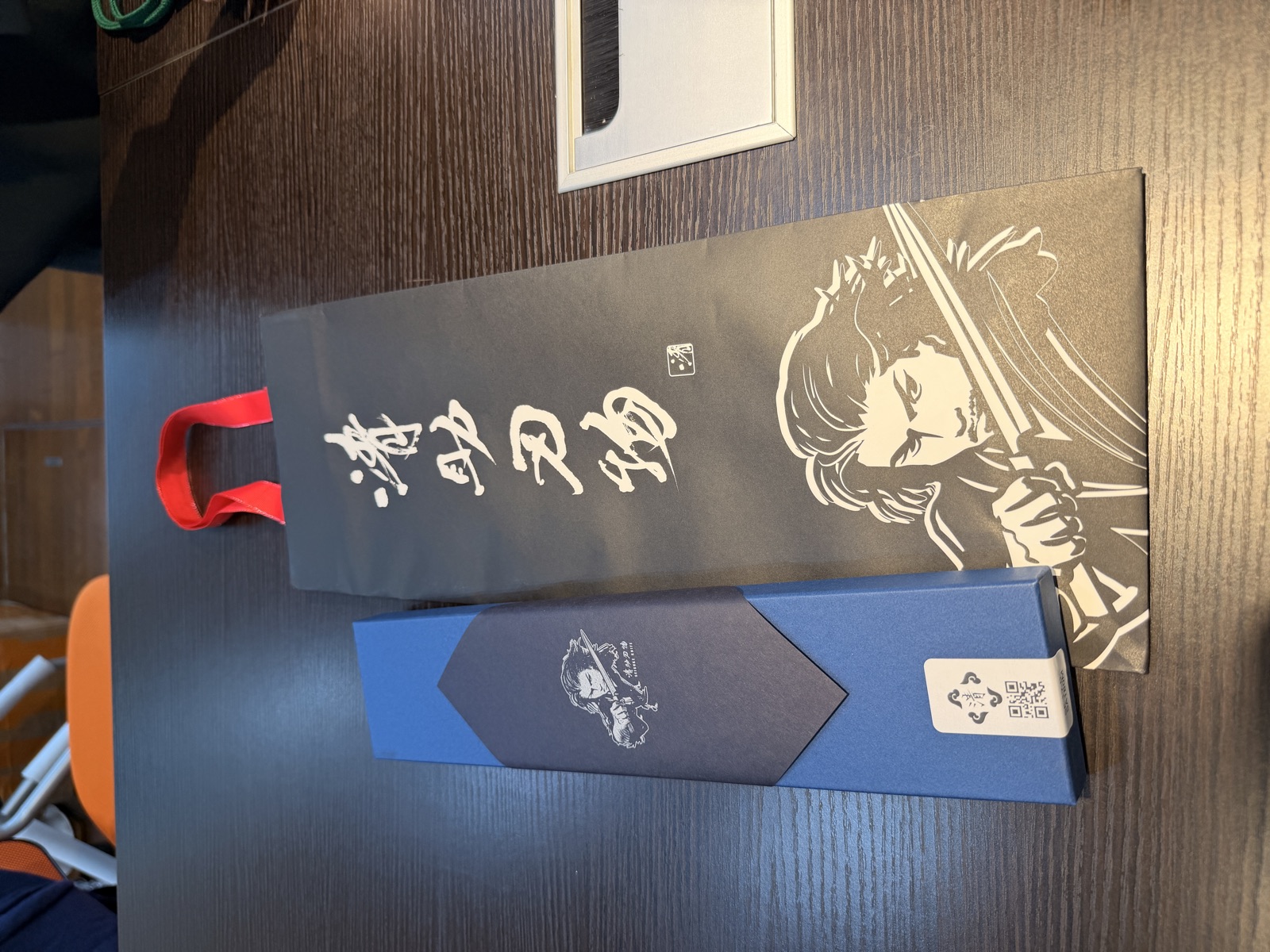
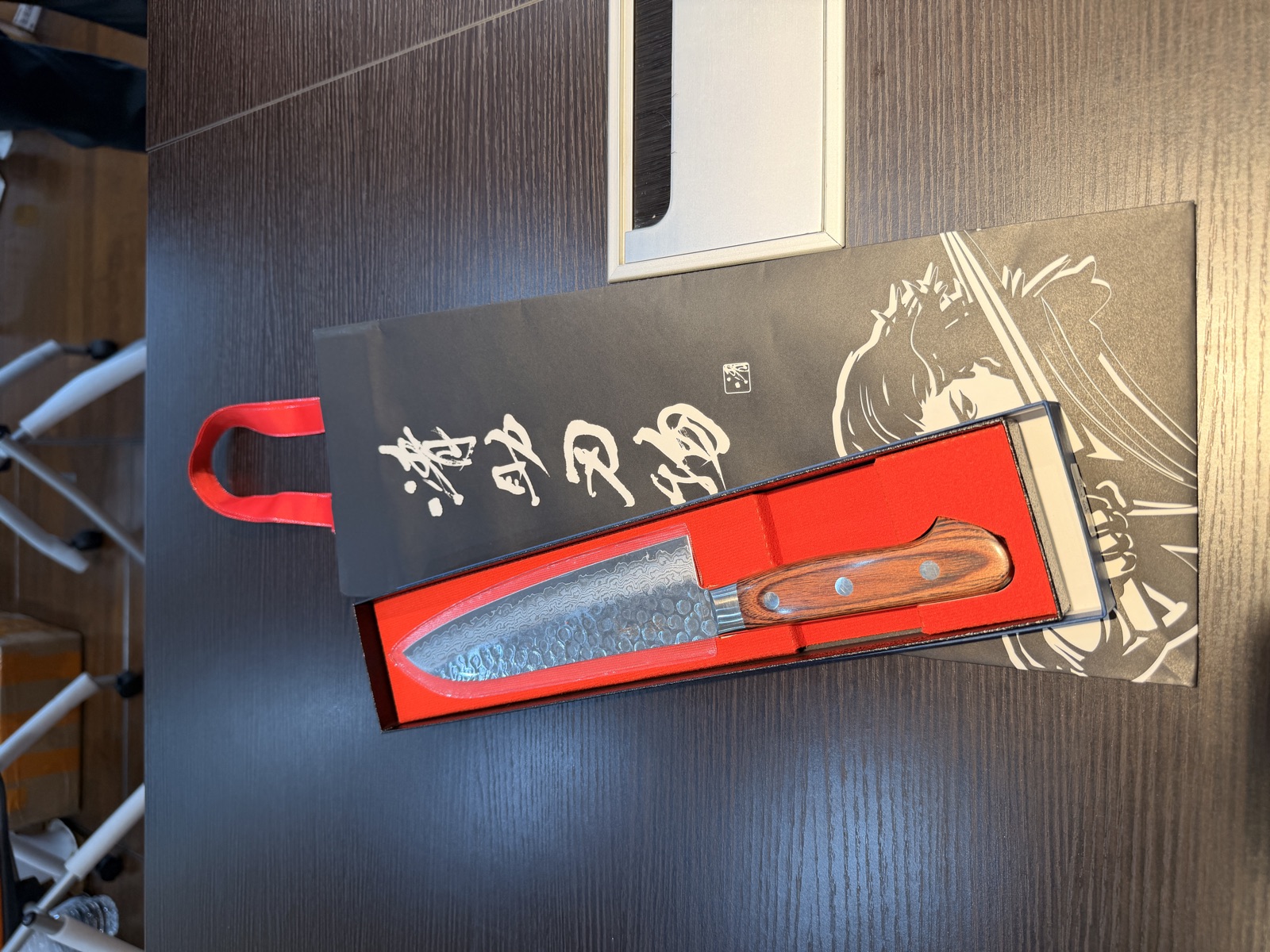
Distinct strengths: (1) English service throughout, from price tags to staff, (2) curated handmade knives from multiple Japanese knife-making regions, (3) global online ordering, (4) clean store layout that suits beginners, (5) thoughtful, hands-on cutting demonstrations.
Takanojin (貴ノ刃) — Curated Selection
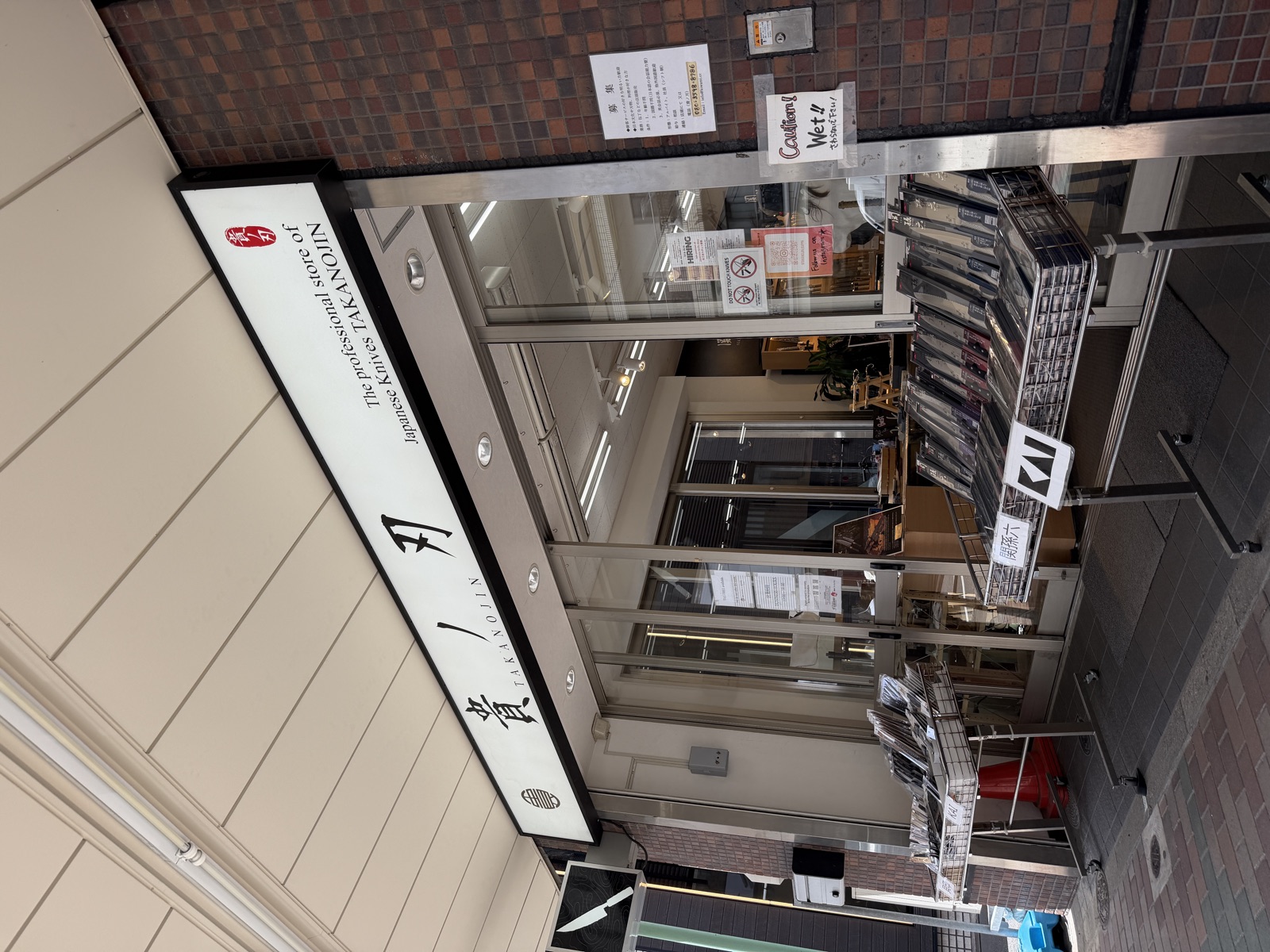
- Location: Taito, Tokyo (Kappabashi Dougu Street)
- Phone: 03-5830-6413
- Group: kiwami.top group
- What we bought: VG MAX damascus santoku, 170 mm (¥22,000 / ~$147)
House style: Takanojin is the "quality over quantity" curated boutique of the group, anchored by Kiwami's house ZDP-189 line and Kai's premium Shun brand, with each category pared down to the editor's pick. If you would rather trust a specialist's eye than wade through hundreds of options, this is the shop for you. Even in the around-$150 tier, the candidates on the wall have already been filtered for quality. We bought a VG MAX damascus santoku, 170 mm (¥22,000) — the only VG MAX in the test, the grade Kai positions above VG10.
Service: The store is on the smaller side, which means you get genuine one-on-one attention. After asking about budget and cooking habits, the staff narrowed the field to three blades and put each in our hand. The questioning gets real — "What vegetables do you cut most at home? Right-handed or left?" — so even a fully-trusted recommendation feels well-grounded. Takanojin also tells you up front that photography is welcome, which is a thoughtful touch.
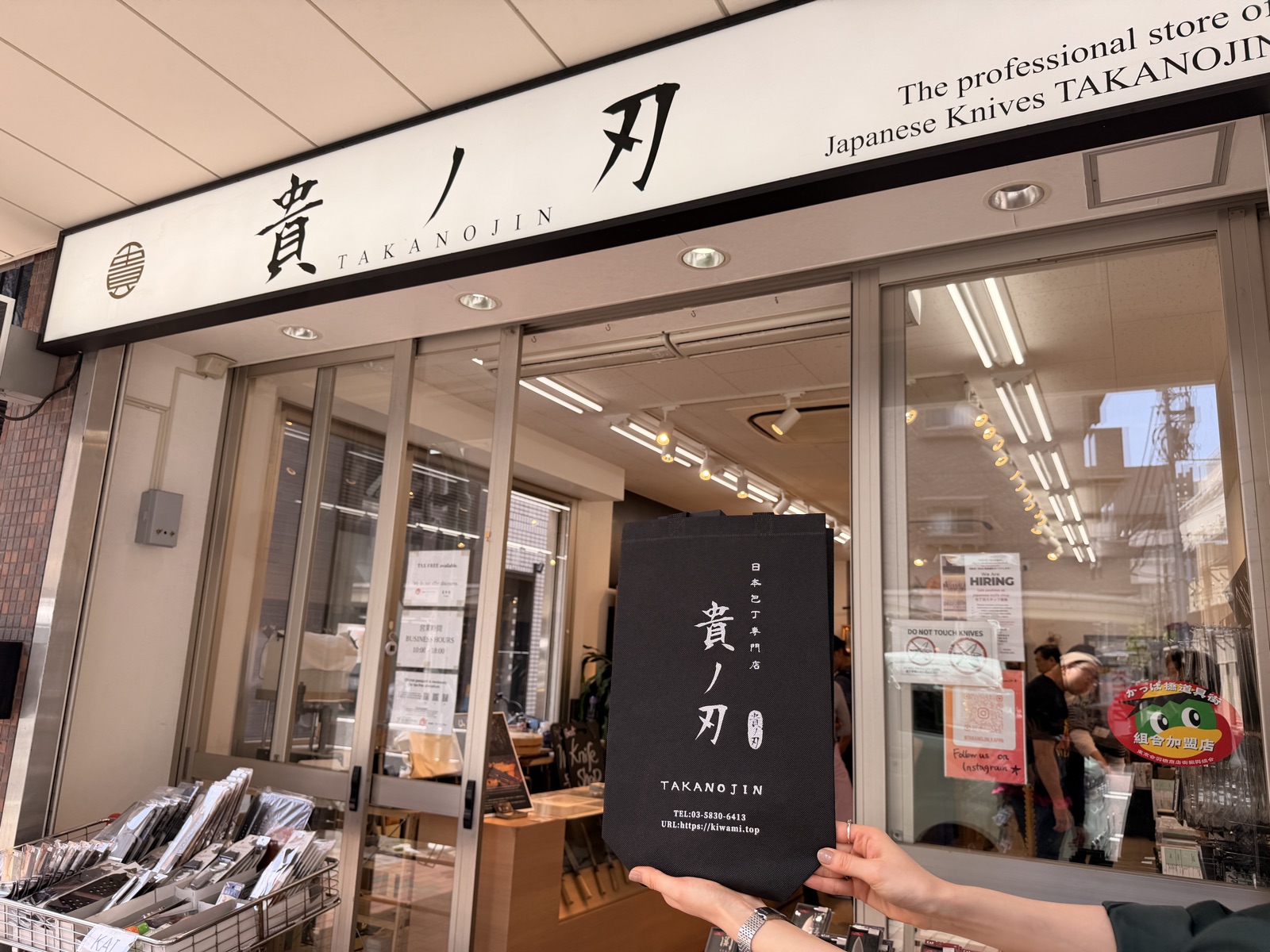
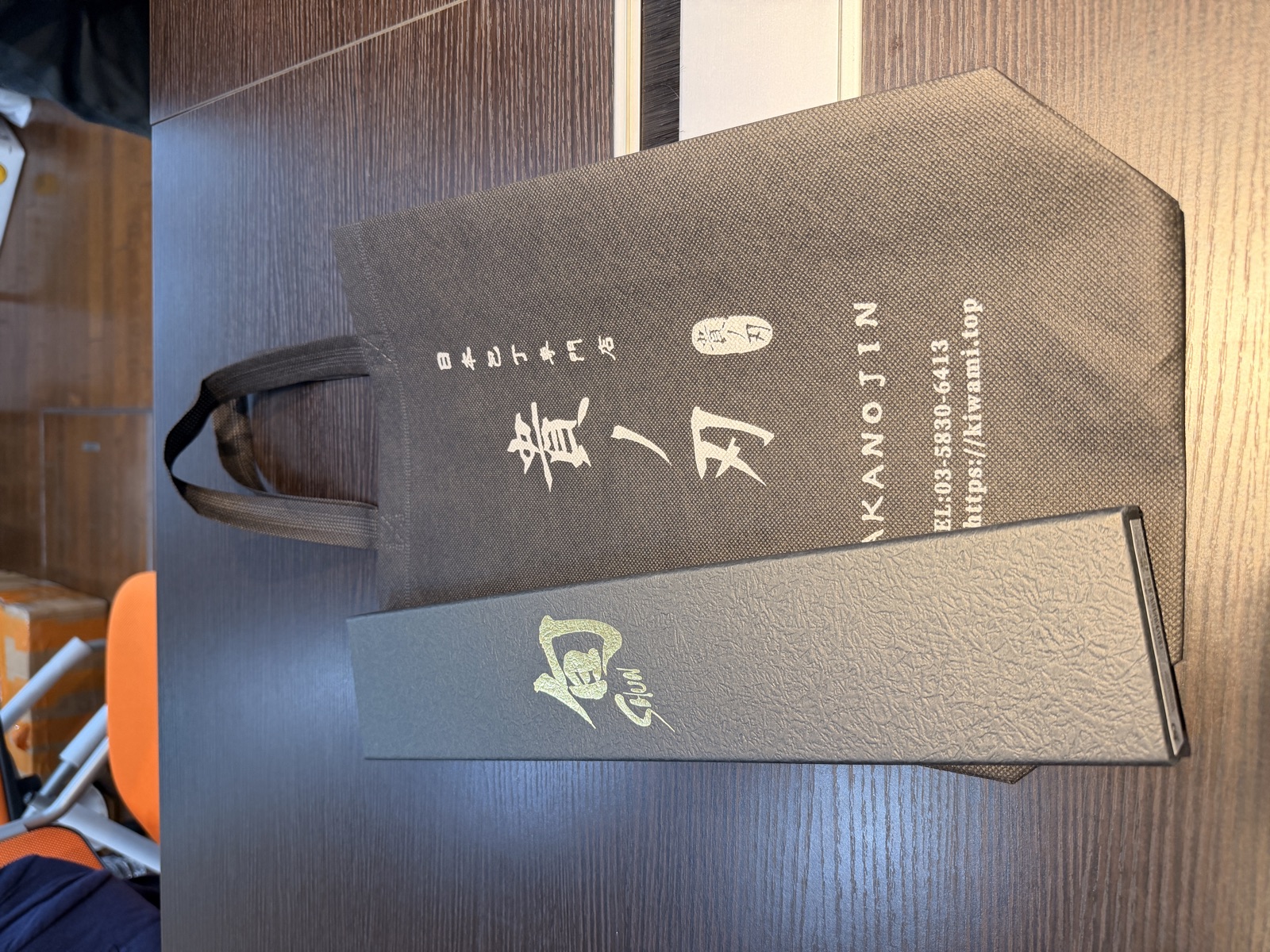
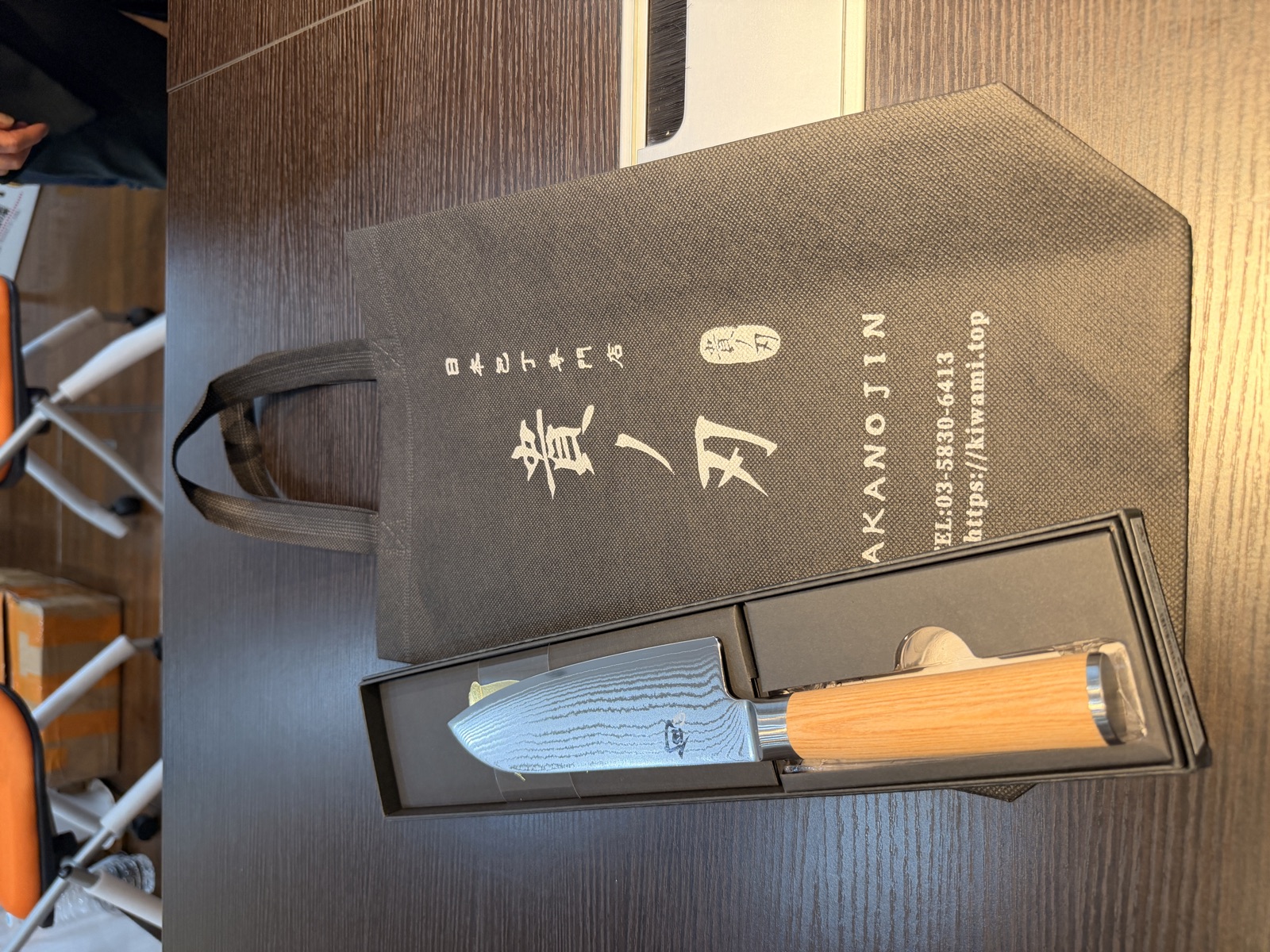
Distinct strengths: (1) a tight curated selection that removes decision fatigue, (2) thorough one-on-one consultation, (3) carries Kiwami's ZDP-189 line and the Shun brand, (4) the rarity factor — you walk out with a knife that most people are not carrying.
Tsubaya (つば屋) — Founded 1956, a Long-Established Kappabashi Shop
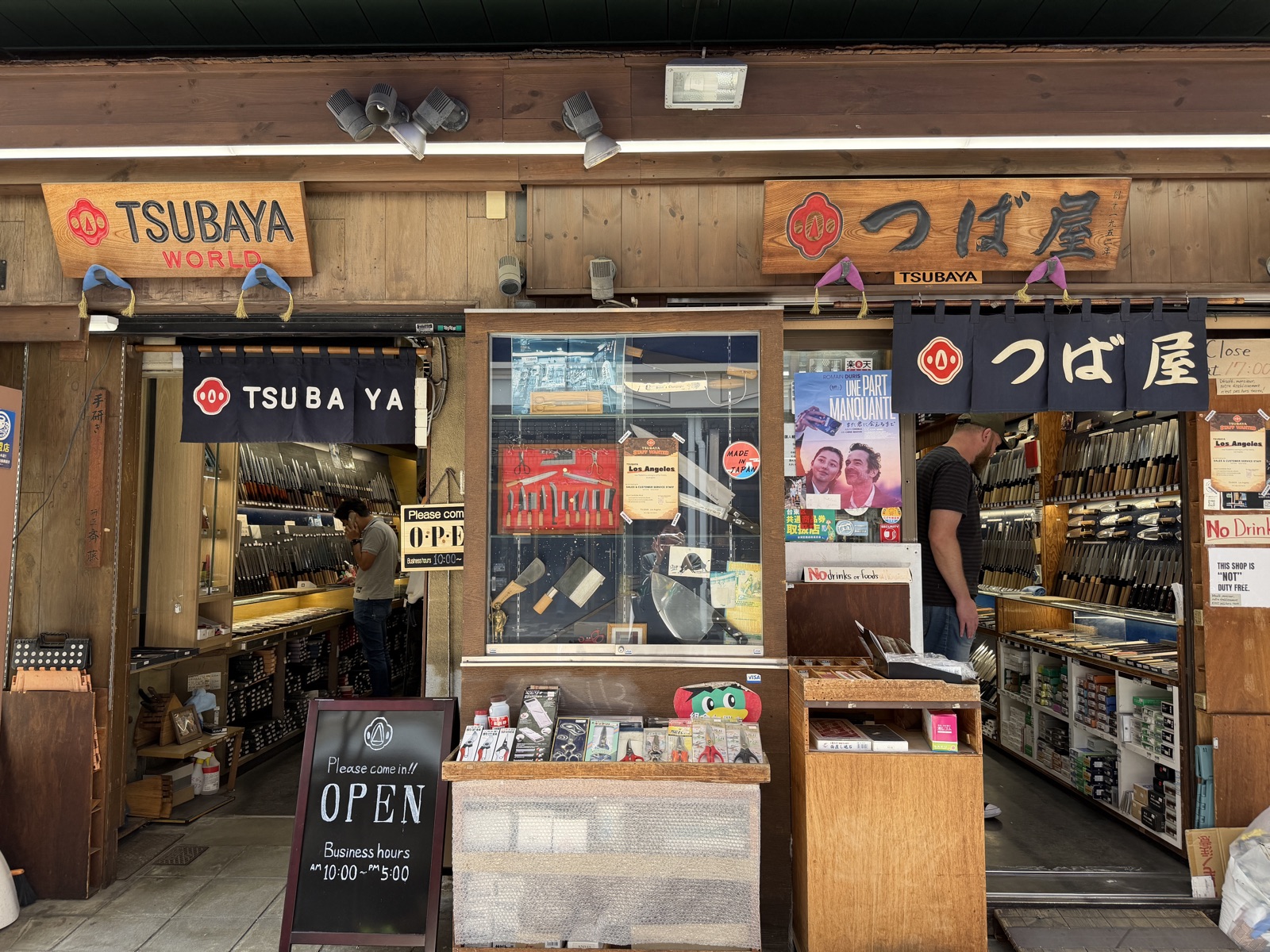
- Address: 3-7-2 Nishi-Asakusa, Taito, Tokyo
- Hours: Mon-Fri 9:00-18:00, Sat-Sun-holidays 10:00-17:00 (closed New Year only)
- Founded: 1956
- What we bought: VG10 damascus santoku, 165 mm (¥23,100 / ~$154)
House style: Tsubaya was founded in 1956, a long-established Kappabashi shop with close to seventy years of history. They source traditional Japanese knives from trusted domestic makers, and one of the reasons to buy here is the post-purchase sharpening service. A knife bought at Tsubaya can be brought back to be resharpened by their craftsmen. For someone who wants a knife to use for many years, this is a strong option. The knife we bought is a VG10 damascus santoku, 165 mm (¥23,100) — the highest-priced knife in the test, but the same core steel grade (VG10) as Seisuke; the damascus layers form the sides of the blade, not the edge.
Service: The shop is staffed by veterans who have been doing this work for decades — calm, grounded, deeply knowledgeable. Start a conversation about blade geometry, steel, or sharpening, and they share what they know without holding back. You will also be taught how to sharpen here — they actually demonstrated correct whetstone technique for us so we could maintain the edge at home. This is a shop where you learn how to live with a knife over the long term.
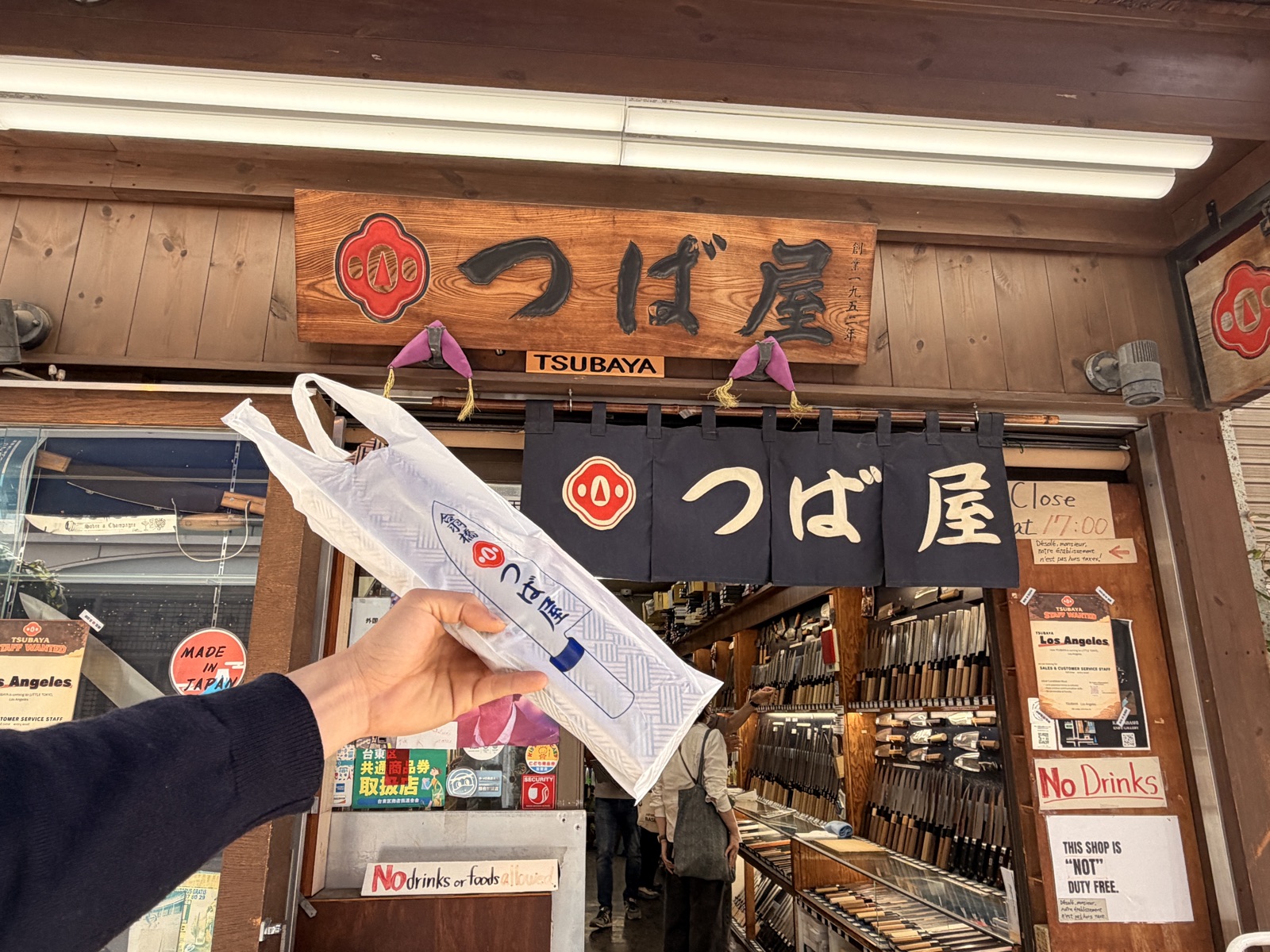
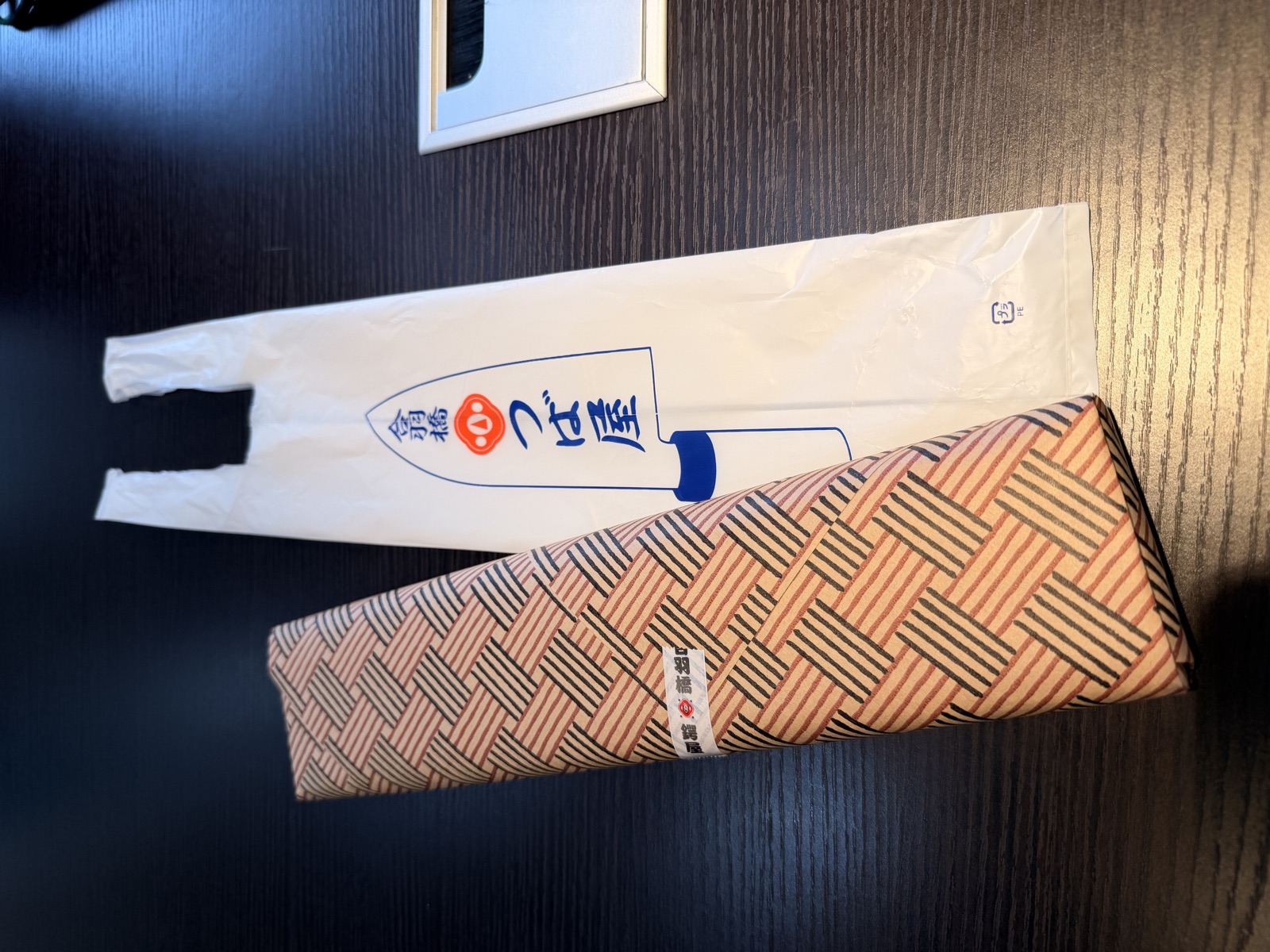
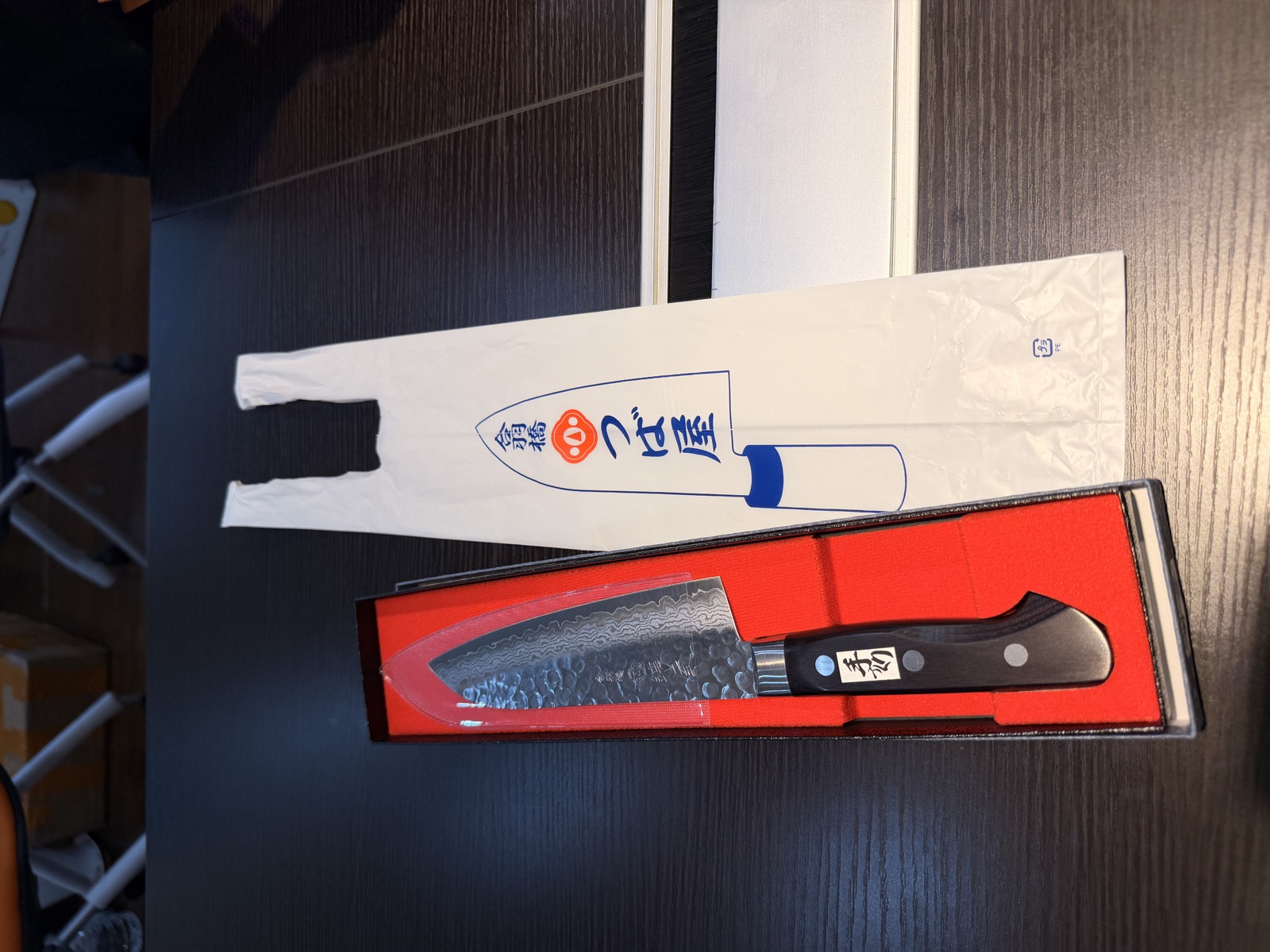
Distinct strengths: (1) post-purchase sharpening service, (2) the trust and history of a shop founded in 1956, (3) hands-on sharpening lessons from craftsmen, (4) a curated catalog of traditional Japanese makers, (5) a strong option for those wanting a long-lasting knife.
Methodology
To keep this review fair, we ran the test on a strict protocol. Holding every variable constant — the same vegetables, the same hinoki board, the same hand — is what lets each shop's actual character come through.
Test environment (held constant)
- Cutting board: the same hinoki board (30 mm thick, three months in service)
- Ingredients: tomato (medium, ripe), onion (medium), and daikon (~7 cm diameter) all bought the same day at the same supermarket
- Operator: one person made every cut, so hand and technique stayed the same across all six knives
- Technique: standard santoku push cuts — tomato in 5 mm rounds, onion brunoise, daikon in 5 mm rounds
- Knife state: every blade tested as-purchased, with the maker's factory edge unmodified
How we recorded
- Every test captured on video — 18 clips total (six knives × three foods)
- Cross-section, fragment dispersion, and bite into the board photographed in three ranking shots
- Notes on cutting feel, edge bite, and tomato-skin release written up by the person handling filming and record-keeping
Scoring
For each test, we ranked the six knives 1st through 6th and assigned points: 6 points for 1st, 5 for 2nd, 4 for 3rd, 3 for 4th, 2 for 5th, 1 for 6th. The three test totals (max 18, min 3) determined the overall ranking. Each ranking weighed edge sharpness, cleanness of the cross-section, lightness of bite into the food, and how cleanly fragments stayed together.
One caveat: rank gaps express differences in design philosophy, not quality hierarchy. Within the same price bracket, knives with different edge angles, blade widths, and weight distributions will favor different foods — that is by design. Read every test result as a clue to what each knife is built for.
Test 1: Tomato
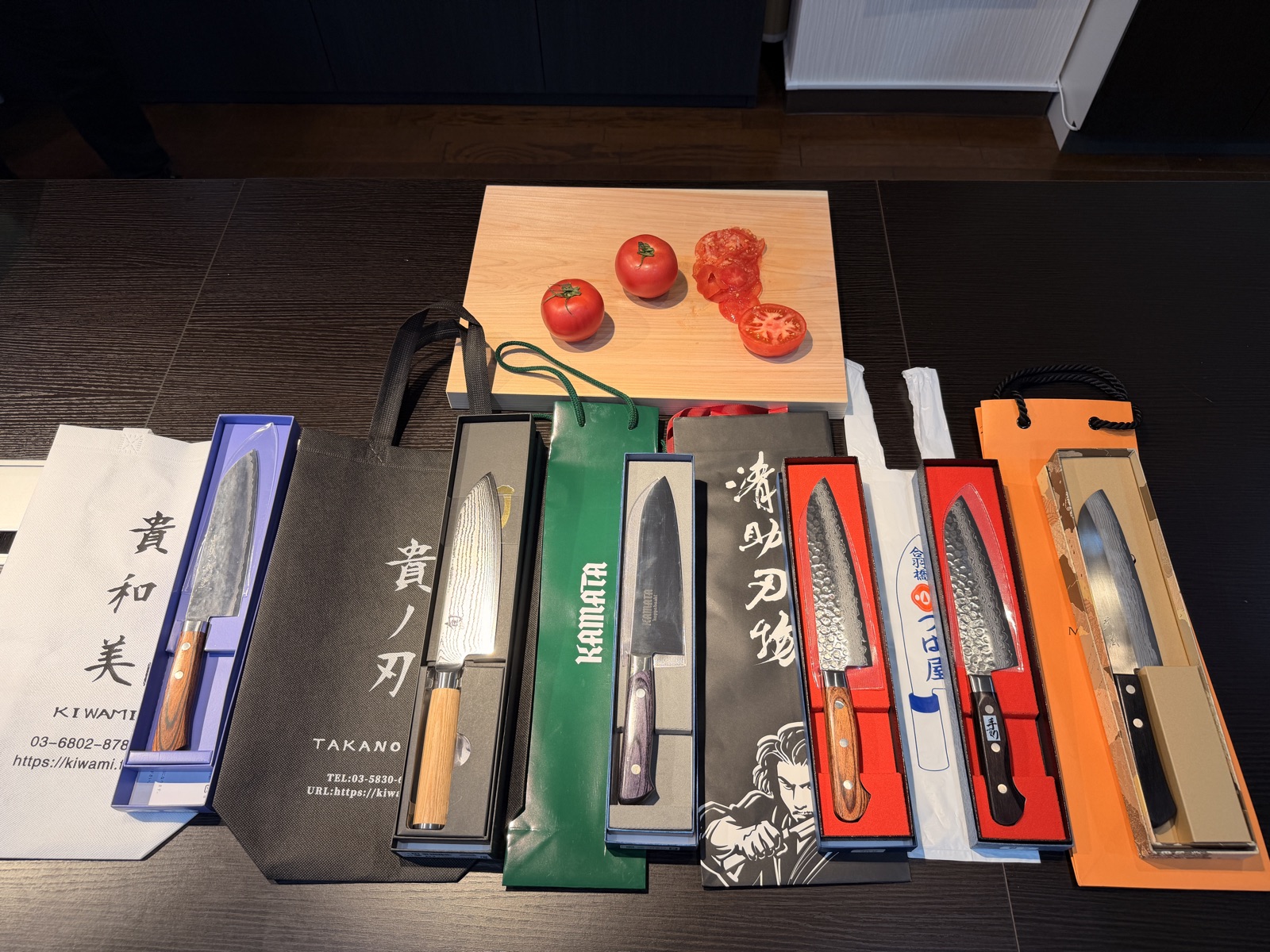
Tomato is the most unforgiving test of edge sharpness there is. The skin is slippery; even a slightly dulled edge slides off and crushes the flesh underneath. We sliced a ripe medium tomato in 5 mm rounds and ranked by skin entry, cross-section beauty, and juice loss.
Tomato ranking
1st: Kiwami — the lightest, most resistance-free skin entry of the six, catching the skin and gliding through to the core in one motion. Cross-sections looked like glass; juice loss was minimal. Pure edge sharpness at its best.
2nd: Takanojin — a sharp, decisive entry into the skin and a cross-section essentially indistinguishable from first place. The VG MAX core showing its supple, precision character — the only knife in the test with that grade of steel, and you can feel it.
3rd: Kamata Hakensha — the sharpening specialist's finishing pays off. Edge precision caught the skin cleanly and produced a steady, predictable cut. The all-rounder doing exactly what an all-rounder should.
4th: Seisuke Knife — the tenacious, supple edge characteristic of Echizen forging shows up on tomato as a slightly settled, "moist" cut. The blade does not so much bite the food as glide alongside it — a signature that Echizen fans will recognize and value.
5th: Tsubaya — the heritage-knife "cut by weight" design comes through clearly on tomato. The style is to trust the blade's own mass rather than chase pure tip sharpness — and the post-purchase sharpening service helps maintain the edge over time.
6th: MUSASHI JAPAN — an entry-tier knife built around edge hardness that beginners can handle without worry. On tomato, the cut is more about reassurance than precision — exactly right for the cook who needs to live with a knife day in and day out and learn its rhythms.
Reading the tomato test: the top three (Kiwami, Takanojin, Kamata Hakensha) all share an acute, thin-edge geometry. The bottom three (Seisuke, Tsubaya, MUSASHI) emphasize "supple edge," "blade weight," and "everyday confidence" instead — all valid design directions, just not the ones tomato rewards. As you will see, the ranking flips meaningfully on daikon.
Test 2: Onion
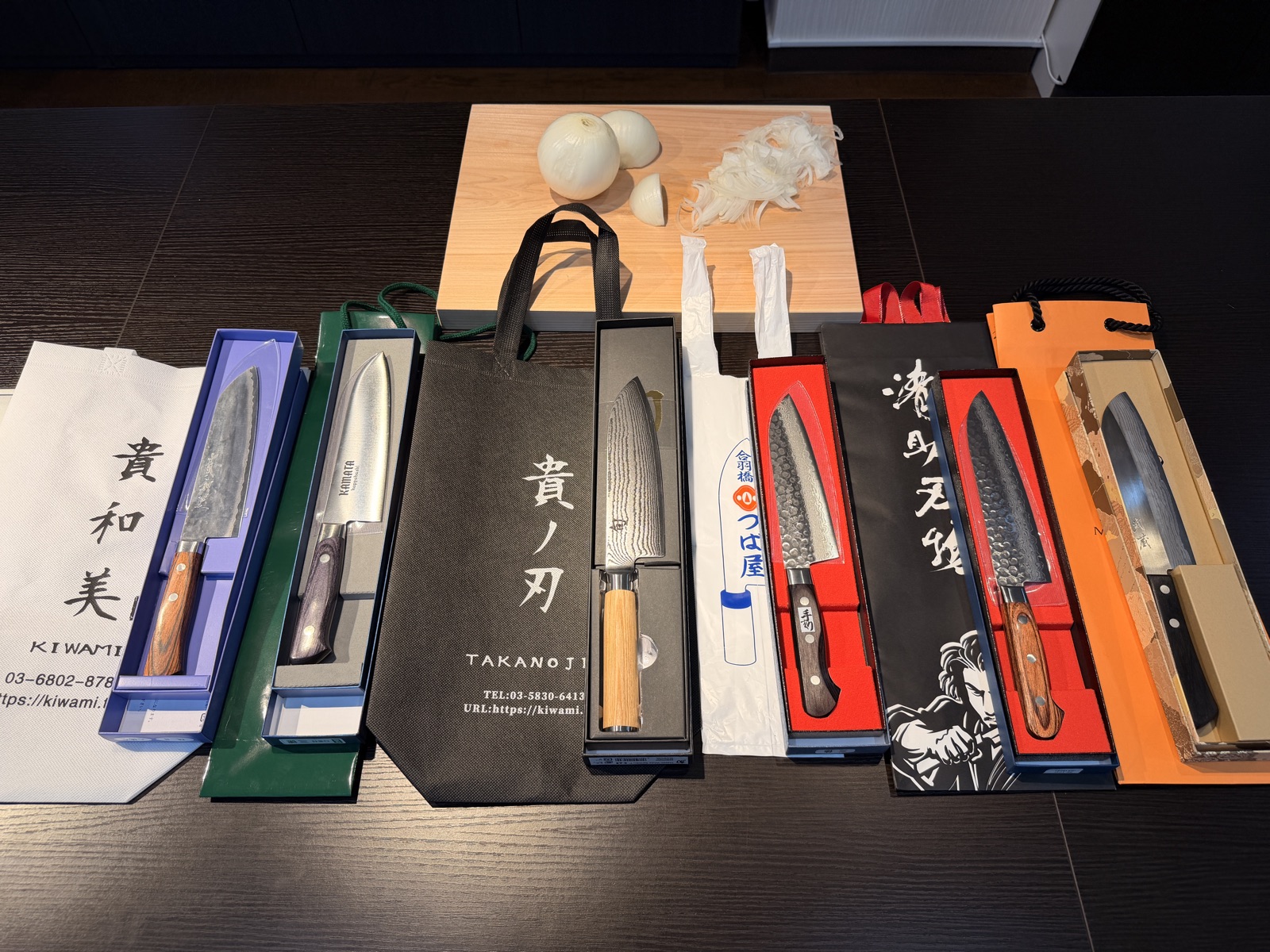
Onion is a layered-cell food. A dull edge tears the cells instead of cutting them, and that detonates the sulfur compounds that sting your eyes. Pros say "if your knife is sharp, you don't cry" — that is why. We halved a medium onion lengthwise and brunoised it, then judged uniformity, layer integrity, and how much onion stuck to the blade.
Onion ranking
1st: Kiwami — separated each onion layer cleanly without shredding the cells. The dice was uniform; the brunoise was tight. The precision-cut champion, in fine form.
2nd: Kamata Hakensha — the sharpening specialist's precision shines on onion too. Excellent balance between edge angle and blade width: layers held together, the food released cleanly off the blade. The all-rounder living up to its description.
3rd: Takanojin — the VG MAX core's keen edge separated the cells cleanly. Light bite and a brisk rhythm meant the brunoise moved fast.
4th: Tsubaya — weight balance is the story here, with the blade letting its own mass do the work. The brunoise rhythm is comfortable, and fatigue stays low over long sessions. The post-purchase sharpening service helps maintain the edge over time.
5th: Seisuke Knife — the supple Echizen edge approaches onion as "unfolding the layers gently" rather than shearing through them. Less of a sharp brunoise, more of a careful disassembly — a trait that is actually well-suited to the delicate work of traditional Japanese cooking.
6th: MUSASHI JAPAN — entry-tier hardness designed for "daily home use." Less about acute precision cuts and more about steady, dependable separation. A genuinely friendly knife for a household where multiple people share the same blade.
Test 3: Daikon
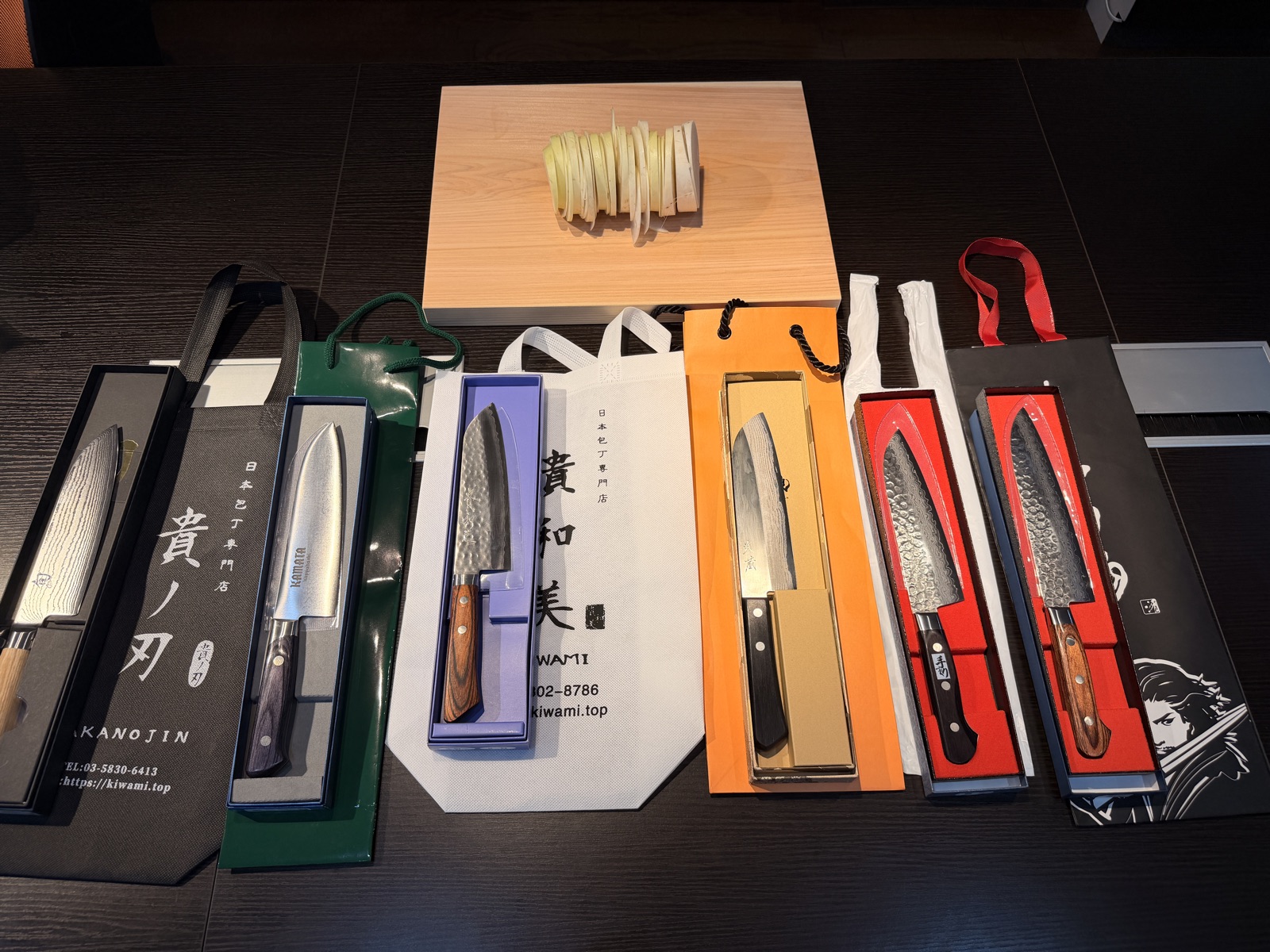
Daikon is a thick, dense food. The questions it asks are not about thinness or acute sharpness but "blade weight," "cleaving force," and "how stable the bite is into the food." A completely different axis from tomato or onion — and the test where the ranking turns over. We cut a 7 cm diameter daikon into 5 mm rounds, judged by lightness of bite and smoothness of the cut face.
Daikon ranking
1st: Takanojin — second and third on tomato and onion, first here. The combination of a VG MAX core — the grade Kai positions above VG10 — and a well-judged blade thickness handled the bite into thick food better than any of the others. With one knife per shop we cannot separate steel from grind, but this is where the harder, thicker blade pulled ahead.
2nd: Kamata Hakensha — high level on daikon too. Top-three on every food says everything about a sharpening specialist's finishing standard. The ideal pick if you want one knife to do everything.
3rd: Kiwami — first on tomato and onion, third on daikon. This is exactly what an acutely-ground, thin-edge geometry looks like on thick food: more side resistance from the blade flank. The character that emerges is unambiguous — Kiwami is a precision instrument for soft-food cutting, and that is its identity.
4th: MUSASHI JAPAN — sixth on tomato and onion, fourth on daikon. A real jump. The "cut by weight" design that felt understated on lighter foods earns its keep here. This is the knife you actually want for root-vegetable home cooking.
5th: Tsubaya — heritage blade weight and edge tenacity translate, on daikon, to steady, controlled stroke cutting. Clean release off the blade, comfortable rhythm. This is the knife you grow into — one you tune over decades to your own hand.
6th: Seisuke Knife — the supple Echizen edge is built to shine on delicate, gentle separation of soft foods. On a dense root vegetable it works in a "moves alongside the food" way; the home territory of this blade is sashimi, fine slicing, and the precision work of traditional Japanese cuisine.
Reading the daikon test: this is the most important finding in the entire piece. "The overall first-place knife finishes third on daikon" tells you, plainly, that picking a knife means picking the food you actually cut most. Soft foods? An acute grind like Kiwami. Thick root vegetables? Something with thickness like Takanojin or MUSASHI. The selection logic literally inverts.
Overall Ranking and Points Table
Total points across the three tests (1st = 6 pt, 6th = 1 pt):
| Rank | Shop | Tomato | Onion | Daikon | Total | Strength |
|---|---|---|---|---|---|---|
| 1st | Kiwami | 1st (6 pt) | 1st (6 pt) | 3rd (4 pt) | 16 pt | Razor-sharp precision cuts |
| 2nd | Takanojin | 2nd (5 pt) | 3rd (4 pt) | 1st (6 pt) | 15 pt | Strong on dense, thick foods |
| 3rd | Kamata Hakensha | 3rd (4 pt) | 2nd (5 pt) | 2nd (5 pt) | 14 pt | All-rounder, top-three on every food |
| 4th | Tsubaya | 5th (2 pt) | 4th (3 pt) | 5th (2 pt) | 7 pt | Post-purchase sharpening, long-lasting design |
| 5th | Seisuke Knife | 4th (3 pt) | 5th (2 pt) | 6th (1 pt) | 6 pt | Curated multi-region selection, English service |
| 6th | MUSASHI JAPAN | 6th (1 pt) | 6th (1 pt) | 4th (3 pt) | 5 pt | Beginner-friendly stability, strong on daikon |
What stood out:
- The top three sit within 2 points of each other. Real-world performance is essentially even at the top — order was decided by which food each knife favored.
- 4th-6th are knives built around different design directions; their relationship to our test foods was simply less direct. Match them to the right food and they perform every bit as well as the leaders.
- The daikon test reorders the field, so households that cook a lot of root vegetables should look hard at MUSASHI and Takanojin.
- Every knife in this test arrived sharp enough out of the box to cut all three foods cleanly on the day. What makes Kappabashi unusual is density rather than exclusivity: sixteen-plus specialist knife shops inside a few blocks, so you can compare this many houses in one afternoon.
Recommendations by Buyer Type — Which Shop Is Right for You?
What these are based on: one knife bought at each shop and cut on a single day. They describe the six knives we bought and the service we received that day — not an assessment of everything each shop stocks.
"Overall first place" is not the same as "best for you." Cooking style, support needs, budget, and the reason you are buying all change the answer. Use the buyer-type recommendations below to find the shop that fits your profile.
Buying your first Japanese knife → MUSASHI JAPAN or Tsubaya
For a first knife, what matters most is "easy to walk into, easy to live with for years." MUSASHI JAPAN, with its 2023-opened, beginner-welcoming floor and its deep selection in the entry tier, is unintimidating from the moment you step in. Sign up for one of their sharpening workshops and you will also learn the satisfaction of maintaining your own blade. Tsubaya, on the other hand, offers a post-purchase sharpening service — a place you can come back to when something feels off — and the veteran staff will teach you how to sharpen at home. Both are excellent first stops; pick the atmosphere that suits you.
Want a long-lasting knife with ongoing support → Tsubaya
If you want a knife you can think of as a long-term partner, Tsubaya is a strong option. Founded in 1956, the post-purchase sharpening service lets craftsmen maintain the edge when you bring the knife back. Close to seventy years of trust, traditional makers, and a good place to find a knife built to last.
Need English service or international shipping → Seisuke Knife or Kiwami
For overseas visitors and international shipping, look at Seisuke Knife or Kiwami. Seisuke has dedicated English-speaking staff and an English website with global shipping, and is well-known for international customer service. As a curated select shop featuring handmade knives from multiple Japanese knife-making regions (Echizen, Sakai, etc.), it is popular with overseas chefs working with sushi, sashimi, and fine slicing. Kiwami is internationally famous as the ZDP-189 specialist and runs equally strong English service with international shipping.
Want one knife that handles everything → Kamata Hakensha
Kamata Hakensha was the only knife of the six to finish top-three on all three foods — the right answer for "I want one knife to handle everything." A sharpening specialist's finishing precision shows in the product, and their post-purchase resharpening service means the edge has somewhere to go when it dulls. We did not record what we paid at the counter, so we cannot rank this knife on value; what we can say is that no other knife in the test was this consistent across tomato, onion and daikon. "When in doubt, Kamata" is a rule that holds up.
Top-end quality and precision cuts → Kiwami
Kiwami, which separated itself from the rest on pure edge sharpness, is the right choice for cooks who want precise, delicate cuts — tomato slices, onion brunoise, herbs, fish. The core steel here is VG1 — one tier below VG10 on paper — yet on the two precision tests we ran that day it came out ahead of the damascus VG10 knives. That is what house sharpening technique looks like. The deep blade-knowledge of a ZDP-189 specialist runs through the entire range, including the around-$150 line. The on-site cutting demo means you can verify the edge with your own hand before you commit.
Looking for a rare, distinctive knife → Takanojin
Takanojin's "quality over quantity" curated approach is the place to find a knife you will not see in mass-market stores. Anchored by Kiwami's house ZDP-189 line and Kai's premium Shun brand, every category has been pared down to a curator's pick. The knife we bought was the only VG MAX in the test — the grade Kai positions above VG10 — and it took first place on daikon, the densest of our three foods. If you want that grade in this price range, this is where we found it.
The pattern, when you step back, is that every one of the six shops is a first-choice recommendation under some clear lens. Rankings reflect the direction of an edge under specific test conditions — nothing more. Our overall view is that all six shops deliver a top-tier knife in the around-$150 range (¥17,800-23,100), and the right one is the one that fits the kind of cook you are.
Prices are approximate ranges, not live pricing — they vary by retailer, availability, tax and exchange rate. Always confirm with the seller before buying.
Frequently Asked Questions
Can you really buy a great Japanese knife for around $150?
Stainless or carbon steel for home use?
Does the damascus pattern make a knife perform better?
What's the difference between VG MAX, VG10, and VG1?
Santoku or gyuto for a beginner?
Do Kappabashi shops speak English?
Where can I get my knife sharpened?
Can I buy from outside Japan?
Why standardize on 'santoku, stainless, around $150' across all six shops?
Where can I buy these specific knives?
Editor's Note — A Day on Foot in Kappabashi
One day in April 2026, our editorial team walked Kappabashi from 10 a.m. to 5 p.m., visited every one of the six shops, bought a santoku at each, returned to the editorial kitchen in Tokyo that same evening, and started cutting through identical ingredients. The eighteenth video clip went into the can well after midnight.
What stayed with us was how distinct each of the six houses felt. Kamata Hakensha and the sharpener's discipline of the edge. Kiwami carrying ZDP-189 philosophy down into the entry tier. MUSASHI JAPAN, the welcoming flagship for newcomers. Seisuke Knife, the door open to international buyers. Takanojin, holding the line on a curator's eye and the only VG MAX in the test. Tsubaya, the long-term relationship through post-purchase sharpening. The same around-$150 budget, six entirely different stories.
A knife is not just a tool — it is a partner at the daily table. The overall ranking here is, ultimately, "what happened when our editorial team cut three specific foods in our kitchen on a specific day in April 2026." The only way to find your real best knife is to walk into the shop yourself, talk to the staff, and feel whether the handle fits your hand.
If you can make it to Kappabashi, visit all six. Set rankings aside, take in each shop's atmosphere and service, and trust your own hand to decide. If you still need a tiebreaker, the buyer-type recommendations above will steer you. Even at around $150 (¥17,800-23,100), the right knife — the one you will keep for life — is genuinely available here.
Related reading: for the full sixteen-shop directory, see the Kappabashi knife shop guide; for santoku vs. gyuto, the santoku guide; for choosing a blade, how to choose a Japanese knife.