Best Sujihiki Knife 2026: Japanese Carving Knives by Budget
Basis Spec comparison · not hands-on tested
How we chose: makers' published specs, materials and price. We have not used these products ourselves. How we test
Quick answer
A sujihiki knife is a long, thin, double-bevel Japanese slicer — the Japanese carving knife, built to slice roasts, turkey, brisket, ham and boneless fish in one pull. The best sujihiki for most cooks is the Tojiro DP 240mm ($169–$172, checked 2026-10-27), with the MAC Professional 260mm ($234.95) or the Misono UX10 ($439.50–$539.50 at Korin) as lifetime picks.
Choose the length by what you carve: 240mm for turkey breast and most home roasts, 270mm for prime rib and ham, and the longest slicer you can store for a whole brisket. Unlike a single-bevel yanagiba, a sujihiki sharpens like any double-bevel knife.
- Best first sujihiki
- Tojiro DP 240mm
- Best lifetime
- MAC Pro 260mm / Misono UX10
- Bevel
- Double-bevel
- Common lengths
- 240 / 270 / 300mm
Buying from abroad? See how to order a Japanese knife online and what duties to expect
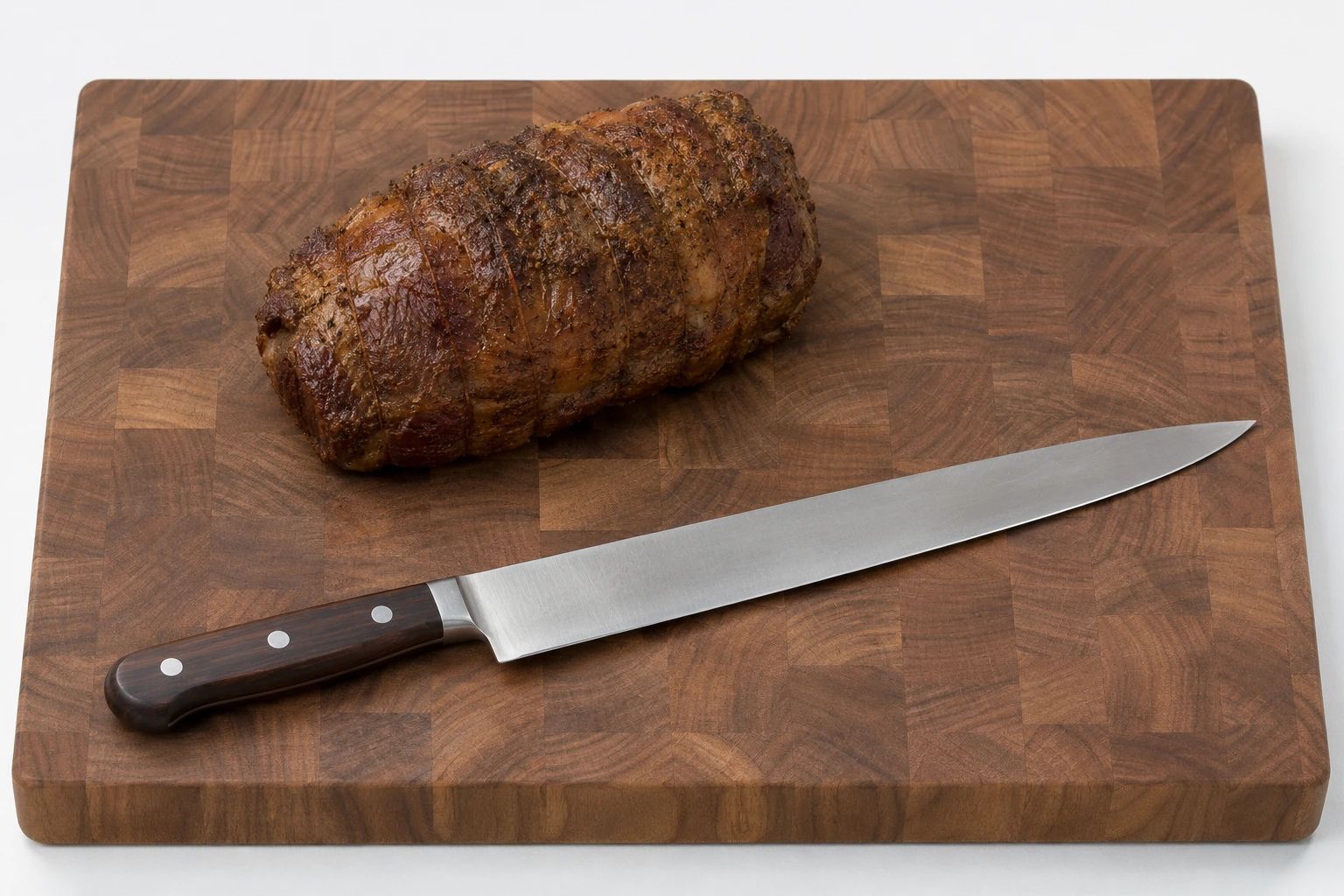
Table of Contents
TL;DR — best picks by use-case
The best-value first sujihiki is the Tojiro DP Sujihiki 240mm (F-805, now sold as Tojiro Classic): $172 at Chef Knives To Go and $169, in stock, at Chubo on 2026-10-27[1][3]. For a “buy once” carving and slicing knife, step up to a MAC Professional 260mm slicer ($234.95 at Cutlery and More[10]) or a Misono UX10 sujihiki ($439.50–$539.50, in stock at Korin[5][6]).
- Value / first sujihiki — Tojiro DP Sujihiki 240mm ($169–$172) — the editor’s choice on-ramp, VG-10 core, HRC 60
- Value, traditional feel — Sakai Takayuki Grand Chef wa-sujihiki 240/270mm ($184.99/$190.99 on sale at Hocho Knife) — Böhler-Uddeholm stainless, wa handle[13][14]
- Lifetime — Misono UX10 Sujihiki 240/270mm ($439.50/$539.50 at Korin; Chubo’s $325/$365 listings were sold out) — Swedish stainless per Korin, HRC 60, 70/30 edge[5][7]
- Lifetime, Western-pro — MAC Professional Slicer 260mm (MKS-105, $234.95; dimpled MSL-105 $189.95, both at Cutlery and More) — HRC 60, 15° per side[10][11]
- Long slicer for brisket — MAC Chef Series SL-115, 11¼ in (about 286mm), $165 at MAC[12]
- Step-up Japanese — Sakai Takayuki Ginsan wa-sujihiki ($410.99 for 240mm on sale at Hocho Knife) — refined finish, gift-grade[15]
Short version: a Tojiro DP 240mm (about $170), or a MAC Professional ($234.95) or Misono UX10 ($439.50+) slicer — most cooks who carve and slice are well served by one of these. Carving a turkey on Thanksgiving (26 November 2026)? The 240mm is enough; see carving season for brisket, ham and prime rib.
Travelling to Japan? You can make your own knife near Tokyo, Kyoto, Osaka or Nagoya. Compare all nine knife-making workshops in Japan →
What is a sujihiki knife?
A sujihiki (筋引包丁, roughly “muscle/sinew slicer”) is a long, narrow, double-bevel Japanese slicing knife — the Japanese carving knife. ZWILLING calls sujihiki “Japanese-style carving knives” with long, thin blades[19], and Korin says the sujihiki is intended for slicing boneless protein, its short blade height creating less friction as it draws through fish and meat[5]. In English it is also sold as a Japanese slicer knife or slicing knife.
Its job is to draw long, clean slices through cooked proteins and fish in a single pulling stroke: a rested roast, brisket, prime rib, ham, turkey breast, smoked salmon, and boneless fish fillets. The length lets you slice in one pull rather than sawing, and the thin, flat profile produces a smooth cut face that does not tear or compress the food.
The hard rules that shaped every pick below:
- Slicing and carving — not chopping. A sujihiki is for clean pull-stroke slicing of cooked proteins and boneless fish. It is a poor choice for general prep, hard vegetables, or rock-chopping.
- Never on bone. The thin edge is built for flesh, not joints. Carve around bones; do not lever or hack through them.
- Double-bevel, so it sharpens normally. Unlike a single-bevel yanagiba, a sujihiki sharpens on both faces like a chef’s knife. Most work in either hand as sold; a few are ground asymmetrically (see the left-handed FAQ).
- Low-maintenance by design. Most quality sujihikis are stainless, so they tolerate the wet, lightly fatty work of carving far better than a carbon single-bevel slicer.
Sujihiki length: 240, 270 or 300mm?
Buy 240mm for a home kitchen and turkey, 270mm if you carve prime rib, ham and wide roasts often, and the longest slicer you can store for whole briskets. A sujihiki is meant to slice in one pull, so the blade should comfortably exceed the width of whatever you are carving. ZWILLING gives 8 to 12 inches as the typical range[19]; the picks on this page come in these lengths:
| Length | Inches | Suits | Picks at this length (2026-10-27) |
|---|---|---|---|
| 240mm | 9.4 in | First sujihiki, smaller boards, turkey breast, most home roasts, fish sides | Tojiro DP F-805 ($169–$172), Sakai Takayuki Grand Chef ($184.99), Misono UX10 ($439.50), Sakai Takayuki Ginsan ($410.99) |
| 260–270mm | 10.25–10.6 in | Prime rib, ham, wider roasts, salmon sides; a trimmed brisket flat | MAC Professional MKS-105, 260mm ($234.95); Tojiro DP F-806, 266mm blade ($211 at CKTG; sold out at Chubo); Grand Chef ($190.99); Misono UX10 ($539.50) |
| About 285–300mm | 11¼–11.8 in | Whole packer brisket, large roasts, pro slicing | MAC Chef Series SL-115, 11¼ in ($165); Sakai Takayuki Ginsan kiritsuke-tip sujihiki, 300mm ($580.99 on sale) |
Sources for this table: Chef Knives To Go[1][2], Chubo[3][4], Hocho Knife[13][14][15][16], Korin[5][6], Cutlery and More[10] and MAC[12]. If you are unsure, buy 240mm for a home kitchen or 270mm if you carve large roasts often; both are long enough for nearly all home carving without becoming unwieldy.
Sujihiki vs Western carving knife
A sujihiki does the same job as a Western carving or slicing knife; the differences on published specs are harder steel and a wider choice of long blades, not a radically different edge angle. Here is a 240mm sujihiki, a Japanese-made Western-handled slicer and a German carving knife side by side:
| Knife | Blade length | Hardness | Edge | Price (2026-10-27) |
|---|---|---|---|---|
| Tojiro DP Sujihiki 240mm | 240mm (9.4 in) | HRC 60 | Even double bevel; VG-10 core | $172 (Chef Knives To Go)[1] |
| MAC Professional Slicer MKS-105 | 10.25 in (260mm) | HRC 60 | Double bevel, 15° per side | $234.95 (Cutlery and More)[10] |
| WÜSTHOF Classic Ikon 9″ Carving Knife | 9.0 in (229mm) | 58 HRC | WÜSTHOF sharpens standard blades at 14° per side | $200 (WÜSTHOF)[18] |
What the table shows: edge angles are close (14° vs 15° per side), and a 9-inch Western carver is only about 11mm shorter than a 240mm sujihiki. The real differences are that the Japanese slicers are listed two points harder (HRC 60 vs 58), and that the sujihiki on this page are also sold at 270mm and longer. America’s Test Kitchen draws a useful line: “Unlike shorter chef’s knives and pointed, flexible carving knives, slicing knives are long and straight” for smooth, even slicing[24]. A sujihiki is the long, straight kind. If you already own a good Western carving knife and mostly carve a turkey once a year, it will do; buy a sujihiki when you want a longer, harder blade for brisket, prime rib and fish too.
Sujihiki vs yanagiba: double-bevel vs single-bevel
Buy a sujihiki if you want one versatile, low-maintenance slicer for everything from roasts to fish; buy a yanagiba if pure sashimi quality is the whole point and you accept a single-bevel edge. The two knives share a silhouette — long, narrow, built to slice in one pull — but they are ground differently. Korin sums up the relationship: the sujihiki is often seen as the Western-style equivalent of the traditional yanagi knife[5].
- Sujihiki — double-bevel. Edge ground on both faces, like a Western knife. It sharpens on a standard whetstone with no special technique, tolerates wet protein work well (usually stainless), and slices both cooked meats and raw fish. The trade-off: on pure sashimi it cannot quite match the mirror-clean release of a single bevel.
- Yanagiba — single-bevel. Bevel on one face, flat ura on the other. It gives the cleanest sashimi cut and the smoothest slice release, but it is handed (left-handed cooks need a priced special order), demands single-bevel sharpening, and is often carbon, so it needs more care.
- Handedness, honestly. Most sujihiki work in either hand as sold, but not all: Korin lists the Misono UX10 sujihiki as a right-handed 70/30 edge and offers a left-hand conversion for $20[5]. That is still a far smaller hurdle than a left-handed yanagiba.
Our full best yanagiba knife guide covers the single-bevel side, and our single vs double bevel guide explains why the geometry behaves so differently. There is no winner here — only the right tool for how you cook.
Sujihiki vs gyuto: slicer vs all-rounder
If you only buy one knife, make it a gyuto; add a sujihiki when carving and clean slicing become frequent enough to want a dedicated blade. Both are long double-bevel knives, but the purpose differs and it shows in the blade shape.
- Gyuto — the all-rounder. Taller blade with a curved belly for rocking and chopping, built to do everything: vegetables, meat, general prep. It is the one knife most kitchens should own first.
- Sujihiki — the slicer. Longer, narrower, and flatter, optimised to draw a single long slice cleanly rather than to chop. It excels at carving and portioning and is poor at general prep.
A tall, curved gyuto can carve in a pinch — Cook’s Country carves its turkey with a chef’s knife[20] — but its height and belly drag on long slices through a wide roast, where the sujihiki’s flat, narrow profile glides. See our best gyuto knife picks if you do not yet own an all-rounder, and our broader best Japanese knives roundup for how the two fit a full set.
Carving season: turkey, brisket, ham, prime rib
For the holiday roasts, a 240mm sujihiki handles turkey breast, a 270mm handles prime rib and ham, and brisket wants the longest slicer you own. US Thanksgiving falls on 26 November 2026, with holiday hams and rib roasts after it. The methods below are summarised from the test kitchens and pitmasters who published them; we add only which length suits each job.
Turkey — 240mm
Cook’s Country rests the bird for at least 30 minutes (an hour for a bigger bird), then carves each breast off in one piece by running the knife along the curve of the breastbone with long motions, not sawing, and slices the breast thinly crosswise so each slice keeps some skin[20]. Because the breast comes off the bone before slicing, a 240mm sujihiki is plenty; use a sturdier knife, not the thin sujihiki edge, around the joints.
Brisket — the longest you have (270mm for a flat, about 300mm for a whole packer)
Steven Raichlen’s Barbecue Bible guide rests brisket for 30 to 60 minutes, slices against the grain to keep it tender, and aims for slices about the thickness of a No. 2 pencil; its ideal tool is a long, sharp slicing or brisket knife, 12 to 14 inches with a Granton edge[21]. Jeff Phillips of Smoking-Meat.com separates the point from the flat along the natural seam of fat, because their fibers run in different directions, and slices the flat about the width of a pencil[22]. Of the slicers on this page, Sakai Takayuki’s 300mm Ginsan kiritsuke-tip sujihiki ($580.99 on sale)[16] and MAC’s 11¼-inch SL-115 ($165)[12] come closest to that 12-to-14-inch length; a 270mm sujihiki is enough once the flat is separated.
Ham — 240 to 270mm, plus a paring knife
America’s Test Kitchen notes that spiral-sliced hams are not fully sliced. Its method: with the ham on its side, cut around the bone with a paring knife to free the attached slices; switch to a carving knife and slice horizontally above the bone to remove the whole top section; turn the ham cut-side down and slice down along the bone to remove the rest; then cut between the slices[23]. A 240–270mm sujihiki suits the long horizontal cut — let the edge run alongside the bone, never into it.
Prime rib — 270mm
America’s Test Kitchen takes the bones off before carving (it cuts the twine and removes the roast from the ribs), carves ¾-inch-thick slices, and carves only as many as you need so the rest of the roast stays warm. It recommends a slicing knife — long and straight, with a rounded tip for tableside serving[24]. Our suggestion is 270mm: once the bones are off, the extra length over a 240mm blade helps you finish each ¾-inch slice in one long pull.
How we chose
- Specs — the makers’ and retailers’ published steel, blade length, weight, bevel, hardness and handle.
- Care needs — stainless vs carbon for a slicer that spends its time on wet proteins.
- Price and stock — the price and stock status shown on the named US retailer’s or maker’s page on 2026-10-27.
We do not invent hardness numbers or specs. Where a maker documents a steel we name it; where a figure comes from a retailer we say so. We have not cut with these knives; the only knives we have cut with are the six santoku in our Kappabashi under-$150 test.
Value tier — your first double-bevel slicer
Editor pick: Tojiro DP Sujihiki 240mm (F-805) — $172 at Chef Knives To Go, $169 and in stock at Chubo (2026-10-27)
A sensible on-ramp to a real Japanese slicer. Chef Knives To Go now lists it as the Tojiro Classic Sujihiki 240mm: a VG-10 core with 13-chrome stainless cladding, HRC 60, an even double bevel and a weight of 180g[1]; Chubo sells the same knife under the Fujitora DP logo and lists a 1.9mm spine[3]. Chef Knives To Go gives Niigata, Japan, as the place of manufacture[1]. It takes a keen edge, sharpens easily on a whetstone, and gives you authentic sujihiki length and a thin slicing profile without a craft-knife price. The 270mm version (F-806, 266mm blade, 236g) is $211 at Chef Knives To Go[2]; Chubo’s $189 listing was sold out[4].
- Strengths — VG-10 keenness, easy to sharpen, low maintenance, even bevel for either hand, widely available, honest value
- Weaknesses — plain styling; riveted Western handle rather than a traditional wa handle; not a sashimi specialist
- Buy if — first sujihiki, you carve and slice regularly, you want one versatile low-maintenance slicer
Traditional-feel alternative: Sakai Takayuki Grand Chef Japanese-style sujihiki — 240mm (ST-10623) $184.99 or 270mm (ST-10624) $190.99, both on sale and in stock at Hocho Knife[13][14] — a Sakai Takayuki slicer in Böhler-Uddeholm high-carbon stainless (about HRC 61–62, retailer figure) with a hexagonal wood wa handle and buffalo-horn ferrule, 140g at 240mm. The Ginsan wa-sujihiki looks similar but has an ebony handle and costs more than twice as much (see the pro tier). You pay a little more than the Tojiro for a more traditional Japanese feel, which is the right call if you prefer a wa handle in the hand.
Lifetime tier — the carving knife for keeps
Editor pick: Misono UX10 Sujihiki 240mm or 270mm — $439.50 and $539.50, in stock at Korin on 2026-10-27[5][6]
Misono’s UX10 is the top line of Misono’s range, per Korin. It is made from high-purity EU stainless (Misono does not publish the grade; retailers call it Swedish), HRC 60 per Korin, and is known for a thin grind — Chubo lists a 1.9mm spine at 240mm. On a long sujihiki that thin geometry pays off directly: the blade glides through a roast with very little drag, and the edge is keen and easy to bring back on a stone. Korin lists 175g for the 240mm and 178g for the 270mm. Two honest notes for US buyers: Chubo lists the same knives at $325 and $365, but both were sold out when we checked[7][8]; and the UX10 sujihiki is ground 70/30 for right-handers, with a $20 left-hand conversion at Korin[5].
- Strengths — refined thin grind, excellent slice glide and release, keen long-lasting stainless edge, beautiful finish
- Weaknesses — premium price where it is in stock; right-handed 70/30 edge as standard; the thin blade is less forgiving of lateral force
- Buy if — you carve and slice often, want a “buy once” blade, and value edge feel
Western-pro alternative: MAC Professional Slicer 260mm (MKS-105) — $234.95 at Cutlery and More (low stock), $275 at MAC’s own store[10][9] — a 10.25-inch blade, 7.5oz (about 213g) and 2.5mm thick per MAC, HRC 60 and 15° per side per Cutlery and More. The dimpled MSL-105 is $189.95 at Cutlery and More (in stock) and $225 at MAC[11]. MAC lists no 240mm or 270mm Professional slicer (its 10½-inch MSB-105 is a bread/roast knife). MAC’s high-carbon stainless holds an edge well, the geometry suits long clean slices, and it is very low maintenance — a strong “last slicer” if you prefer a Western handle over a more Japanese aesthetic.
Pro tier — refined and hand-finished slicers
This tier is finish, steel, and provenance more than raw everyday performance. The differences in ordinary carving narrow, but premium steels, hand-finishing and refined wa handles carry the price. These are the slicers that look as good on the table as they cut.
Editor pick: Sakai Takayuki Ginsan Warikomi wa-sujihiki — 240mm (ST-14223) $410.99, 270mm $447.99, both on sale at Hocho Knife on 2026-10-27[15][16]
The Ginsan Warikomi wa-sujihiki has a Ginsan (Silver #3) stainless core, HRC 60–61 (retailer figure), an octagonal ebony handle with a buffalo-horn ring, and weighs 172g at 240mm; the 240mm was listed in stock[15]. The same range lists a 300mm kiritsuke-tip sujihiki at $580.99 on sale, for anyone who wants a long Japanese slicer for brisket[16]. You get a refined grind, clean slice release and a gift-grade finish.
- Strengths — Sakai finish, Ginsan core, gift-grade looks, refined handle, clean slicing
- Weaknesses — more about pride and finish than extra cutting ability; price
- Buy if — you want a beautiful lifetime slicer, a gift-grade knife, or a more traditional Japanese build
Damascus look for less: Sakai Takayuki 33-layer Damascus sujihiki 240mm — $199, in stock at Chubo[17] — a VG-10 core in 33-layer folded cladding, HRC 60, 50/50 double bevel and a mahogany handle. Worth being clear: the Damascus pattern is cosmetic — the core steel does the cutting — so buy the look if you love it, but do not expect the pattern itself to improve performance.
Full comparison table
Prices in USD as shown on the named retailer’s or maker’s page on 2026-10-27; sale prices are marked. Prices and stock change often, so check before you buy.
| Pick | Tier | Price (USD, 2026-10-27) | Length | Steel / hardness |
|---|---|---|---|---|
| Tojiro DP Sujihiki (F-805 / F-806) | Value / first | $169 (Chubo, in stock) – $172 (CKTG); 270mm $211 (CKTG) | 240 / 270mm | VG-10 core, stainless clad; HRC 60 |
| Sakai Takayuki Grand Chef wa-sujihiki | Value, traditional feel | $184.99 / $190.99 sale (Hocho Knife) | 240 / 270mm | Böhler-Uddeholm stainless; about HRC 61–62 (retailer) |
| Misono UX10 Sujihiki | Lifetime | $439.50 / $539.50 (Korin, in stock); Chubo $325 / $365 sold out | 240 / 270mm | EU stainless (grade not published); HRC 60; 70/30 edge |
| MAC Professional Slicer (MKS-105) | Lifetime, Western-pro | $234.95 (Cutlery and More); dimpled MSL-105 $189.95 | 260mm | MAC high-carbon stainless; HRC 60 |
| MAC Chef Series Slicer (SL-115) | Long slicer for brisket | $165 (MAC) | 11¼ in (about 286mm) | Not stated on MAC’s page |
| Sakai Takayuki Ginsan Warikomi wa-sujihiki | Pro / gift-grade | $410.99 / $447.99 sale (Hocho Knife) | 240 / 270mm (300mm kiritsuke-tip $580.99) | Ginsan (Silver #3); HRC 60–61 (retailer) |
| Sakai Takayuki 33-layer Damascus | Damascus look | $199 (Chubo, in stock) | 240mm | VG-10 core; HRC 60 |
How to choose without regret
- First sujihiki → value tier. Tojiro DP 240mm, or a Sakai Takayuki Grand Chef if you want a wa handle. Learn the single-pull slice here before spending more.
- Want it for life → Misono UX10 or MAC Professional. A thin-ground Misono if edge feel matters most to you, or a MAC if you want a Western-handled slicer for less money. Both are low maintenance.
- Left-handed? Check the bevel. The Tojiro DP is an even double bevel; the Misono UX10 is 70/30 right-handed unless you pay for a conversion. Either way it is easier than a yanagiba.
- Prefer stainless. A slicer meets wet protein constantly; VG-10, Swedish-type stainless, and Ginsan give a keen edge with far less rust worry than carbon.
- Size to the roast. 240mm for turkey and most home roasts, 270mm for prime rib and ham, the longest you can store for whole briskets.
- Don’t pay for Damascus expecting sharper cuts. The pattern is cosmetic; the core steel does the cutting.
Stuck? For most cooks the answer is the Tojiro DP Sujihiki 240mm to start, stepping up to a Misono UX10 or MAC Professional slicer when carving becomes a regular habit. For more on carving and portioning meat, see our best Japanese knife for meat guide, plus best yanagiba knife, best gyuto knife and single vs double bevel.
Buying a sujihiki in Japan
Japan is usually cheaper for the same maker, and a long, length-sensitive slicer is exactly the kind of knife worth holding in hand before you commit. Tokyo’s Kappabashi kitchenware street and the forges of Sakai carry a wide selection of double-bevel slicers, from value Tojiro up to refined Damascus and pro Misono. Good shops will discuss steel, length, handle and bevel ratio honestly — worth asking about if you are left-handed.
If you cannot travel, reputable makers and shops ship internationally. For broader category context, see our best Japanese knives roundup, and to understand the steels behind these picks, our steel types guide.
Frequently Asked Questions
What is a sujihiki knife?
Sujihiki vs carving knife — what is the difference?
What is the best knife for carving a turkey?
What length sujihiki for brisket?
Sujihiki vs yanagiba — which slicer should I buy?
Sujihiki vs gyuto — do I need both?
Is a sujihiki good for left-handed cooks?
Carbon or stainless steel for a sujihiki?
Can a beginner use a sujihiki?
Sources
- [1] TOJIRO CLASSIC Sujihiki 240mm (F-805) , Chef Knives To Go (2026-10-27)
- [2] TOJIRO CLASSIC Sujihiki 270mm (F-806) , Chef Knives To Go (2026-10-27)
- [3] Tojiro Fujitora DP Sujihiki 240mm (9.4″) , Chubo Knives (2026-10-27)
- [4] Tojiro Fujitora DP Sujihiki 270mm (10.6″) , Chubo Knives (2026-10-27)
- [5] Misono UX10 Sujihiki 9.4″ (24cm) , Korin (2026-10-27)
- [6] Misono UX10 Sujihiki 10.5″ , Korin (2026-10-27)
- [7] Misono UX10 Sujihiki 240mm (9.4″) , Chubo Knives (2026-10-27)
- [8] Misono UX10 Sujihiki 270mm (10.6″) , Chubo Knives (2026-10-27)
- [9] Professional Series 10 1/2″ Slicer (MKS-105) , MAC Knife (2026-10-27)
- [10] MAC Professional 10.25″ Slicing Knife , Cutlery and More (2026-10-27)
- [11] MAC Professional 10.25″ Hollow Edge Slicing Knife (MSL-105) , Cutlery and More (2026-10-27)
- [12] Chef Series 11¼″ Slicer (SL-115) , MAC Knife (2026-10-27)
- [13] Sakai Takayuki Grand Chef Japanese-style Chef’s Slicer (Sujihiki) 240mm , Hocho Knife (2026-10-27)
- [14] Sakai Takayuki Grand Chef Japanese-style Chef’s Slicer (Sujihiki) 270mm , Hocho Knife (2026-10-27)
- [15] Sakai Takayuki Ginsan Warikomi Ebony Handle Japanese Chef’s Slicer (Sujihiki) 240mm , Hocho Knife (2026-10-27)
- [16] Sakai Takayuki Ginsan Warikomi Ebony Handle (range listing) , Hocho Knife (2026-10-27)
- [17] Sakai Takayuki 33 Layer Damascus Sujihiki 240mm (9.4″) , Chubo Knives (2026-10-27)
- [18] Classic Ikon 9″ Carving Knife , WÜSTHOF (2026-10-27)
- [19] Sujihiki knives , ZWILLING USA (2026-10-27)
- [20] How to Carve a Turkey Like a Pro — Morgan Bolling , Cook’s Country (America’s Test Kitchen) (2022-11-17)
- [21] How to Slice Brisket — Steven Raichlen , Barbecue Bible (2019-05-10)
- [22] How to Slice a Brisket — Jeff Phillips , Smoking-Meat.com
- [23] How to Carve a Ham — Cook’s Illustrated Editors , America’s Test Kitchen (2023-04-10)
- [24] How to Buy and Cook Prime Rib , America’s Test Kitchen (2023-11-13)