Santoku Knife: What It Is and How to Choose One (2026)
QUICK ANSWER
The santoku (三徳, "three virtues") is Japan's most popular home kitchen knife — a 165-180mm double-bevel blade designed for vegetables, meat, and fish equally.
Flatter profile than a chef knife favors push-cuts over rocking. Best entry into Japanese knives for Western cooks. HRC 58-63, edge 12-15° per side.
Blade length
165-180mm
Bevel
Double-bevel (50/50 or asymmetric)
HRC
58-63
Use
All-purpose home cooking
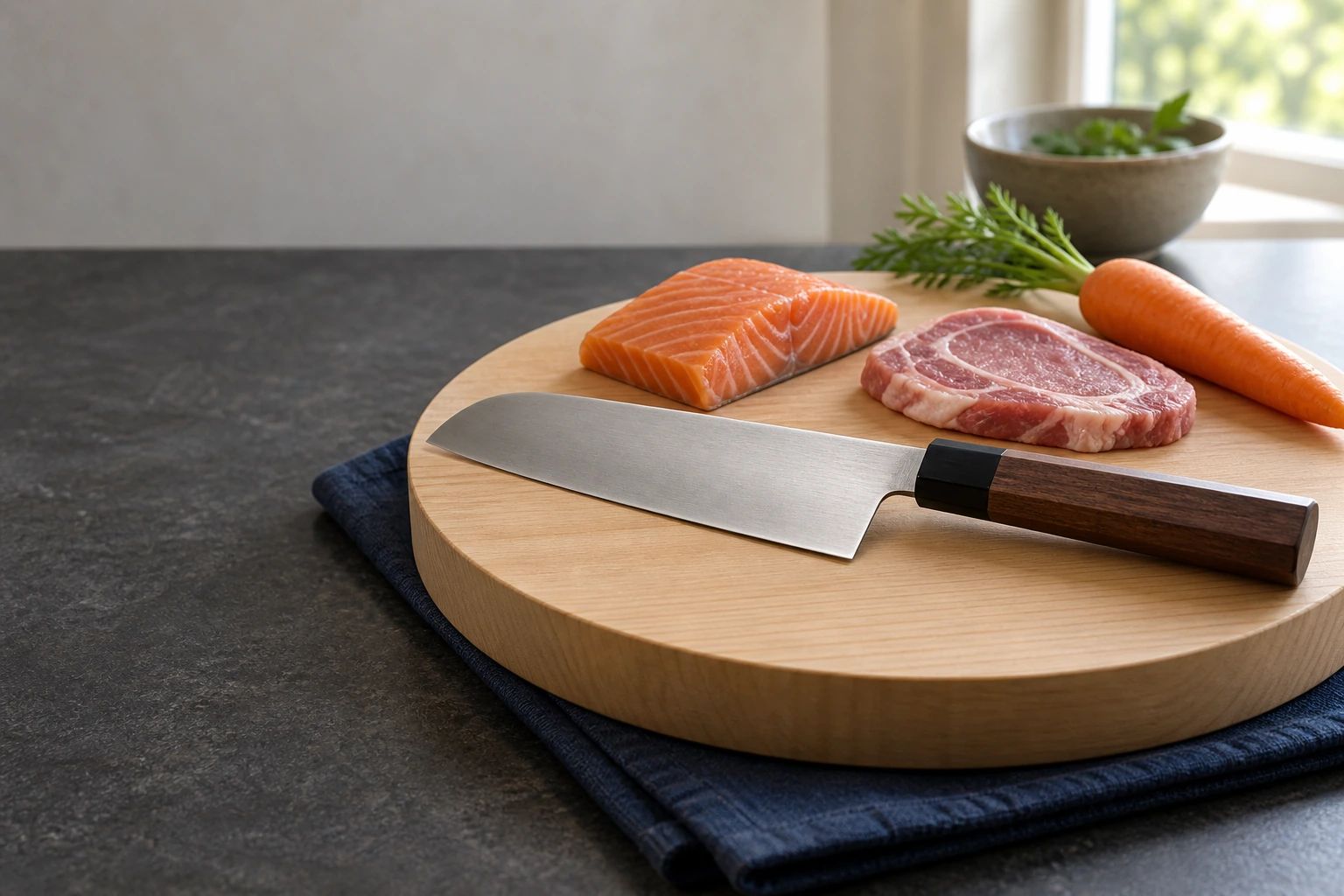
Table of Contents
The santoku knife is Japan's most popular kitchen knife — a versatile, all-purpose blade designed to handle meat, fish, and vegetables with equal precision. With its distinctive flat edge profile and lightweight construction, the santoku has become one of the most sought-after knives worldwide, favored by home cooks and professional chefs alike.
This comprehensive guide covers everything you need to know: what makes a santoku unique, how it compares to Western chef's knives and other Japanese knives, how to choose the right one, our expert recommendations across every budget, and how to care for and sharpen it.
What Is a Santoku Knife?
A santoku knife (三徳包丁, santoku bōchō) is a general-purpose Japanese kitchen knife with a blade length typically between 150mm and 180mm (6-7 inches). It features a flat edge profile, a wide blade, and a sheepsfoot-style tip that curves downward to meet the edge — giving it a silhouette that is unmistakable and instantly recognizable.
Unlike Western chef's knives that evolved from French and German traditions, the santoku was developed in post-war Japan as a hybrid — combining elements of the traditional Japanese nakiri (vegetable knife) with the Western gyuto (chef's knife). The result is a knife that excels at all three primary cutting tasks: slicing proteins, dicing vegetables, and mincing herbs.
What Does "Santoku" Mean?
The name santoku (三徳) translates to "three virtues" or "three uses." This refers to the knife's ability to handle three types of ingredients:
- Meat (肉, niku)
- Fish (魚, sakana)
- Vegetables (野菜, yasai)
Some interpretations suggest the three virtues refer instead to three cutting techniques: slicing, dicing, and mincing. Either way, the name captures the santoku's essence: one knife, three jobs, done well.
The History of the Santoku
The santoku is a relatively modern knife, developed in Japan in the 1940s-50s as home cooking shifted away from the traditional emphasis on fish toward a more Western, meat-inclusive diet. Japanese households needed a single knife that could handle everything — and the existing deba (heavy fish knife) and nakiri (pure vegetable knife) weren't versatile enough. The santoku was the answer.
Today, santoku knives are made in every major Japanese knife-making region — Seki (Gifu Prefecture, home to Miyabi, Shun, Tojiro, and Misono), Sakai (Osaka Prefecture, traditional hand-forging), and Echizen (Fukui Prefecture, known for Takefu Knife Village). Each region has its own stylistic signature, but all produce santoku of exceptional quality.
Santoku vs Chef's Knife: Key Differences
| Feature | Santoku | Chef's Knife (Western) |
|---|---|---|
| Typical length | 150-180mm (6-7") | 200-250mm (8-10") |
| Weight | 100-170g (lighter) | 150-250g (heavier) |
| Blade profile | Flat edge, sheepsfoot tip | Curved belly, pointed tip |
| Cutting technique | Push cut, chop | Rock chop, push cut |
| Blade angle (per side) | 10-15° | 15-20° |
| Steel hardness | 60-66 HRC (harder) | 54-58 HRC (softer) |
| Edge retention | Excellent | Good |
| Best for | Precision cuts, vegetables, daily prep | Versatility, larger proteins, rock-chopping |
| Beginner-friendly | ★★★★★ | ★★★★ |
Bottom line: Choose a santoku if you prefer a lighter, more compact knife and primarily use push-cutting techniques. Choose a chef's knife if you prefer rock-chopping and need a longer blade for larger ingredients like whole chickens or watermelons.
Santoku vs Gyuto
The gyuto (牛刀, literally "cow sword") is the Japanese chef's knife — a direct adaptation of the Western chef's knife made with Japanese steel and geometry. Compared to the santoku:
- Length: Gyuto is longer (210-240mm typical) and better for large ingredients
- Profile: Gyuto has a curved belly for rocking cuts; santoku is flatter
- Tip: Gyuto has a fine point for piercing and precision; santoku has a blunt sheepsfoot
- Versatility: Gyuto is more versatile if you cook big proteins; santoku is better for daily home prep
Santoku vs Nakiri
The nakiri (菜切) is the traditional Japanese vegetable knife — a rectangular, completely flat blade made for vegetables and nothing else. Compared to the santoku:
- Specialization: Nakiri is vegetable-only; santoku handles meat and fish too
- Profile: Nakiri has a completely rectangular, flat blade; santoku has a slight curve near the tip
- Blade height: Nakiri is taller (48-60mm) for knuckle clearance; santoku is shorter (45-50mm)
- Best choice: If you only own one knife, pick santoku. If you already have a chef's knife, add a nakiri for vegetables.
Key Features of a Santoku Knife
Blade Shape & Profile
The santoku's blade is characterized by:
- Flat edge — minimal curve allows full contact with the cutting board for clean, precise cuts. This is the defining feature.
- Wide blade — 45-50mm tall, providing a large surface for scooping cut ingredients.
- Sheepsfoot tip — the spine curves down to meet the edge, reducing the risk of accidental piercing. Ideal for controlled, downward cuts.
- Granton edge (kullenschliff / optional) — hollow-ground dimples along the blade that prevent food from sticking. Common on Western-made santoku; less common on traditional Japanese models.
- Thin grind — the blade is thinner than a Western chef's knife, producing cleaner cuts and less food "wedging."
Steel Types
| Steel | HRC Hardness | Characteristics | Price Range |
|---|---|---|---|
| Stainless (VG-10) | 60-62 | Easy maintenance, good edge retention, rust-resistant. The go-to for mid-range. | $80-200 |
| Stainless (AUS-10) | 59-61 | Similar to VG-10, slightly softer, easier to sharpen. Good budget option. | $50-120 |
| Carbon (Shirogami #2) | 62-65 | Razor-sharp, easy to sharpen, develops patina, requires maintenance. | $60-150 |
| Carbon (Aogami #2) | 63-66 | Excellent edge retention, slightly harder to sharpen than White. | $80-200 |
| Powdered Steel (SG2 / R2) | 63-64 | Premium stainless, exceptional edge retention, low maintenance. | $150-350 |
| Powdered Steel (ZDP-189) | 66-68 | Extreme hardness, elite edge retention, premium price. | $250-500+ |
| Damascus | 60-66 | Beautiful wave pattern, core steel varies, aesthetic + functional. | $100-500+ |
Handle Styles
Santoku knives come with two main handle styles:
- Wa handle (traditional Japanese) — lightweight octagonal or D-shaped wood handle, often made of magnolia, cherry, or ho wood. Blade-forward balance, more traditional feel.
- Yo handle (Western-style) — riveted, full-tang handle made of pakkawood, micarta, or composite. Heavier, more durable, and familiar to Western cooks. Most popular export santoku (Miyabi, Shun, MAC) use yo handles.
How to Use a Santoku Knife
The santoku excels with the push-cut technique:
- Position the blade above the ingredient with the tip slightly forward.
- Push the blade forward and down in a single smooth motion.
- Lift the blade and repeat — avoid rocking.
- For fine mincing, use a rapid up-and-down chopping motion with the blade pivoting from the tip.
Use the "claw grip" on your non-dominant hand: curl fingertips inward and use your knuckles as a guide for the blade. This prevents cuts and lets you work at speed safely.
What Is a Santoku Best For?
- Vegetables: Dicing onions, slicing cucumbers, mincing garlic, julienning carrots, chopping cabbage
- Proteins: Slicing boneless chicken, cutting fish fillets, portioning tofu, slicing cooked meats
- Herbs: Fine chiffonade of basil, mincing parsley, chopping cilantro
- Fruits: Slicing apples, dicing mangoes, supreming citrus, halving strawberries
Avoid using a santoku for: Cutting through bones, splitting squash, carving large roasts, bread slicing, or anything frozen. The harder steel and thinner geometry will chip.
How to Choose a Santoku Knife
When selecting a santoku, consider these factors in order of importance:
- Size — pick based on your kitchen and hand size (see guide below)
- Steel type — stainless (VG-10, AUS-10) for low maintenance; carbon (Shirogami, Aogami) for ultimate sharpness
- Handle style — Western handle for familiarity; wa handle for authentic feel
- Budget — $50-100 for entry, $100-200 for mid-range, $200+ for premium
- Brand reputation — stick with established makers (Tojiro, MAC, Shun, Miyabi, Misono)
Size Guide
| Size | Best For | Hand Size |
|---|---|---|
| 140mm (5.5") | Small kitchens, petty work, small hands, apartment cooking | Small |
| 165mm (6.5") | Most home cooks — the standard size, best all-around choice | Medium |
| 180mm (7") | Larger ingredients, bigger cutting boards, frequent meal prep | Medium-Large |
Best Santoku Knives 2026
For a full budget-by-budget breakdown with prices, steel and editor ratings, see our best santoku knife 2026 guide.
We have tested dozens of santoku knives across all price ranges. Here are our top picks for 2026:
Best Overall: Shun Classic Santoku (178mm)
Price: ~$170 | Steel: VG-MAX core, 32-layer Damascus | HRC: 60-61
The Shun Classic is the benchmark for Western-market santoku. A VG-MAX core (Shun's proprietary blend, based on VG-10) clad in 32 layers of Damascus creates a knife that is beautiful, sharp, and durable. The pakkawood D-shaped handle is comfortable for both right and left-handed users. See our full Shun review.
Best Budget: Tojiro DP Series Santoku (170mm)
Price: ~$55 | Steel: VG-10 | HRC: 60
The Tojiro DP is legendary for its value. VG-10 stainless core with 3-layer construction provides excellent sharpness and easy maintenance. The perfect starter santoku — this is what most Japanese cooking schools recommend for beginners. Read our full Tojiro brand guide.
Best for Professionals: MAC Professional Santoku (170mm)
Price: ~$105 | Steel: MAC's proprietary stainless | HRC: 59-61
Preferred by professional chefs worldwide. Exceptional edge retention, incredibly thin blade, and excellent balance. MAC's geometry is optimized for high-volume prep — this is a knife that earns its keep. Full details in our MAC brand guide.
Best Premium: Miyabi Birchwood SG2 Santoku (180mm)
Price: ~$280 | Steel: SG2 Micro-Carbide powdered | HRC: 63
Stunning 101-layer Damascus pattern with an SG2 powdered steel core. Hand-honed in Seki, Japan, with a distinctive birchwood handle. The perfect blend of artistry and cutting performance. See our Miyabi brand guide for more.
Best Traditional: Misono UX10 Santoku (180mm)
Price: ~$195 | Steel: Swedish stainless | HRC: 59-60
A favorite among working chefs who want a no-nonsense tool. The Misono UX10 uses Swedish high-carbon stainless steel for a razor-sharp edge that is easy to maintain. Lightweight, beautifully balanced, and built to last decades. Read our Misono brand guide.
Best Damascus Pattern: Yaxell Ran Plus Santoku (165mm)
Price: ~$220 | Steel: VG-10 core, 69-layer Damascus | HRC: 61
A gorgeous 69-layer Damascus santoku with a VG-10 core. The pattern is striking and the cutting performance is excellent. A great choice if you want a knife that performs and looks the part on the counter.
Santoku by Brand
Each major Japanese knife brand has its own santoku line with distinct characteristics. Explore our detailed brand guides:
- Shun — The most accessible premium brand in the West. VG-MAX core, Damascus cladding, Western-style handles.
- Miyabi — Made in Seki for Zwilling Henckels. SG2 powdered steel, stunning Damascus, birchwood handles.
- Tojiro — The value king. VG-10 DP series starts under $60 with performance that rivals knives 3x the price.
- MAC — The professional's choice. Ultra-thin blades, legendary edge retention, proprietary stainless steel.
- Misono — Traditional Seki craftsmanship. Swedish steel, Western handles, beloved by working chefs since 1935.
Care & Maintenance
- Hand wash only — never put a Japanese knife in the dishwasher. The high heat and harsh detergents will damage the blade and handle.
- Dry immediately after washing to prevent water spots (essential for carbon steel, good practice for stainless).
- Use a wooden or bamboo cutting board — avoid glass, stone, marble, or ceramic surfaces. They will chip the hard Japanese edge within a few cuts.
- Hone between sharpenings — use a ceramic honing rod (not a steel) every few uses. Steel rods are too hard and will damage Japanese blades.
- Store properly — use a magnetic knife strip, blade guard (saya), or knife roll. Avoid loose drawer storage where the edge can contact other utensils.
- Oil carbon blades — if you have a Shirogami or Aogami santoku, wipe the blade with camellia oil or a light mineral oil before storage to prevent rust.
How to Sharpen a Santoku
Sharpening a santoku correctly is a skill worth learning — it transforms a good knife into a great one. See our full sharpening guide for detailed instructions. The basic steps:
- Soak a 1000-grit whetstone in water for 5-10 minutes until bubbles stop.
- Set the angle — hold the santoku at 10-15° to the stone (about two coins thick).
- Push forward and down in smooth strokes with light pressure. 10-15 strokes per section.
- Flip and repeat on the back bevel with the same technique.
- Refine with 3000-6000 grit for a polished, razor-sharp edge.
- Test by slicing a sheet of paper or a ripe tomato — it should cut effortlessly.
Sharpen every 2-3 months for home use, more often for heavy users. Avoid pull-through sharpeners — they strip too much metal and ruin the asymmetric Japanese edge geometry.