Nakiri Knife: The Japanese Vegetable Knife Guide
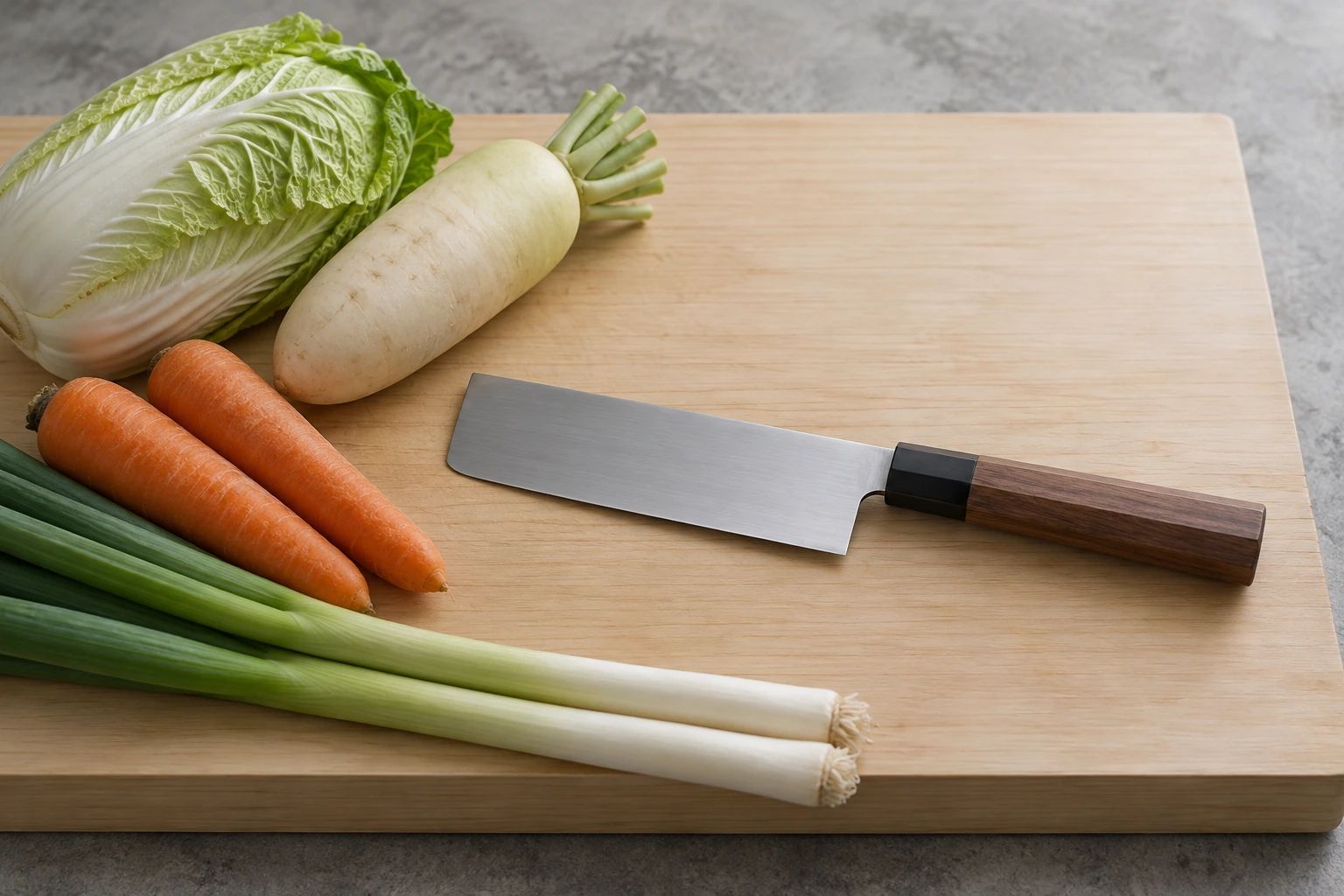
Table of Contents
The nakiri knife (菜切包丁) is Japan's dedicated vegetable knife — purpose-built for slicing, dicing, and chopping vegetables with unmatched precision. Its distinctive rectangular blade, flat edge, and thin profile make it the ideal tool for anyone who cooks with vegetables daily.
What Is a Nakiri Knife?
The nakiri (菜切, literally "vegetable cutter") is a double-beveled Japanese kitchen knife with a thin, rectangular blade typically 150-180mm long. Unlike Western knives with curved edges, the nakiri's perfectly flat blade profile makes complete contact with the cutting board on every stroke, producing clean, uniform cuts.
The nakiri originated as the home cook's counterpart to the professional usuba knife. While the usuba requires single-bevel expertise, the nakiri's double bevel makes it accessible to all skill levels.
Nakiri vs Usuba: What's the Difference?
| Feature | Nakiri | Usuba |
|---|---|---|
| Bevel | Double (both sides) | Single (one side only) |
| Skill level | All levels | Professional |
| Blade thickness | Thin | Thicker spine, ultra-thin edge |
| Primary use | Home vegetable prep | Professional katsuramuki, decorative cuts |
| Maintenance | Easy | Requires skill to sharpen |
| Price | $50-300 | $100-500+ |
Nakiri vs Santoku
| Feature | Nakiri | Santoku |
|---|---|---|
| Specialization | Vegetables only | All-purpose (meat, fish, vegetables) |
| Blade shape | Rectangular, flat | Sheepsfoot, slight curve |
| Tip | Squared/rounded — no point | Pointed sheepsfoot tip |
| Vegetable performance | ★★★★★ | ★★★★ |
| Versatility | ★★★ | ★★★★★ |
Bottom line: Get a nakiri as your second knife if you love cooking vegetables. Get a santoku first if you need one knife for everything.
Nakiri Cutting Techniques
The nakiri's flat blade profile enables four essential cutting techniques that work better on this knife than on any other:
- Push cut (oshi-giri) — Push the blade forward and down simultaneously, letting the full flat edge contact the board at once. This is the nakiri's primary technique and produces the cleanest cuts. Ideal for slicing cucumbers, daikon, and carrots into uniform rounds.
- Tap chop (tataki-giri) — Lift the blade straight up and bring it down in a rapid tapping motion without rocking. Perfect for rough-chopping cabbage, napa cabbage, and leafy greens where speed matters more than uniformity.
- Julienne (sen-giri) — First cut vegetables into thin planks using the push cut, then stack the planks and slice into matchstick-size strips. The nakiri's flat blade keeps every strip the same thickness. Essential for garnishes, stir-fries, and salads.
- Brunoise (small dice) — After julienning, rotate the strips 90° and cut into tiny cubes. The nakiri's height gives your knuckles clearance, and the flat edge ensures each cube is uniform. Used for mirepoix, salsas, and fine vegetable garnishes.
How to Use a Nakiri
The nakiri uses a simple straight up-and-down chopping motion:
- Place the flat edge against the cutting board
- Lift straight up and bring down — no rocking, no sliding
- For thin slices, use a push-cut: push forward and down simultaneously
- The wide blade acts as a scoop to transfer cut vegetables
Why Chefs Love the Nakiri for Prep
During our testing at Kappabashi, the nakiri was the knife type that surprised us most — its flat blade profile makes vegetable prep noticeably faster than a santoku. When we timed chefs julienning daikon, dicing onions, and shredding cabbage, the nakiri consistently finished 15-20% faster than a santoku of the same price range. The reason is simple: the flat edge cuts on every millimeter of the stroke, while a curved blade only contacts part of the board at any given moment.
Professional chefs particularly love the nakiri for high-volume prep of specific vegetables: cabbage for tonkatsu (ultra-thin shreds), daikon for garnishes (translucent rounds and fine julienne), cucumber for salads (uniform thin slices), eggplant for stir-fries (consistent half-moons), and scallions for ramen (rapid fine rings). If your cooking involves daily vegetable prep, the nakiri transforms the experience from a chore into something genuinely satisfying.
What a Nakiri Is Best For
- Precision slicing — paper-thin cucumber, daikon, and radish slices
- Julienne cuts — uniform matchstick-size vegetable strips
- Dicing onions — the flat blade excels at clean horizontal and vertical cuts
- Chopping herbs — rapid up-and-down motion for fine mincing
- Large vegetables — cabbage, lettuce, napa cabbage — the wide blade handles them well
How to Choose a Nakiri
- Size: 165mm is standard. Go 180mm if you regularly cut large vegetables
- Steel: Stainless (VG-10) for easy care; carbon (White #2, Blue #2) for ultimate sharpness
- Weight: Lighter nakiris (under 170g) are better for extended prep sessions
- Handle: Japanese wa-handle (octagonal) for lighter weight; Western handle for familiar grip
Our Recommendations
Best Budget: Tojiro DP Nakiri (165mm) — ~$45
VG-10 core, 3-layer construction. Outstanding value — the same quality/value proposition that made Tojiro famous in the santoku category.
Best Mid-Range: Shun Classic Nakiri (165mm) — ~$130
VG-MAX steel, 69-layer Damascus cladding. Beautiful and functional. The PakkaWood handle is comfortable and durable.
Best Premium: Masakage Yuki Nakiri (165mm) — ~$180
Aogami Super (Blue Super) carbon steel core with stainless cladding. Kurouchi (forge-scale) finish. Made by artisans in Sanjo, Niigata. Exceptional edge taking and retention.
Best Artisan: Yoshimi Kato Nashiji Nakiri (165mm) — ~$220
Hand-forged by one of Echizen's most respected bladesmiths. The nashiji (pear skin) finish gives a rustic, textured appearance that also helps with food release. Aogami Super carbon core delivers extraordinary sharpness. The fit and finish reflect genuine handcrafted care — no two knives are identical. A step up for cooks who want artisan quality in their daily vegetable prep.
Best Collector's Pick: Kurosaki Fujin Nakiri (165mm) — ~$280
Yu Kurosaki's Fujin (Wind God) series features a hammered, textured blade surface with SG2/R2 powdered steel core. The combination of stainless convenience and carbon-like sharpness makes this the best-performing nakiri we tested. The hand-forged texture provides excellent food release, and the SG2 core holds an edge significantly longer than VG-10. For serious vegetable cooks who want the best, this is it.