Best Japanese Knife Sharpener 2026: Whetstone, Electric, or Pull-Through?
QUICK ANSWER
The only Japanese-knife-safe sharpener is a whetstone — pull-through devices and electric sharpeners destroy HRC 60+ edges.
Safe
Whetstone
Risky
Pull-through
Avoid on JP knives
Electric sharpeners
Honing rod
Ceramic only
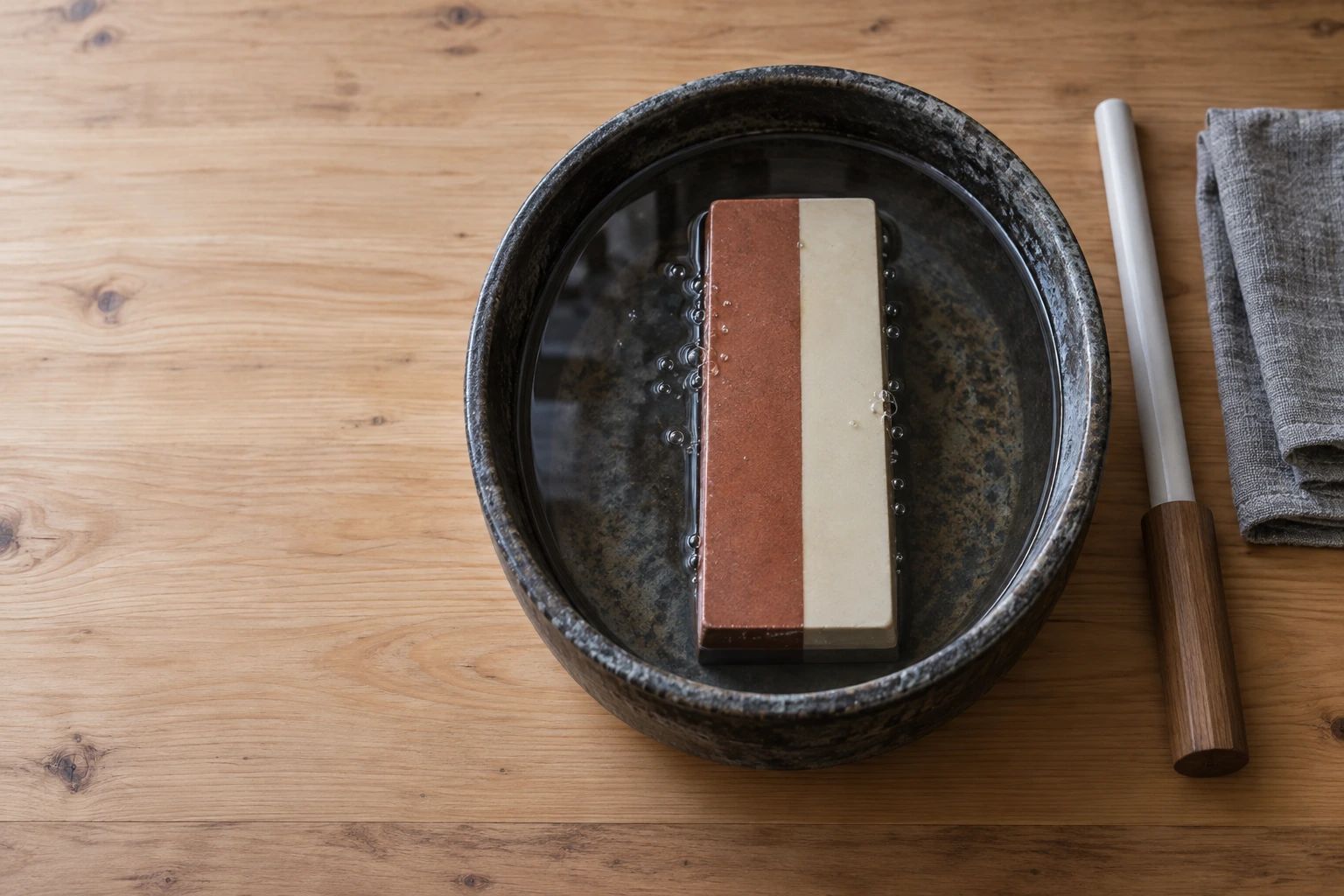
Table of Contents
TL;DR — whetstone is the answer
If you own a Japanese knife at HRC 58+, a whetstone (#1000 + #3000) is the only correct answer. Pull-through is forbidden; electric needs careful model choice; honing rod is a ceramic-only backup.
- Whetstone (#1000+#3000) — the home default. $25-100 covers 90% of Japanese knife maintenance.
- Electric sharpener — Chef'sChoice or Work Sharp Japanese-knife-compatible models ($150+) are conditionally OK. Cheap units are not.
- Pull-through (V-style) — never on Japanese knives at HRC 60+. Last-resort for cheap Western blades only.
- Honing rod — ceramic only (~#1200) for daily touch-ups. Steel grooved rods are a hard no.
- Don't want to learn → send to a pro every 6-12 months. $10-30 per knife.
- Want to learn → buy a stone and put in the hours. It pays back.
Short version: learn the stone, or hire a pro. Do not buy a pull-through.
The four sharpening tool types
Four families of tools, four very different jobs.
- 1. Whetstones — water-lubricated abrasive stones. Grit number (#1000, #3000, #6000) selects coarseness. The traditional Japanese method and the most precise way to set an edge.
- 2. Electric sharpeners — motorized abrasive belts or discs. Huge gap between cheap home models ($30-100) and pro systems ($200+).
- 3. Pull-through (V-style) sharpeners — fixed-angle V of crossed rods, manual. $10-50. The angle is wrong for Japanese knives.
- 4. Honing rods — slender cylinders for re-aligning a deformed apex. Steel grooved (Western) or ceramic (Japanese-compatible).
The jobs differ. Stones and electrics remove metal to build a new apex. Pull-throughs force a fixed angle. Honing rods realign a microscopically deformed edge. For Japanese knives: stones are central, honing rods support, pro electric is conditional, and pull-through is forbidden.
Whetstones — the Japanese standard
The Japanese knife was built around the whetstone. Hand-stones predate the Heian period in Japan; the geometry, hardness, and edge angles of modern Japanese knives all assume stone sharpening.
Grit ladder:
- #220-#400 (coarse) — chip repair, edge reprofiling. Not for routine maintenance.
- #800-#1000 (medium) — the home workhorse. Rebuilds the apex from a dull state.
- #3000-#5000 (finishing) — follows the medium stone, refines the cut and polishes the bevel.
- #6000-#12000 (ultra-finishing) — mirror polish, razor-grade sharpness for advanced users.
The right starter kit at home: a #1000/#3000 dual-sided stone. Shapton "Kuromaku," King, and Naniwa run $25-80 in Japan, more abroad. Premium stones (Shapton Pro, Glass Stone) at $80+ feel smoother and stay flatter, but home users rarely notice the difference.
Technique: see our sharpening guide. Stone selection: whetstone guide. Edge angles: sharpening angle guide.
Electric sharpeners — narrowly useful
Electrics promise "speed" and "consistency." Whether they can deliver on a Japanese knife depends entirely on the model.
Cheap home electrics ($30-100): fixed at ~20° per side. Drag a Japanese knife through and the geometry breaks — you need a full medium-stone session to recover. Forbidden.
Pro-grade systems ($200+): Chef'sChoice 1520 (~$160), Work Sharp Ken Onion (~$200), Tormek T-8 (~$700). All offer 15-17° settings for Japanese geometry and produce sharp, consistent edges fast.
- Chef'sChoice 1520: three-stage (coarse, medium, finishing) with switchable 15° and 20° settings. Three to five passes restore a Japanese edge.
- Work Sharp Ken Onion: belt sander system, continuously variable 15-30° angle. Highest control, but easiest to over-grind.
- Tormek T-8: wet, slow-speed wheel — closest to traditional stone results. Price and footprint make it impractical for most homes.
If you go electric, budget at least $150. Anything under that shortens the life of your Japanese knives.
Pull-through — never on Japanese knives
Pull-throughs are the single greatest enemy of a Japanese kitchen knife. They sell for $10-50, promise "draw the knife through and it's sharp again," and deliver shortened blade life instead.
The mechanism: two hard rods (steel or ceramic) crossed in a V at a fixed ~20° per side. The edge is dragged between them, abrading both bevels at once.
Problem 1: wrong angle. Japanese knives are 15-17° per side. Pull-through is ~20°. You overwrite the acute edge with an obtuse one — and lose all the slicing performance the geometry was supposed to provide.
Problem 2: micro-chipping. The aggressive forced abrasion creates tiny tear-outs along the apex of HRC 60+ steel. Under a microscope the edge looks like a tiny saw, not a clean line.
Problem 3: not easily reversible. Recovering a pull-through-damaged Japanese knife takes 30+ minutes on a #1000 stone, or $20-50 to a sharpener. Some thinner blades never fully recover their original profile.
Pull-throughs are appropriate only for HRC 56-and-below Western knives (mass-market Wüsthof, some Henckels, hardware-store knives). Never use them on Japanese blades, MAC, Misono, Shun, Tojiro, or any high-end Western knife either.
Honing rods — the daily backup
A honing rod (sharpening steel) isn't a sharpener — it's an aligner. The micro-thin apex of any knife bends slightly during use; a honing rod nudges it back straight. Daily use, two minutes of work.
Two types for Japanese knives:
- Ceramic rod: high-density ceramic with gentle abrasive surface (~#1200 equivalent). Aligns the edge without damaging hard Japanese steel. Japanese knives require ceramic. $30-100.
- Steel grooved rod: Western traditional, fine grooves on a hardened steel cylinder. Appropriate for HRC 56-and-below knives. Will micro-chip HRC 60+ Japanese steel. Do not use.
Technique: hold the knife in your dominant hand, the rod vertical in the other. Place the edge against the rod at the same 15-17° per side angle, draw heel-to-tip in a single smooth stroke. Repeat on the other side. Five to ten strokes per side. One minute total.
Frequency: daily before prep, or two or three times a week. This alone halves your whetstone visit frequency.
Picks: Kyocera fine ceramic rod (~$40), Wüsthof ceramic rod 26cm (~$80). Misono and Tojiro ceramic rods are equally good if you find them.
Full comparison table
| Tool | Price (USD) | Japanese knife OK? | Learning curve | Speed | Result quality | Editor rating |
|---|---|---|---|---|---|---|
| Whetstone #1000/#3000 | $25-100 | Yes — perfect | High (weeks) | Slow (15-30 min) | Best | ★★★★★ |
| Whetstone #6000+ | $60-300 | Finishing only | Very high | Slow | Mirror | ★★★★☆ |
| Electric (pro) | $150-700 | Conditional | Medium | Fast (3-5 min) | Good | ★★★☆☆ |
| Electric (cheap) | $30-100 | No | Low | Very fast | Destroys edge | ★☆☆☆☆ |
| Pull-through (V-style) | $10-50 | Never | Low | Very fast | Permanent damage | ★☆☆☆☆ |
| Ceramic honing rod | $30-100 | Yes — for upkeep | Low | Fast (1 min) | Touch-up only | ★★★★☆ |
| Steel grooved rod | $30-150 | No | Low | Fast | Micro-chips | ★☆☆☆☆ |
| Pro sharpening service | $10-30 per knife | Yes — perfect | None | 1-2 week turnaround | Best | ★★★★★ |
Recommended products by type
Editor picks (USD May 2026):
1. Whetstones (the home default)
- Shapton Kuromaku #1000 + #5000 ($90 total) — pro favorite, smooth feel, flat retention.
- King Hyper #1000 + #3000 ($55 total) — the classic home pick, best value.
- Naniwa Gouken #1000/#3000 dual-sided ($35) — one stone, both grits.
2. Ceramic rods (daily maintenance)
- Kyocera fine ceramic rod (CT-7-MO) (~$40) — Japanese-made, trusted.
- Wüsthof ceramic rod 26cm (~$80) — larger grip, easier to hold steady.
3. Electric sharpeners (conditional)
- Chef'sChoice 1520 (~$160) — best home electric with Japanese-knife setting.
- Work Sharp Ken Onion Edition (~$200) — pro flexibility, continuous angle.
4. Send to a pro
- Kappabashi shops (Tsubaya, etc.) — $10-30 per knife, 3-7 days.
- Local cutlery stores — most major cities have a sharpening service.
- Manufacturer direct — Shun, Tojiro, Sakai Takayuki all offer factory sharpening.
Pragmatic editor recommendation: ceramic rod (daily) + #1000/#3000 stone (monthly) + pro sharpening (every 6 months). A Japanese knife maintained this way stays in good shape for 5-10+ years.