Kiritsuke vs Gyuto: Which Professional Japanese Knife Should You Buy?
QUICK ANSWER
Kiritsuke is a hybrid sushi-chef knife with a reverse-tanto tip (240-300mm, traditionally single-bevel); gyuto is the everyday Western-style chef knife (210-240mm, double-bevel).
Kiritsuke length
240-300mm
Gyuto length
210-240mm
Kiritsuke bevel
Single (traditional)
Gyuto bevel
Double
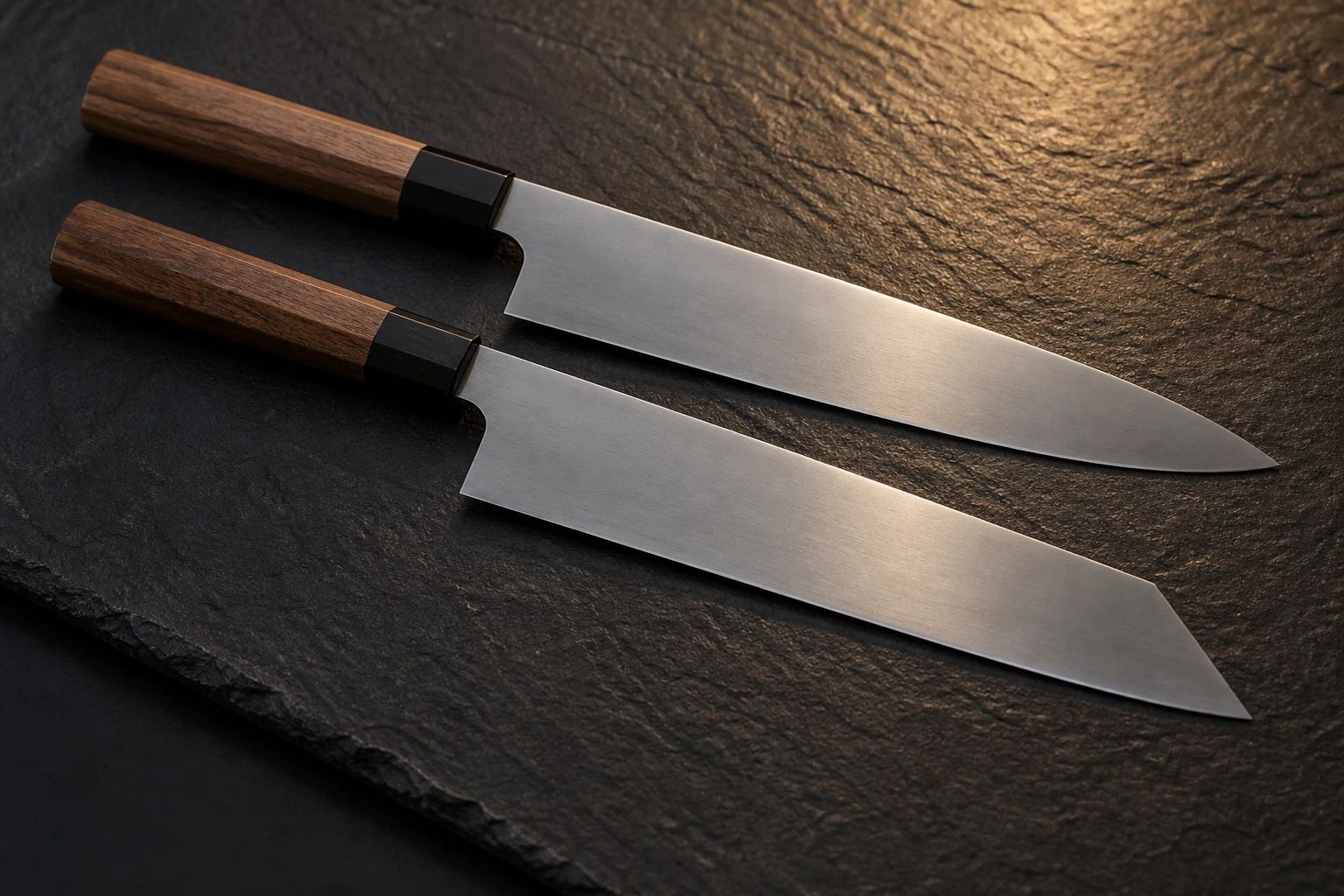
Table of Contents
TL;DR
The kiritsuke is a traditional head-chef knife; the gyuto is the Western-style all-purpose chef knife. If you're choosing your first one, pick the gyuto.
- Both are 210–270mm and overlap in use cases.
- The kiritsuke has a reverse-tanto tip — distinctive but unforgiving.
- Kiritsuke favours push-cuts; rocking cuts are awkward.
- Kiritsuke rewards experience — it punishes sloppy technique.
- The gyuto is universally easy to handle — the safer all-purpose choice.
Two professional knives, two histories
The kiritsuke and the gyuto sit at the top of most professional Japanese knife rolls, and from a distance they look like the same idea: a long, double-edged chef knife between 210 and 270mm.
Up close they are nothing alike. The kiritsuke is a Japanese tradition with a sword's silhouette and a head chef's politics behind it. The gyuto is a 20th-century import — Japan's answer to the French chef knife — built for daily Western prep.
Choosing between them is not a matter of which is better. It's a matter of which cutting motions dominate your cooking, how much sharpening discipline you have, and whether you want a tool or a statement. This guide breaks down the seven differences that actually matter on the cutting board.
Origin and meaning
Kiritsuke (切付) traces its lineage to the formal Japanese kitchen — kaiseki, traditional sushi, ryotei. It was historically the only chef knife allowed at the head chef's station, a visible marker of rank that a junior cook would never touch. The single-bevel form combines two professional knives in one body: the yanagiba (slicer) and the usuba (vegetable). Mastering it meant mastering both sides of Japanese knife work.
Gyuto (牛刀) literally translates to "cow sword." It was developed after Japan opened to Western cuisine, when Japanese smiths copied the French chef knife profile and re-built it with Japanese steel and grinding. Today it's the default chef knife in Japanese restaurants of every kind, and the most popular Japanese knife exported overseas. Two utterly different stories — both ending in a 240mm knife on the cutting board.
The profile difference that defines everything
Almost every functional gap between these knives comes from a single design choice: the curve of the cutting edge. A kiritsuke has a nearly straight edge running from heel to within 30–40mm of the tip, then snaps upward at a sharp, sword-like angle. A gyuto has a continuous, gentle curve — a French-style belly — ending in a soft point that lifts easily off the board.
The flat profile of the kiritsuke optimizes push and pull cuts. Think of laying a daikon flat and shaving paper-thin sheets, or sliding through sashimi in a single pull stroke. The angled tip lets the chef tip in for fine vegetable detail without rotating the wrist. The gyuto's curve, by contrast, optimizes rocking and dicing — the heel stays on the board while the tip rises, the same motion a Western chef uses on onions, herbs and ginger.
On vegetables you peel and slab, the kiritsuke is faster. On vegetables you dice, the gyuto is faster. Most home cooks do more dicing than slabbing, which is why a gyuto remains the safer single-knife choice.
Single-bevel vs double-bevel reality
There is real confusion in the market here, so be careful when you shop. A traditional kiritsuke is single-bevel — sharpened only on the right side, with a flat back (urasuki) — and behaves like a yanagiba. It's a specialist's tool meant for sushi-level slicing on fish and shaved vegetable work. Most home cooks should not buy this version.
What you actually find in most online stores today is the double-bevel kiritsuke-gyuto — sometimes called "K-tip gyuto." It keeps the flat edge and angled tip, but it's sharpened on both sides like a normal chef knife. This is the version that crossed over to Western kitchens. Konosuke, Yu Kurosaki, Takamura and others all make versions; they sharpen, behave and feel much closer to a gyuto than to a yanagiba.
If a listing is vague, look at the spine: a single-bevel will show an obviously asymmetrical grind. Single-bevel = pro tool. Double-bevel hybrid = home-friendly. The price difference between the two categories is large.
Cutting feel: what each knife actually does best
On our test board we ran both knives through five common tasks. The kiritsuke pulled ahead on long slices — sashimi-style pulls on salmon, suji-hiki removal of beef sinew, and julienne work on carrots and daikon. The flat edge stayed in full contact with the board, leaving cleaner sheets. It also wins decisively on garnish: chrysanthemum cuts, fan slices and katsuramuki (rotary peel) sit naturally with its angled tip.
The gyuto won everything that involved a curve in the wrist. Onions diced faster, parsley reduced to dust quicker, and breaking down a whole chicken — separating thigh, popping out the wishbone — was simply more comfortable with the curved belly. If you cook a lot of stir fries, soups and Western mains, the gyuto's geometry matches your hands. If you cook sashimi, sunomono and Japanese vegetable dishes, the kiritsuke does.
Sharpening difficulty
A gyuto is the easiest of the three knives to maintain. The continuous curve guides your hand naturally; there are no transitions to track. A first-time stone user can produce a working edge on a gyuto inside an afternoon. The double-bevel kiritsuke-gyuto is one step harder: the sharp angled tip is easy to round if you let pressure drift, and many beginners shave off too much steel from the front 30mm of edge until the silhouette deforms.
The single-bevel kiritsuke is a different discipline entirely. You're maintaining the urasuki on the back, the wide bevel on the front, and the geometry transition into the angled tip — all while keeping the cutting edge dead-straight. Without proper instruction, most home users round the tip within months. This is why we recommend single-bevel only to cooks already comfortable with single-bevel yanagiba or usuba.
Price and availability
Production volume is the simplest explanation for the price gap. Major makers stamp out gyutos by the thousand; kiritsuke versions are made in smaller batches, often by more senior smiths, and the angled tip adds grinding time. Expect a roughly 20–30 percent premium over an equivalent gyuto from the same line.
At the entry level, double-bevel kiritsuke-gyuto from Tojiro DP or Yu Kurosaki Senko start around 15,000–25,000 yen. Mid-range work from Takamura or Yoshikane runs 30,000–60,000 yen. Konosuke Fujiyama kiritsuke-gyuto typically lands around 80,000 yen. Serious single-bevel kiritsuke from Sukenari or top Sakai workshops can clear 120,000–200,000 yen and require waiting lists. Gyuto, by contrast, has hundreds of options between 6,000 and 300,000 yen — far more entry points.
Which one is right for you
The decision is mostly a question of cooking style and discipline:
- Sushi or Japanese cuisine focus + advanced skill — a single-bevel kiritsuke is genuinely the right tool. You'll outgrow a gyuto quickly.
- General Western cooking, single-knife household — buy a 210 or 240mm gyuto. It's the most versatile, most forgiving and most fairly priced of any chef knife on the planet.
- You already own a gyuto and want a "graduate" knife — a double-bevel kiritsuke-gyuto is the natural second purchase. It expands your slicing range and looks stunning on the board.
- Status, aesthetic, gift — kiritsuke wins, with the caveat that it's harder to sharpen well.
See our broader breakdowns in santoku vs gyuto and Japanese vs German knives, plus the deep dives on kiritsuke and gyuto for full buying detail.
Side-by-side comparison
| Feature | Kiritsuke | Gyuto |
|---|---|---|
| Origin | Japanese (head-chef knife) | Japanese-Western hybrid |
| Profile | Nearly straight edge + angled tip | Curved belly (French chef) |
| Bevel (traditional) | Single-bevel | Double-bevel |
| Bevel (modern hybrid) | Double-bevel kiritsuke-gyuto | Double-bevel always |
| Length typical | 210–270mm | 180–300mm |
| Best cutting motion | Push, pull, fine slicing | Push, rock, dice |
| Best for | Vegetables, sushi, garnish | All-purpose |
| Sharpening difficulty | Hard (single-bevel) / medium (hybrid) | Easy |
| Price typical | ¥15K–150K | ¥6K–300K |
| Recommended for | Pro chef, advanced home | Any home or pro |
| Top maker examples | Konosuke, Sukenari | Misono, MAC, Tojiro, Yoshihiro |
Sizing: 210, 240 or 270mm?
Both knives sit in the same length window, but the right size depends on cutting board and cuisine, not on which silhouette you chose. For a gyuto, 210mm is the home standard, 240mm is the professional default, and 270mm is reserved for cooks moving large proteins on full-size restaurant boards. Most home boards (40–50cm) work best with 210mm; jumping to 240mm at home pays off only if you frequently break down large proteins or watermelons.
For a kiritsuke, the equation shifts. The flat profile only earns its keep when the edge is long enough to take a meaningful sashimi pull or a full daikon slab in one stroke. Below 210mm the geometry feels cramped; we recommend 240mm as the default kiritsuke length, with 210mm only for small kitchens and 270mm for sashimi-heavy work. A 180mm kiritsuke exists as a category but tends to be a stylistic choice rather than a functional one.
Top makers worth knowing
Both categories have specialists, and the names cluster differently. For gyuto, the safe entry-level brands include Tojiro (the workhorse DP series), MAC, Misono (the UX10 in particular) and Yoshihiro. Mid-range picks come from Takamura, Yu Kurosaki, Yoshikane; high-end names are Konosuke, Mazaki, Shibata, Kato. Choice abundance is the gyuto's defining advantage.
For kiritsuke, the field is narrower and skews professional. Single-bevel: Sukenari, Sakai Takayuki, Yoshihiro and high-end Sakai workshops. Double-bevel kiritsuke-gyuto: Konosuke (especially the Fujiyama line), Yu Kurosaki (Senko Ei), Takamura, Hatsukokoro, Tsunehisa. Buying from a reputable Japanese-knife specialist matters more than usual here, because the kiritsuke market has more low-quality clones than the gyuto market — many "kiritsuke" listings on generalist marketplaces are simply gyutos with a sharp tip ground in.
Still unsure which knife type matches your kitchen? Our guide to Japanese knife types walks through every blade in the family — santoku, nakiri, petty, sujihiki, deba, yanagiba — and helps you place the kiritsuke and gyuto in the wider professional kit.
The bottom line: a gyuto is the answer for most cooks most of the time. A kiritsuke is the answer for cooks whose work, skill or aesthetic specifically rewards its silhouette. They are not competitors — they are two different professional answers to two different questions. Pick the question first, then buy the knife.