Kiritsuke Knife: The Japanese Chef's Status Symbol
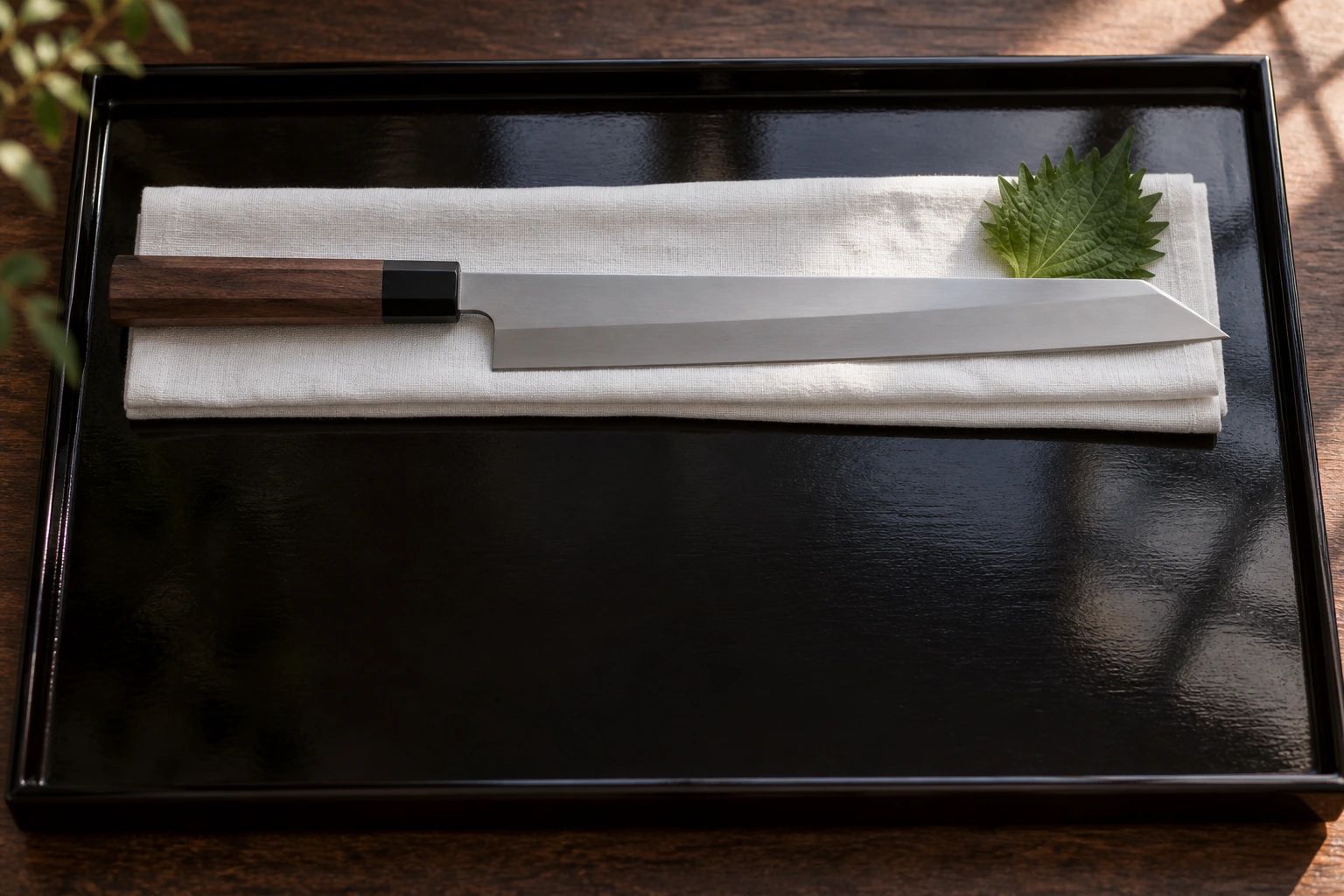
Table of Contents
The kiritsuke (切付) is the most prestigious knife in the Japanese kitchen — a blade traditionally reserved for the head chef alone. Combining the slicing ability of a yanagiba with the vegetable precision of an usuba, the kiritsuke is both a multi-purpose cutting tool and a symbol of mastery. Its distinctive angled tip and flat profile set it apart from every other Japanese knife.
What Is a Kiritsuke Knife?
The kiritsuke (切付, literally "slit and attach" or "cut and press") is a hybrid Japanese knife that merges two traditional single-bevel designs: the yanagiba (long sashimi slicer) and the usuba (thin vegetable knife). The result is a long, flat-profiled blade with a distinctive angled tip — sometimes called a "reverse tanto" or "clipped point" — that can handle both delicate fish slicing and precise vegetable work.
In modern knife-making, the term "kiritsuke" refers to two distinct types:
- Traditional kiritsuke — Single-bevel, intended for professional Japanese chefs. Long (240-270mm), flat, and ground on one side only.
- Kiritsuke-gyuto (kiritsuke-shaped gyuto) — Double-bevel, designed for broader use. Combines the kiritsuke's angular tip and flat profile with the accessibility of a Western-style double-ground edge.
The kiritsuke-gyuto has become extremely popular worldwide, as it offers the kiritsuke's distinctive look and flat cutting style without requiring single-bevel sharpening skills.
History & Tradition
The kiritsuke holds a unique position in Japanese culinary tradition. In traditional professional kitchens (especially in kaiseki and sushi establishments), only the head chef (hancho, 板長) was permitted to use this knife. This was not merely custom — it was a strict hierarchy.
The reasoning was practical and symbolic: the kiritsuke combines two specialist knives into one, so wielding it meant the chef had mastered both fish preparation (the domain of the yanagiba) and vegetable cutting (the domain of the usuba). Junior cooks were expected to use the individual specialist knives until they earned the right to pick up the kiritsuke.
This tradition dates back to the Edo period and the formalization of Japanese kitchen hierarchies. While modern professional kitchens have largely relaxed this rule, the kiritsuke retains its aura of prestige. Many Japanese knife shops still display it as a "chef's knife" rather than a general-purpose tool.
Single-Bevel vs Double-Bevel Kiritsuke
| Feature | Single-Bevel (Traditional) | Double-Bevel (Kiritsuke-Gyuto) |
|---|---|---|
| Edge grind | One side only (right-hand default) | Both sides symmetrical |
| Typical length | 240-270mm | 210-240mm |
| Primary use | Sashimi + vegetables | All-purpose chef's knife |
| Skill level required | Advanced / professional | Intermediate |
| Sharpening | Single-side whetstone technique | Standard double-bevel sharpening |
| Cutting technique | Pull-cut, push-cut | Push-cut, draw-cut, light rocking |
| Food release | Excellent (concave ura side) | Good |
| Price range | $200-$800+ | $80-$350 |
| Best for | Professional Japanese chefs | Enthusiasts and home cooks |
Kiritsuke Knife Specifications
| Specification | Typical Range |
|---|---|
| Blade length | 210-270mm (8.3"-10.6") |
| Blade height | 45-52mm |
| Blade thickness (spine) | 2.0-3.0mm |
| Weight | 150-220g (varies by size and steel) |
| Steel options | White #2, Blue #2, VG-10, SG2, Aogami Super |
| Edge type | Single-bevel (traditional) or double-bevel |
| Standard size | 240mm (9.5") |
| HRC hardness | 60-67 |
| Best for | Sashimi, vegetables, precision slicing, general prep |
Kiritsuke vs Gyuto
The kiritsuke and gyuto are both popular multi-purpose Japanese knives, but they have fundamentally different blade geometries and cutting styles.
| Feature | Kiritsuke | Gyuto |
|---|---|---|
| Blade profile | Flat with angled tip | Curved belly with pointed tip |
| Primary cutting style | Push-cut, draw-cut | Rock chop, push-cut |
| Tip shape | Angled ("reverse tanto") | Pointed (like a French chef's knife) |
| Rocking cuts | Not ideal (flat profile) | Excellent (curved belly) |
| Precision work | ★★★★★ | ★★★★ |
| Versatility | ★★★★ | ★★★★★ |
| Sashimi slicing | ★★★★★ | ★★★ |
| Beginner-friendly | ★★★ | ★★★★★ |
| Visual distinction | Iconic, sword-like | Classic chef's knife shape |
Choose a kiritsuke if you prefer push-cutting and draw-cutting techniques, work with a lot of fish and vegetables, and want a knife with serious visual presence. Choose a gyuto if you want maximum versatility, use rocking cuts frequently, and need a knife that handles every task well.
How to Use a Kiritsuke Knife
The kiritsuke's flat profile demands a different cutting technique than curved chef's knives:
- Push-cut (oshi-giri) — The primary technique. Push the blade forward and down through ingredients in a single motion. The flat edge ensures full contact with the cutting board.
- Draw-cut (hiki-giri) — Pull the blade toward you in a long, smooth stroke. Essential for slicing sashimi and creating clean, cell-preserving cuts.
- Tap-cut (tataki-giri) — Use the flat portion of the blade for rapid up-and-down chopping of herbs and aromatics.
- Tip work — The angled tip excels at scoring, detail cuts, and separating delicate proteins.
Avoid rocking cuts. The kiritsuke's flat profile does not have the curved belly needed for a rocking motion. Attempting to rock-chop will result in uneven cuts and faster blade wear.
Steel Types for Kiritsuke Knives
Traditional single-bevel kiritsuke knives are almost always made from carbon steel. Double-bevel versions use a wider range of steels.
- Shirogami White #2 — HRC 62-65. The traditional choice. Pure carbon steel that takes an incredibly fine edge and is easy to resharpen. Requires rust prevention.
- Aogami Blue #2 — HRC 63-66. Carbon steel with chromium and tungsten additives for better edge retention. The professional's favorite for single-bevel kiritsuke.
- Aogami Super — HRC 65-67. The highest-performing carbon steel. Extreme edge retention but more difficult to sharpen.
- VG-10 — HRC 60-62. The most popular stainless option for double-bevel kiritsuke. Low maintenance with good sharpness.
- SG2 / R2 — HRC 63-64. Powdered stainless steel. Premium performance with stain resistance. Ideal for the kiritsuke-gyuto style.
Kiritsuke Size Guide
| Size | Type | Best For | Recommended For |
|---|---|---|---|
| 210mm (8.3") | Double-bevel | Compact all-purpose use | Home cooks wanting kiritsuke style |
| 240mm (9.5") | Both types | The standard — most versatile size | Most users, enthusiasts, professionals |
| 270mm (10.6") | Single-bevel | Traditional professional use | Experienced chefs, sashimi specialists |
| 300mm (11.8") | Single-bevel | Large-scale fish work | Professional sushi/kaiseki chefs only |
The 240mm is the gold standard for kiritsuke knives. It provides enough blade length for clean draw-cuts through fish while remaining manageable for vegetable prep. Home cooks who find 240mm intimidating should consider a 210mm double-bevel kiritsuke-gyuto.
Best Kiritsuke Knife Recommendations
Best Entry-Level: Tojiro Shirogami Kiritsuke (240mm) — ~$80
White #2 carbon steel, double-bevel. Tojiro delivers excellent sharpness and a flat kiritsuke profile at an unbeatable price. A great way to experience the kiritsuke cutting style without a major investment.
Best Mid-Range: Takamura R2 Kiritsuke (210mm) — ~$180
SG2 powdered steel, double-bevel. Extremely thin and precise, with stainless convenience. Takamura's renowned laser-thin geometry makes this one of the sharpest kiritsuke knives available.
Best Traditional: Sakai Takayuki Aogami Blue #2 Kiritsuke (240mm) — ~$280
Single-bevel, hand-forged in Sakai. Blue #2 carbon steel with a magnolia handle. Authentic professional-grade kiritsuke with outstanding edge retention and traditional craftsmanship.
Best Premium: Sukenari SG2 Damascus Kiritsuke (240mm) — ~$350
SG2 core with 33-layer Damascus cladding, double-bevel. Forged in Takefu, Echizen. Combines stunning aesthetics with elite cutting performance. A collector's piece that performs at the highest level.
Care & Maintenance Tips
- Hand wash immediately after use — Especially critical for carbon steel kiritsuke. Wipe dry with a clean cloth right after washing. Never leave wet.
- Use a whetstone, not a honing rod — Kiritsuke knives (especially single-bevel) should only be sharpened on whetstones. Use 1000 grit for regular maintenance, 3000-6000 grit for polishing.
- Single-bevel sharpening is one-sided — Only sharpen the bevel side (typically the right). The flat (ura) side gets only a few light passes to remove the burr.
- Use a wooden or plastic cutting board — The thin, hard blade will chip on glass, ceramic, or bamboo surfaces.
- No lateral force or twisting — The kiritsuke is thin and hard. Prying, twisting, or cutting frozen foods will chip the edge.
- Store on a magnetic rack or in a saya — Protect the edge from contact with other utensils. A wooden saya (sheath) is traditional and ideal.
- Apply camellia oil for carbon steel — If using a carbon steel kiritsuke, oil the blade before storage to prevent rust. Tsubaki (camellia) oil is the traditional choice.