Santoku vs Gyuto: Which Japanese Knife Should You Buy?
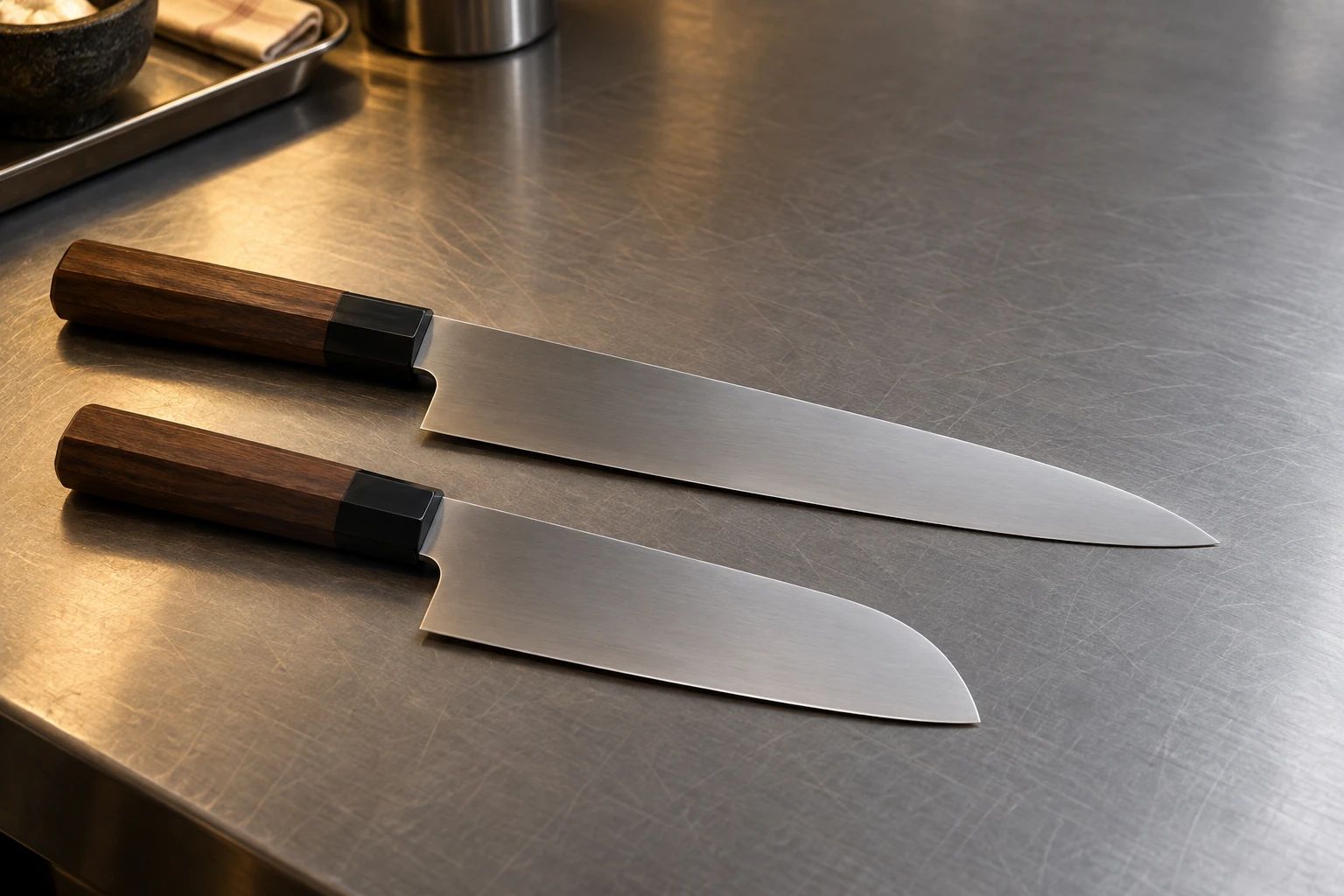
Table of Contents
The Two Most Popular Japanese Knives, Compared Head-to-Head
The santoku and the gyuto are the two most popular Japanese kitchen knives in the world. If you are buying your first high-quality Japanese knife, the decision almost always comes down to these two. Both are general-purpose blades capable of handling meat, fish, and vegetables — but they differ in blade shape, weight, cutting technique, and ideal use cases.
This guide breaks down every meaningful difference so you can make the right choice for your kitchen, your cooking style, and your budget.
Side-by-Side Comparison
| Feature | Santoku | Gyuto |
|---|---|---|
| Blade length | 150-180mm (6-7") | 210-270mm (8-10.5") |
| Weight | 100-170g (lighter) | 150-250g (heavier) |
| Blade profile | Flat edge, sheepsfoot tip | Curved belly, pointed tip |
| Cutting technique | Push cut, tap chop | Rock chop, push cut, draw cut |
| Best for | Precision vegetable work, home cooking | Versatile all-purpose, large ingredients |
| Beginner-friendly | ★★★★★ | ★★★★ |
| Price range | $40 - $300+ | $50 - $400+ |
| Steel options | VG-10, AUS-10, White #2, Blue #2, SG2 | VG-10, AUS-10, White #2, Blue #2, SG2, ZDP-189, R2 |
| Handle styles | Wa (Japanese) or Western | Wa (Japanese) or Western |
| Maintenance | Low to moderate | Low to moderate |
| Versatility score | 8 / 10 | 9.5 / 10 |
| Our pick | Best for home cooks and small kitchens | Best all-rounder for serious cooking |
When to Choose Santoku
The santoku is the better choice in these scenarios:
1. You Cook Mostly Vegetables and Smaller Ingredients
The santoku's flat edge profile makes full contact with the cutting board, producing clean, uniform cuts on vegetables, herbs, and boneless proteins. If your daily cooking involves dicing onions, mincing garlic, slicing cucumbers, and julienning carrots, the santoku is purpose-built for this work. The wide blade also doubles as a scoop to transfer ingredients from board to pan.
2. You Have Small Hands or a Small Kitchen
At 165-180mm, the santoku is noticeably shorter and lighter than a standard 210mm gyuto. Cooks with smaller hands find it more comfortable and easier to control. In compact kitchens with limited counter space, the shorter blade is more maneuverable and less likely to collide with walls or other equipment.
3. You Are Buying Your Very First Japanese Knife
The santoku's lighter weight and intuitive push-cut technique make it the gentlest introduction to Japanese knives. There is less risk of tip damage compared to a gyuto's delicate pointed tip, and the learning curve is shorter. Many Japanese cooking instructors recommend the santoku as a first knife for home cooks.
When to Choose Gyuto
The gyuto is the better choice in these scenarios:
1. You Want One Knife That Does Everything
The gyuto is the most versatile single knife in any kitchen. Its curved blade accommodates both rocking and push-cutting techniques. The pointed tip handles detail work, scoring, and piercing. The extra length makes it efficient for slicing large roasts, watermelons, and cabbages. If you could only own one knife, the gyuto is the answer.
2. You Cook Professionally or Prep Large Volumes
Professional kitchens demand speed and efficiency. The gyuto's longer blade covers more surface area per stroke, reducing the number of cuts needed. Rock-chopping herbs and mirepoix is faster with a curved belly. The 240mm and 270mm sizes are workhorses in restaurant environments around the world.
3. You Frequently Handle Large Proteins
Breaking down whole chickens, slicing brisket, portioning salmon fillets — the gyuto's length and pointed tip give you reach and precision that a shorter santoku cannot match. While neither knife is designed for cutting through bone, the gyuto handles large-protein fabrication far more comfortably.
Can You Own Both?
Absolutely — and many serious cooks do. The santoku and gyuto complement each other well. A common setup is:
- Gyuto (210mm) as the primary all-purpose knife for larger tasks
- Santoku (165mm) as a secondary knife for quick vegetable prep, smaller tasks, or when the gyuto feels like overkill
This pairing covers virtually every kitchen cutting task. Add a petty knife (120-150mm) and a bread knife, and you have a complete, professional-grade knife set with only four knives.
Our Recommendation by Cook Type
| Cook Type | Recommended Knife | Why |
|---|---|---|
| Home cook (general) | Santoku 165mm | Lighter, easier to learn, perfect for daily home meals |
| Professional chef | Gyuto 210-240mm | Maximum versatility for high-volume prep |
| Meal-prep enthusiast | Gyuto 210mm | Longer blade handles batch vegetable prep efficiently |
| Small hands / compact kitchen | Santoku 165mm | Shorter, lighter, easier to maneuver in tight spaces |
| Mostly vegetarian cooking | Santoku 180mm | Flat edge excels at vegetable precision cuts |
| Meat-heavy cooking | Gyuto 240mm | Length and tip for large proteins and slicing |
| Already own a Western chef's knife | Santoku 165mm | Adds a different blade profile and technique to your kit |
| Upgrading from a Western chef's knife | Gyuto 210mm | Familiar shape with Japanese steel performance |
The bottom line: If you are a home cook who values simplicity and ease of use, start with a santoku. If you want the single most versatile knife in the kitchen and do not mind a bit more blade to handle, go with a gyuto. Either way, you are getting a world-class cutting tool that will outperform almost any mass-market Western knife.