Japanese Knife Gift Guide 2026: Etiquette, Budgets & Picks
QUICK ANSWER
Best Japanese knife gifts: VG10 Tojiro DP santoku ($85) for new cooks, Sakai Takayuki damascus for senior gifts ($150-300), avoid carbon steel for anyone unfamiliar with daily care.
Beginner gift
Tojiro DP $85
Premium gift
Sakai Takayuki damascus
Avoid
Carbon for novices
Engraving
Adds personal touch
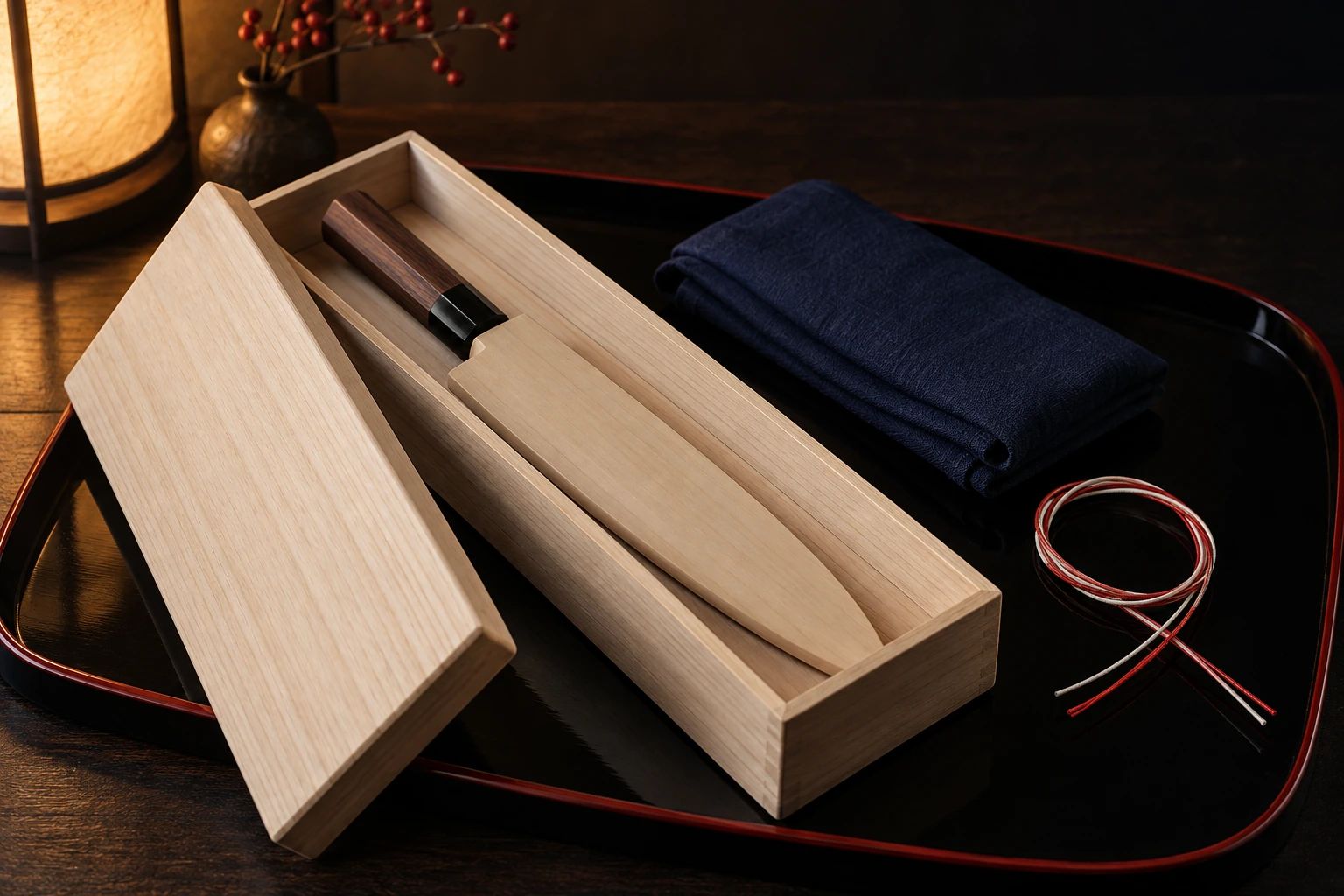
Table of Contents
The 5-Yen Coin Tradition: Why Knives Need a Symbolic Purchase
In Japan, gifting a blade carries a quiet superstition: knives are said to cut the relationship between giver and receiver. The traditional countermeasure is elegant. The recipient slips a single 5-yen coin (五円硬貨) back to the giver, transforming the act from a gift into a symbolic purchase. No relationship is severed, because the knife was technically bought.
The reason it has to be 5 yen is linguistic. Go-en (五円, "five yen") is a homophone of ご縁, meaning "good fortune," "connection," or "fated relationship." Handing over the coin literally pays for the knife and figuratively pays for continued good ties. Older couples still observe this at weddings; younger Japanese gift-givers sometimes tape a 5-yen coin to the box with a small note explaining the custom.
For international gift-givers, the gesture is optional but appreciated — Kappabashi shops often include a 5-yen coin in the gift wrap by request. If you're sending a knife abroad, a brief explanatory card lets the recipient participate in the tradition without confusion. See our Japanese knife types guide for context on which blades carry the most ceremonial weight.
Price Points by Occasion
Japanese gift-giving follows tighter conventions than Western practice. The amount signals the depth of relationship and the gravity of the occasion. Spending too little reads as careless; spending dramatically above the convention can embarrass the recipient.
| Occasion | Typical budget (JPY) | Approx. USD | Suggested category |
|---|---|---|---|
| Wedding | ¥30,000–100,000 | $200–700 | Premium gyuto or matched santoku + petty set |
| Housewarming | ¥10,000–30,000 | $70–200 | Solid stainless santoku or 210mm gyuto |
| Graduation / first job | ¥8,000–20,000 | $55–140 | Entry-level VG-10 santoku or bunka |
| Retirement of a chef | ¥50,000+ | $350+ | Hand-forged blue-paper gyuto or signature yanagiba |
| Thank-you / hostess gift | ¥5,000–15,000 | $35–100 | Petty knife or paring knife |
| Birthday (close friend) | ¥15,000–40,000 | $100–280 | Santoku or gyuto matched to their cooking style |
Prices are approximate ranges, not live pricing — they vary by retailer, availability, tax and exchange rate. Always confirm with the seller before buying.
For more on what falls in each band, our budget knife round-up covers value picks under ¥15,000, and our overall best-of spans the full range.
Who Gets What: Matching Knife to Cook
Budget alone doesn't make a great gift. The knife has to fit how the recipient actually cooks. A serious sushi enthusiast deserves a yanagiba; the same blade gathers dust in a vegetarian's kitchen. Use this matrix as a starting point.
| Recipient profile | Budget | Recommended knife | Where to buy |
|---|---|---|---|
| Home beginner | ¥10,000 | Tojiro DP Santoku 170mm | Online (Amazon Japan, Tojiro direct) |
| Serious home cook | ¥20,000–40,000 | Misono UX10 Gyuto 210mm | Kappabashi (Kama-Asa, Tsubaya) |
| Pro restaurant chef | ¥50,000+ | Sukenari Aogami Super Gyuto 240mm | Kappabashi specialty (Kiwami, Union Commerce) |
| Sushi / sashimi pro | ¥80,000+ | Sakai Takayuki Yanagiba 270mm, white-paper #2 | Sakai direct or Kappabashi |
| Vegetarian / vegan | ¥15,000 | Nakiri 165mm or Bunka 170mm | Various (Tojiro, MAC, Sakai) |
| Pastry / bread baker | ¥10,000 | Misono Molybdenum bread knife 240mm | Various |
| Outdoor / camping cook | ¥12,000 | Stainless petty 150mm with kydex sheath | Online specialty |
Unsure where the recipient lands? Default to a 170mm santoku in stainless. It handles 80% of Western cooking and demands less maintenance than carbon. For deeper recipient analysis, our how-to-choose guide walks through cooking-style profiling.
Presentation: Paulownia Boxes, Saya, and Engraving
Premium Japanese knives are presented in kiri (paulownia) wood boxes. Paulownia is prized for its exceptional dimensional stability — it doesn't warp with humidity, repels insects, and absorbs moisture before the blade does. A proper kiri-bako adds ¥2,000–8,000 to the gift cost depending on size and finish, and elevates the perceived value substantially. Most Kappabashi shops keep kiri-bako in stock and will fit a knife to the right size while you wait.
Traditional single-bevel knives ship with a saya — a slip-on wooden sheath, usually magnolia or honoki, that protects the edge during storage. The saya is functional, not decorative; recipients who don't know to use it can dull a freshly sharpened yanagiba in weeks. Include a brief care card in the gift if you're sending one of these blades to a non-Japanese cook.
Engraving is the final personalization. Kappabashi engraving services typically run:
- Cost: ¥2,000–5,000 depending on character count and complexity
- Turnaround: Same-day to 3 business days at most major shops
- Best on: Stainless gyuto, santoku, petty, and bunka — anywhere the spine has a flat blank section
- Avoid on: Hand-forged carbon single-bevels where the maker's mark is artistic; Damascus patterns where engraving fights the layered finish
Keep the engraving short. A first name, initials, a date, or a short kanji phrase (一期一会, 旨, 料理魂) all read beautifully. Long English sentences look crowded on a knife spine.
Online vs In-Person Purchase
Where you buy matters as much as what you buy. Each channel has clear strengths.
In-person at Kappabashi (Tokyo) or Sakai (Osaka) wins for personalization. You can hold the blade, compare handle profiles, request engraving, choose the kiri-bako, and have everything wrapped together. Shops with strong English support — Kama-Asa, Tsubaya, Union Commerce, Kiwami — walk international customers through every step. Same-day engraving and gift wrap are routine.
Online wins for international shipping and selection breadth. Kama-Asa, Kiwami, and Sakai Takayuki all run polished English-language storefronts with tracked international shipping. Tojiro and MAC ship via Amazon Japan to most countries. Online stores often stock variants that Kappabashi shops have to special-order. The trade-off: you can't hand-pick the specific knife, and engraving turnaround stretches to 7–14 days for international orders.
Hybrid approach: visit Kappabashi in person, choose the knife and presentation, then have the shop ship it directly to the recipient's address. Most shops offer this and will include a gift card if you provide the message in advance.
Top Gift Picks by Budget
Editorial picks across four budget tiers, all stainless or semi-stainless to minimize maintenance burden on the recipient. For a fuller comparison, see our brand round-up.
Under ¥10,000 — Thoughtful & accessible
- Tojiro DP Santoku 170mm (~¥6,500): The benchmark entry-level Japanese knife. VG-10 core, comfortable Western handle, holds a respectable edge for months of home use.
- Victorinox Fibrox Santoku 170mm (~¥5,500): Not Japanese-made, but extremely forgiving and a sensible "first knife" for someone who might not commit to maintenance.
¥10,000–30,000 — The sweet spot
- MAC HB-85 Santoku 165mm (~¥15,000): A pro-favored thin-bladed santoku. The stock edge is exceptional out of the box.
- Misono Molybdenum Gyuto 210mm (~¥14,000): Workhorse stainless that survives any kitchen.
- Tojiro Shirogami Santoku 170mm with kiri-bako (~¥18,000): White-paper carbon for the curious cook ready to learn maintenance.
¥30,000–100,000 — Premium & ceremonial
- Misono UX10 Gyuto 210mm (~¥32,000): Swedish-stainless steel, mirror polish, professional pedigree. The default "serious gift" gyuto.
- Sakai Takayuki Damascus 33-layer Gyuto 240mm (~¥45,000): Striking damascus pattern with VG-10 core. High visual impact for ceremonial occasions.
- Shun Premier Tim Mälzer Gyuto 240mm (~¥38,000): Hammered finish, walnut handle — looks like a gift the moment it leaves the box.
¥100,000+ — Heirloom-grade
- Sukenari ZDP-189 Gyuto 240mm (~¥120,000): Powder steel at HRC 65+. A working tool that doubles as a collector's piece.
- Sakai Yanagiba, 300mm, mirror-polished, named-engraved (~¥150,000): The retirement gift for a sushi chef. Order through a specialist with 4–8 weeks lead time.
Common Gifting Mistakes
Avoid these and your gift lands cleanly.
- Gifting a single-bevel yanagiba to a non-fish cook. Beautiful blade, but useless if the recipient doesn't break down fish. The specialized sharpening required also means the edge degrades quickly under casual use.
- Wrong handle size for the recipient's hand. Traditional wa-handles (octagonal, D-shape) feel unusual to Western cooks accustomed to riveted Western handles. If unsure, default to a Western-style handle.
- Ignoring included accessories. A premium knife without a beginner sharpening stone (~¥3,000 add-on) leaves the recipient with a tool they can't maintain.
- Carbon steel for someone who won't dry the blade immediately. Carbon develops rust within hours if left wet. Stick to stainless for anyone whose maintenance habits you're unsure of.
- Skipping the 5-yen coin or explanation card when gifting in a Japanese cultural context. The omission can be read as careless, even if the knife itself is exquisite.
- Engraving on a Damascus blade. The pattern fights the engraved characters and the result reads as cluttered.
- Buying the most expensive knife in the shop assuming "more is better." A ¥150,000 yanagiba given to a casual home cook signals you didn't think about who they are.