Deba Knife: The Japanese Fish Butchery Knife
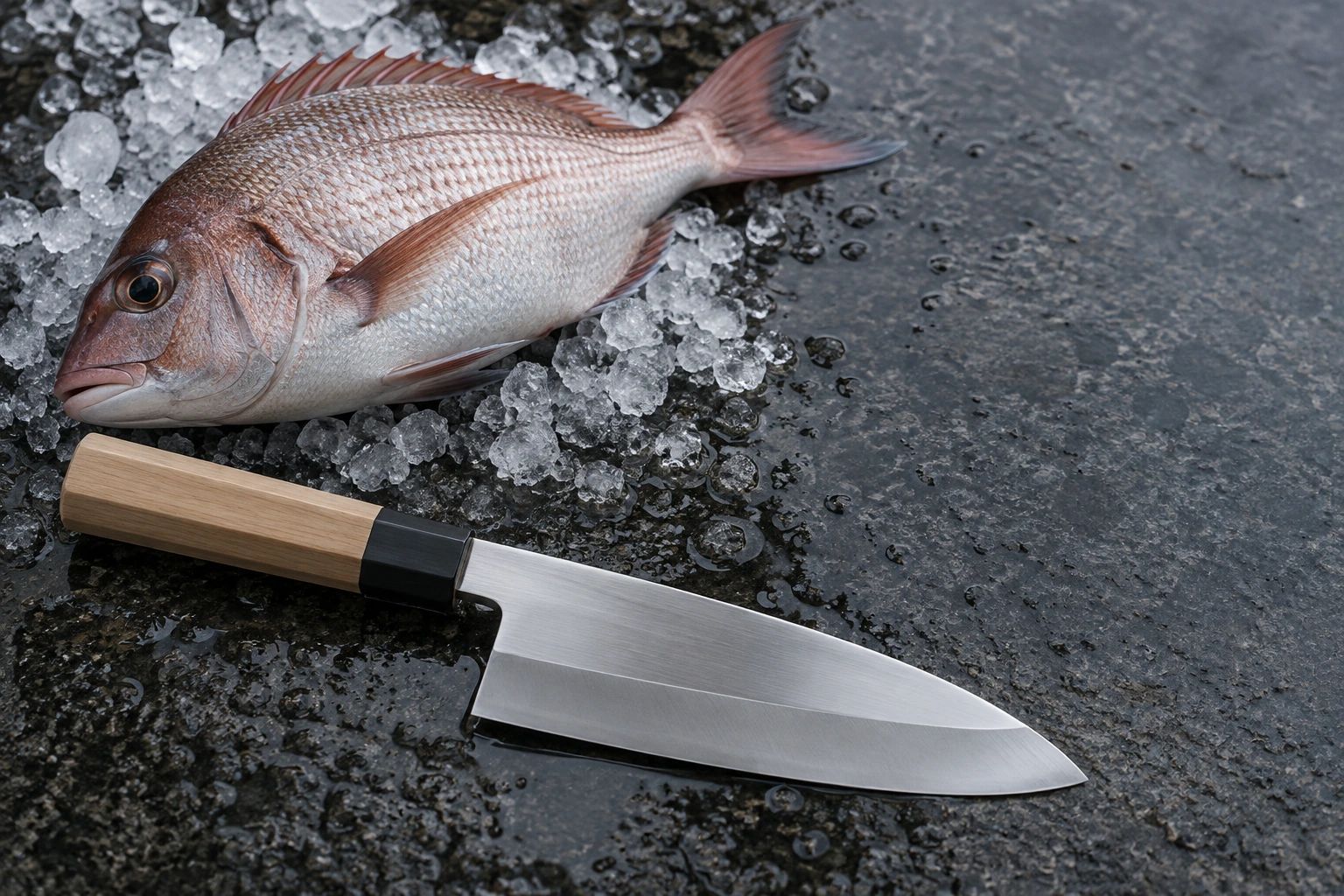
Table of Contents
The deba (出刃包丁) is Japan's dedicated fish butchery knife — a heavy, single-beveled blade designed to break down whole fish with precision. Unlike thin slicing knives, the deba's thick spine can power through fish heads and small bones, while its razor-sharp single bevel produces clean fillets.
What Is a Deba Knife?
Our editorial team consulted with sushi chefs at specialist shops in Kappabashi to understand how professionals select and maintain their deba knives. The guidance in this article reflects their decades of experience breaking down fish daily, combined with our own hands-on testing of deba knives across multiple price ranges.
The deba originated in Sakai, Osaka during the Edo period (1600s) and remains essential in every Japanese fish market and sushi restaurant. Its key characteristics:
- Single bevel — sharpened on one side for extreme precision
- Thick spine — 5-8mm at the heel, tapering to a thin tip
- Heavy weight — 200-350g, using momentum for clean cuts through bone
- Wide heel — for pushing through fish heads and joints
- Pointed tip — for precision filleting work along the backbone
Types of Deba
| Type | Size | Use |
|---|---|---|
| Hon-deba (本出刃) | 150-210mm | Standard deba — all fish butchery tasks |
| Ko-deba (小出刃) | 100-135mm | Small deba — small fish, home kitchens |
| Mioroshi-deba (身卸出刃) | 180-270mm | Thinner deba — filleting + slicing in one knife |
| Ai-deba (相出刃) | 150-210mm | Medium-weight deba — compromise between hon and mioroshi |
Size Guide
| Size | Best For |
|---|---|
| 105-120mm | Small fish (sardines, horse mackerel), home kitchen detail work |
| 150-165mm | Most home cooks — medium fish (sea bream, mackerel) |
| 180-210mm | Professional — large fish (salmon, yellowtail, snapper) |
Deba Size Selection by Fish Type
Choosing the right deba size for the fish you work with most is critical for both efficiency and safety:
| Fish Type | Examples | Recommended Deba Size |
|---|---|---|
| Small fish | Sardines (iwashi), horse mackerel (aji), smelt (wakasagi) | 105-120mm (ko-deba) |
| Medium fish | Sea bream (tai), mackerel (saba), trout (masu) | 150-165mm (standard hon-deba) |
| Large fish | Salmon (sake), yellowtail (buri), snapper (madai) | 180mm (large hon-deba) |
| Very large fish | Tuna (maguro), swordfish (kajiki), large yellowtail | 210mm+ (professional hon-deba) |
Tip: If you only buy one deba for home use, 150mm is the most versatile size. It can handle small-to-medium fish comfortably and can manage larger fish with a bit more effort.
Complete Fish Butchery Workflow
Here is the complete 6-step process for breaking down a whole fish with a deba, as demonstrated by our Kappabashi partner chefs:
- Scale (uroko-tori) — Hold the fish firmly by the tail. Using the spine of the deba (not the edge), scrape from tail to head to remove scales. Work under running water or inside a plastic bag to contain flying scales. Rinse the fish thoroughly.
- Gut (harawata-nuki) — Insert the tip of the deba into the belly opening near the anal fin. Cut forward toward the head with a shallow, controlled stroke, being careful not to puncture the intestines. Remove all innards, rinse the cavity, and scrape away any remaining blood lines along the spine using the tip.
- Remove the head (atama-otoshi) — Place the deba behind the gill plate at an angle, cutting down toward the head. Flip the fish and repeat on the other side. Use the heel of the deba to cut through the spine in one firm, decisive stroke. Save the head for stock (ara) if desired.
- Fillet (sanmai-oroshi / 3-piece breakdown) — Starting from the belly side, insert the tip along the backbone and use long, smooth strokes to separate the fillet. The single bevel guides the blade along the bone structure, minimizing waste. Flip and repeat for the second fillet. You now have 3 pieces: 2 fillets and the bone frame.
- Skin (kawa-hiki) — Place the fillet skin-side down. Starting from the tail end, grip the skin firmly and angle the blade slightly downward, sliding it between the flesh and skin with a sawing motion. (Note: for some preparations like sashimi, a yanagiba is preferred for this step.)
- Portion (kiri-tsuke) — Cut the skinned fillet into portions appropriate for your dish. For sashimi, switch to a yanagiba for clean, single-stroke cuts. For grilling or frying, the deba can handle portioning directly.
How to Use a Deba
- Remove the head — place the deba behind the gill plate, use the heel to cut through the spine in one firm stroke
- Gut the fish — use the tip to open the belly cavity
- Fillet — run the tip along the backbone, using the single bevel to guide the blade along the bone structure
- Remove rib bones — angle the blade under the rib bones and slice them away from the fillet
Important: Never use a deba for rock-chopping, lateral prying, or cutting through large bones. The hard carbon steel can chip if misused.
Carbon vs Stainless Deba
The choice between carbon and stainless steel for a deba is more consequential than for other knife types, because the deba works in a particularly hostile environment — constant contact with fish blood, salt water, and acidic flesh that accelerate corrosion.
Carbon steel (Shirogami White #2 or Aogami Blue #2) is the traditional and professional choice. It takes a sharper edge, is easier to sharpen on a whetstone, and provides better "bite" when cutting through fish skin and small bones. However, carbon steel rusts rapidly when exposed to fish moisture and requires immediate cleaning and drying after every use. Professional sushi chefs overwhelmingly prefer carbon steel because they maintain their knives throughout each service.
Stainless steel (VG-10 or Ginsan/Silver #3) is more practical for home cooks who process fish less frequently. It won't rust if left wet for a few minutes, requires less diligent maintenance, and still delivers good sharpness. The tradeoff is that stainless debas are slightly harder to sharpen and may not achieve the same ultimate keenness as carbon.
Our recommendation: If you break down fish weekly or more, choose carbon steel (White #2 for maximum sharpness, Blue #2 for better edge retention). If you fillet fish occasionally (monthly or less), stainless steel saves you maintenance headaches without sacrificing much performance.
Steel & Maintenance
Traditional debas use carbon steel (Shirogami White #2 or Aogami Blue #2) for maximum sharpness. Key maintenance:
- Wipe dry immediately after each use — carbon steel rusts within minutes
- Apply camellia oil (tsubaki) before storage
- Sharpen the flat side (ura) very carefully — single-bevel knives require specific technique
- Remove fish smell — wash with baking soda paste
Our Recommendations
Best Budget: Tojiro White Steel Deba (165mm) — ~$70
Shirogami #2 core. Excellent sharpness and easy to maintain. The best entry point into traditional single-bevel Japanese knives.
Best Mid-Range: Sakai Takayuki Kasumitogi Deba (165mm) — ~$120
White #2 steel, traditional kasumi (mist) finish. Made in Sakai — the birthplace of deba knives. Beautiful and functional.
Best Premium: Masamoto KS Hon-Deba (180mm) — ~$250
White #1 steel, hand-forged in Tokyo. The standard in top sushi restaurants across Japan. A lifetime investment.