Honesuki Knife: The Japanese Boning Knife, Explained (2026)
QUICK ANSWER
Honesuki (骨スキ) is a Japanese boning knife specialized for poultry — triangular blade, 145-180mm, single or double bevel.
Length
145-180mm
Bevel
Single (maru) or Double (kaku)
Best for
Chicken/duck breakdown
Avoid
Beef bones
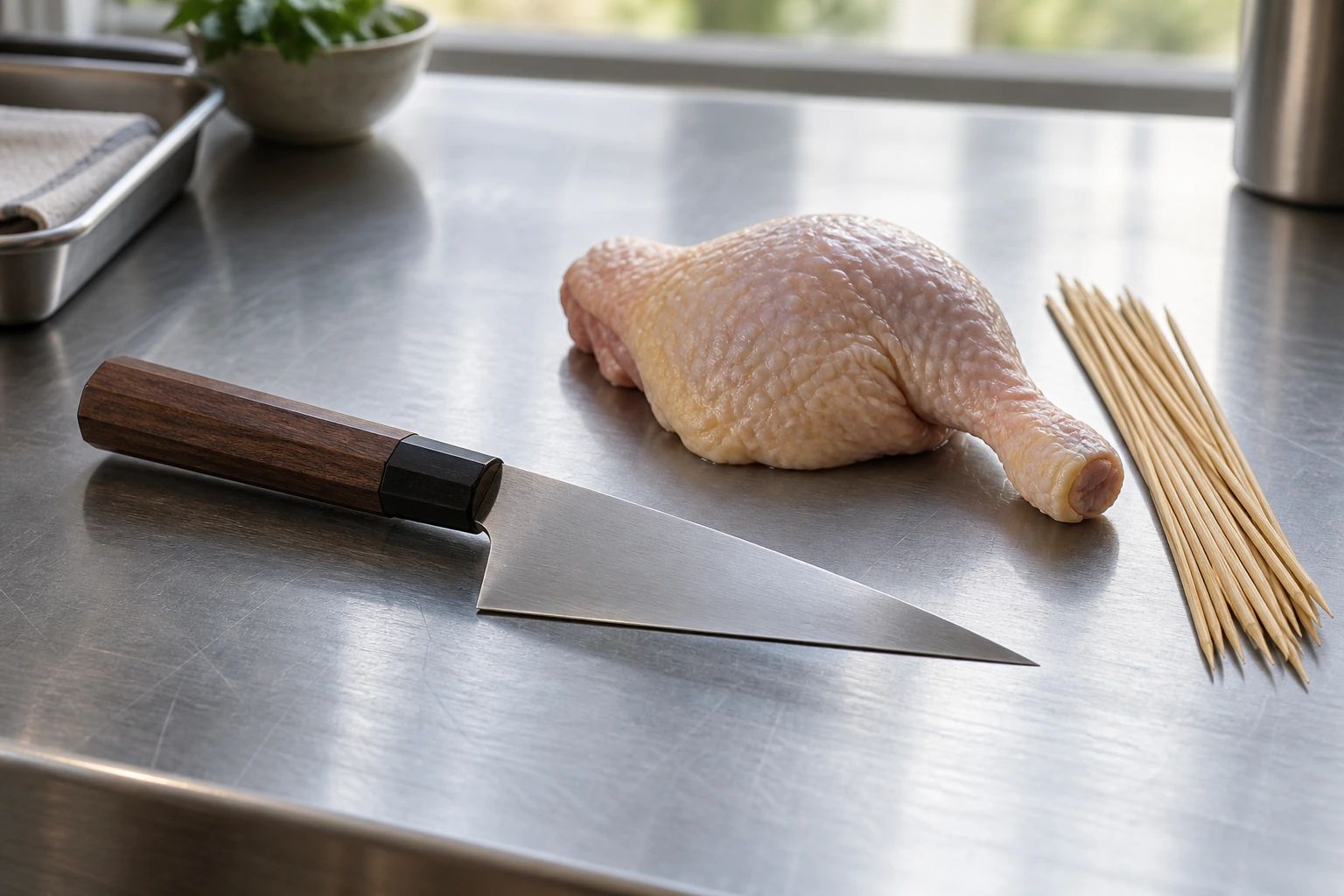
Table of Contents
Honesuki (骨スキ) is the Japanese boning knife specialized for poultry — chickens, ducks, quails. Unlike Western boning knives, which rely on a flexible curved blade to flex around fish bones and trim meat, the honesuki is a rigid, triangular knife built for one job: precise joint articulation on birds. It is not a general-purpose knife, and it is not a fish knife. Once you understand what it is for, it becomes the single most useful tool in your kitchen for breaking down whole poultry.
This guide covers blade geometry, the single-bevel vs double-bevel decision, sizing, technique, how it stacks up against Western boning knives, and where to buy in 2026. It draws on field handling of dozens of honesuki blades at Kappabashi (Tokyo's wholesale knife district) and Sakai workshops.
TL;DR
- Blade shape: triangular point, ~145–180mm, rigid (not flexible)
- Bevel: traditionally single-bevel (honesuki-maru), modern double-bevel versions (honesuki kaku) exist
- Steel: typically VG10, white #2 carbon, AUS-10, or stainless-clad with SG2/R2 core
- Use case: poultry breakdown — separating joints, removing breast, deboning legs and thighs
- NOT for: large bones (beef femurs, pork hips — use a Western cleaver or heavy deba) or fish filleting (use a flexible Western boning or sujihiki)
- Pro vs home: Japanese yakitori chefs prefer single-bevel honesuki-maru for precision; home cooks usually pick double-bevel kaku for easier sharpening and ambidextrous use
- Buy first: 150mm honesuki kaku, VG10 stainless, ¥10,000–18,000 — covers 95% of home scenarios
What is honesuki?
The name honesuki (骨スキ) is literal: hone (骨) means bone, suki (スキ, from 剝く / 透く) means to remove or to pry away. It is the bone-removing knife. The Japanese poultry industry developed it for one specific reason: yakitori. A skilled yakitori chef breaks a whole chicken into 10+ distinct cuts — breast, tenderloin, thigh, drumstick, wings, oysters, tails, skin, cartilage — and the honesuki is the tool that makes that breakdown clean and fast.
The triangular shape is intentional and tells you exactly how to hold it. The heel (the deepest part of the blade) is for articulating joints — you slide it into the gap between bones, then twist or pull to separate. The pointed tip is for precise cuts: tracing the keel bone to release the breast, hooking under tendons, or peeling thigh meat off the bone.
Honesuki is sometimes confused with related boning knives — sabaki, garasuki, and the Western boning knife. They are all related, but each has a distinct job:
- Honesuki: small-to-medium poultry (chicken, duck, quail), 145–180mm
- Garasuki: larger poultry and bigger animals, 180–230mm — a bigger, heavier honesuki
- Sabaki: fish-focused boning, single-bevel, slightly different geometry
- Western boning: flexible curved blade, designed for fish filleting and trimming soft meat
Honesuki vs Western boning knife
The most common mistake new Japanese-knife buyers make is assuming the honesuki replaces their Western boning knife. It doesn't — they are built for opposite tasks.
| Spec | Honesuki (Japanese) | Western boning knife |
|---|---|---|
| Blade length | 145–180mm | 130–150mm |
| Flexibility | Rigid | Flexible to semi-flex |
| Profile | Triangular, pointed tip | Curved, narrow tapered tip |
| Bevel | Single (maru) or double (kaku) | Double, symmetric |
| Steel hardness | HRC 60–63 (hard) | HRC 54–58 (softer) |
| Primary technique | Pull-cut, joint articulation | Flex-and-curve, fillet |
| Best for | Poultry breakdown, yakitori cuts | Fish filleting, trimming, soft meat |
| Bone contact | Tolerates light bone (cartilage, joints) | Avoids bone — flexes around it |
The decision rule: if you primarily break down whole chickens, ducks, or do yakitori-style cuts, the honesuki is the better tool by a wide margin. If you primarily fillet fish, trim silver skin, or work with delicate flexible cuts, the Western boning knife is correct. Many serious home cooks own both. They do not overlap.
Single-bevel (maru) vs double-bevel (kaku) honesuki
Modern honesuki come in two grinds, and which one you pick should be the first decision in your purchase — not the steel, not the brand, not the size.
Honesuki-maru (丸): single-bevel, traditional
Maru means "round" and refers to the rounded heel of the traditional shape. The grind is single-bevel: the cutting edge is on one side only, with the back left flat (with a slight ura hollow). It is asymmetric and chiral — right-handed and left-handed versions exist as separate knives.
- Pros: razor-sharp precision, the asymmetric grind articulates around bones with minimal force, and the rigid back acts as a guide against bone
- Cons: chiral (right- or left-hand only), harder to sharpen (requires kasumi/ura technique), takes weeks to learn the steering
- Buy if: you are a yakitori chef, butcher, or serious home enthusiast willing to invest in single-bevel sharpening
Honesuki kaku (角): double-bevel, modern
Kaku means "square" and refers to the sharper-angled heel of the modern shape. The grind is double-bevel: the cutting edge is symmetric, like a Western knife.
- Pros: ambidextrous, sharpens with standard whetstone technique, easier learning curve, more forgiving on accidental bone contact
- Cons: slightly less precise on professional yakitori cuts (90% of the maru, not 100%)
- Buy if: you are a home cook, first-time honesuki buyer, or you sharpen your own knives but haven't mastered single-bevel
Our editorial recommendation: home cook → kaku; sushi or yakitori professional → maru. If you don't know which you are, you are a home cook. Get the kaku.
For a deeper dive on the bevel choice across all Japanese knives, see our single-bevel vs double-bevel guide.
Sizes and steel options
Size guide
| Size | Best use | Skill level |
|---|---|---|
| 145mm | Precision work on small birds (quail, poussin), small hands | Any |
| 150mm | Standard, most popular — whole chickens, ducks, the default home choice | Any |
| 165mm | Larger birds (large duck, goose), beef short ribs, bigger hands | Intermediate+ |
| 180mm | Rare, professional only — high-volume yakitori or larger poultry | Advanced |
Steel options
- VG10 — the modern hard stainless default. HRC 60–62. Great edge retention, easy to live with, the best all-around home choice. Found in Tojiro DP, MAC, Misono UX10.
- White #2 (shirogami #2) — pure carbon steel. HRC 62–64. Takes the sharpest edge of any common honesuki steel. Rusts within minutes if not wiped — choose only if you wipe-and-dry after every use.
- AUS-10 — close to VG10 with slightly easier sharpening. HRC 59–61. Common in mid-range honesuki around ¥10,000.
- SG2 / R2 (powdered high-speed) — premium stainless. HRC 63–64. Edge retention beats VG10, low maintenance. Common in premium honesuki kaku (¥25,000+).
- ZDP-189 — ultra-hard powdered steel. HRC 66–68. Edge retention is the longest of any common steel, but chips if you contact hard bone. Premium-only.
How to use a honesuki (technique)
The honesuki's golden rule: never force the blade through bone. Articulate around joints. Feel the gap, slide in, twist. If you are using force, you are using the wrong tool or the wrong angle.
- Joint articulation: Place the bird breast-up. Pull the leg away from the body. Feel for the ball-and-socket gap with the tip. Slide the point in, tilt the handle down, and the joint pops apart with almost no force.
- Breast removal: Find the wishbone with the tip. Trace one side of the keel bone (sternum) downward, keeping the tip in light contact with the bone. The breast peels off as a clean lobe.
- Wing removal: Locate the shoulder joint by flexing the wing. Cut tendons on top, articulate the joint with the tip, and lift off.
- Deboning thigh: Cut along the bone with the tip from one end. Peel the meat back. Use the heel to nick the joint ends and free the bone cleanly.
- Skin and tendon work: Use the tip for tendons, the belly of the edge for skin. Always pull-cut — push-cutting flexes the blade and dulls it faster.
Hold the knife in a pinch grip: thumb and forefinger on the blade just above the heel, remaining fingers wrapped around the handle. This gives you maximum control over the tip, which is where 80% of honesuki work happens.
Honesuki family comparison
| Type | Length | Bevel | Best for | Skill level |
|---|---|---|---|---|
| Honesuki-maru | 145–180mm | Single | Yakitori, pro precision poultry | Advanced |
| Honesuki kaku | 145–180mm | Double | Home poultry prep | Beginner+ |
| Garasuki | 180–230mm | Single or double | Larger birds, ducks, butcher work | Advanced |
| Western boning | 130–150mm | Double, flexible | Fish filleting, soft meat trim | Beginner |
| Sabaki | 150–180mm | Single | Fish breakdown, alternative to deba | Advanced |
Care, sharpening, storage
- Wipe immediately after use — particularly critical for carbon-steel honesuki (white #2, blue #2). Even VG10 stainless benefits from prompt drying because chicken fat and saline residues can stain the cladding.
- Hand-wash only — never the dishwasher. High heat and detergent will damage the edge and the handle.
- Sharpening: use #1000 medium stone for the primary bevel, #3000–#6000 for the finish. For honesuki-maru, maintain the ura (back hollow) with one or two flat strokes — never tilt the back. Detail in our sharpening guide.
- Cutting board: use wood or end-grain only. Hard cutting boards (glass, ceramic, bamboo composite) chip the hard edge in a single session.
- Storage: magnetic strip, saya (wood sheath), or knife block. Never loose in a drawer.
- Bone contact: contact is inevitable when breaking down poultry, but minimize it. The honesuki tolerates cartilage and joint ends, not hard bone shafts. If you feel resistance, reposition rather than push.
Where to buy & price ranges
- Entry (¥6,000–12,000): Tojiro DP honesuki kaku, MAC entry — solid VG10, double-bevel, the right place to start
- Mid (¥12,000–25,000): Misono UX10 honesuki, Sakai-made double-bevel kaku, Tojiro Shirogami carbon — meaningful step up in fit, finish, and steel quality
- Premium (¥25,000+): custom Sakai single-bevel maru, Echizen masters (Takefu), SG2/R2 powdered steel models — for serious enthusiasts or professionals
For the in-person experience, Tokyo's Kappabashi district is the place to handle multiple grinds and brands side by side. For online context across the broader Japanese knife market, see our 2026 best Japanese knives ranking.