Hocho vs Honyaki: Laminated and Monolithic Japanese Knives Compared (2026)
QUICK ANSWER
Hocho (包丁) is the generic word for any Japanese knife; honyaki (本焼) is a premium construction style — a single forged piece of high-carbon steel, no soft cladding.
Hocho
Generic term
Honyaki
Mono-steel construction
Cladding
None on honyaki
Price
Honyaki $1,000+
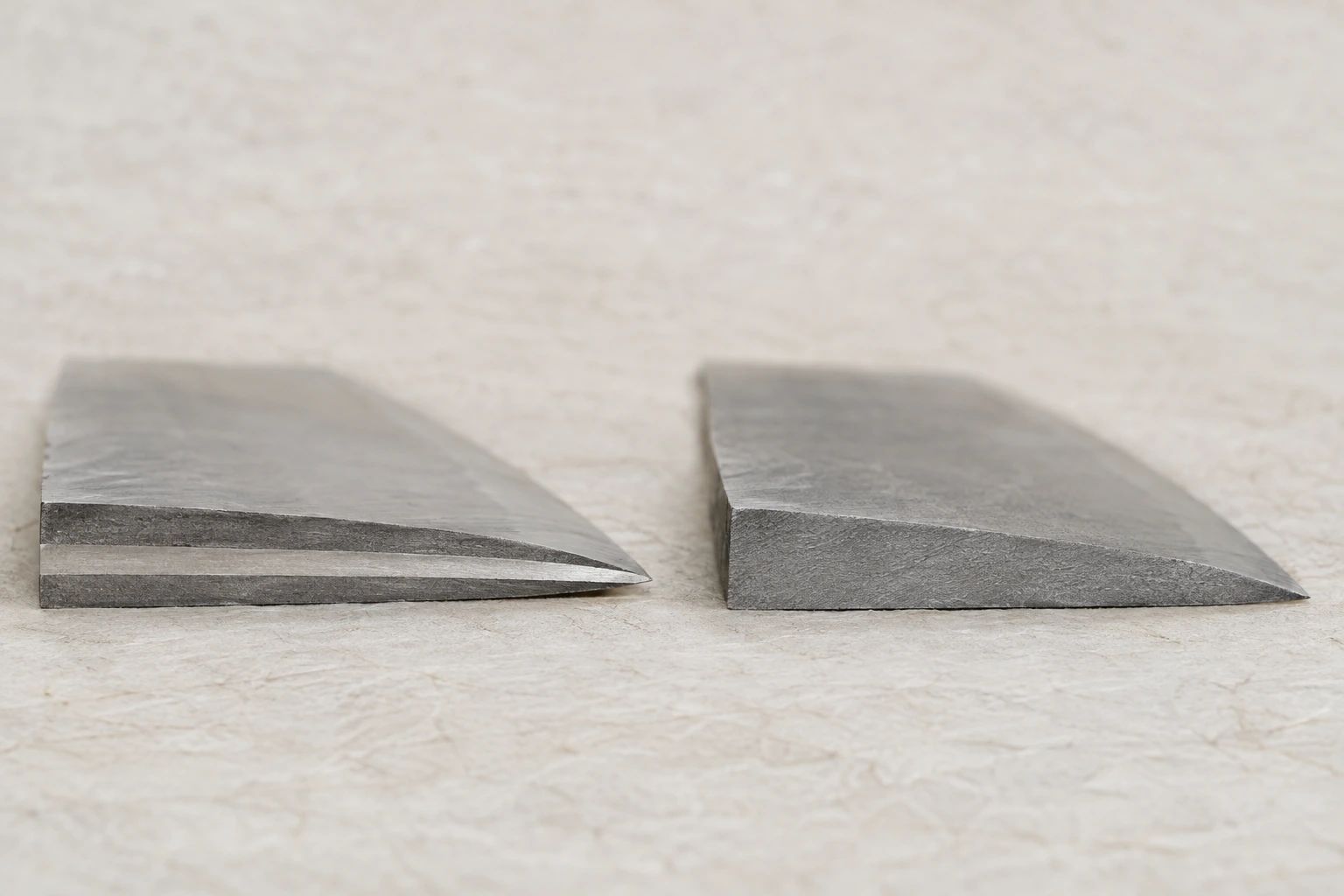
Table of Contents
Hocho vs Honyaki at a Glance
"Hocho versus honyaki" is a slightly misleading framing — every honyaki is a hocho — but it is also the most common question shoppers ask once they realize Japanese knives come in two fundamentally different constructions. A standard hocho is built like a sandwich: a hard cutting core wrapped in softer iron cladding (san-mai or warikomi). A honyaki is forged from one piece of high-carbon steel and selectively hardened with clay coating, the way katana have been made for centuries. The two approaches solve the same problem — putting a hard, sharp edge into a working blade — by completely different routes.
This guide covers the construction difference, the heat treatment that defines honyaki, real performance gaps in the kitchen, how to identify each on sight, current prices, and whether anyone outside a professional sushi or kaiseki line actually needs a honyaki. For broader background on Japanese knife profiles see our types of Japanese knives guide, and for the steel side of the story see Japanese knife steels explained.
Complete Comparison Table
The table below summarizes how laminated hocho and monolithic honyaki differ across every dimension that matters in use.
| Aspect | Hocho (laminated) | Honyaki (monolithic) |
|---|---|---|
| Construction | 3-layer or 5-layer cladding (san-mai / warikomi) | Single piece of high-carbon steel |
| Typical core steel | Shirogami, Aogami, VG-10, SG2 | Shirogami #1 (most common) |
| Cladding | Soft iron (Fe + ~0.05% C) or stainless | None |
| Heat treatment | Standard quench and temper | Clay-coated yaki-ire with selective hardening |
| Edge retention | Excellent | Best-in-class — roughly 2x in pro use |
| Sharpening difficulty | Standard — soft cladding forgives angle errors | Demanding — requires master technique |
| Failure rate during forging | Under 5% | 30 to 50% crack during yaki-ire |
| Repair if chipped | Possible — re-expose core | Often unrepairable on serious chips |
| Active makers in Japan | Hundreds across Sakai, Seki, Echizen, Tsubame-Sanjo | Roughly 30 to 50 capable of top-tier work |
| Visual signature | Kasumi (mist line) where core meets cladding | Hamon (wavy temper line) along the edge |
| Entry price | Around ¥5,000 | Around ¥80,000 |
| Top of market | About ¥150,000 | ¥1,500,000 and above |
| Best for | All users, all skill levels | Pro sushi / kaiseki, serious collectors |
Construction: San-mai Lamination vs Monolithic Forging
The standard Japanese kitchen knife is a san-mai (三枚, three-piece) laminate. A thin strip of hard cutting steel — Shirogami, Aogami, VG-10, SG2, or similar — is forge-welded between two slabs of soft iron at roughly 0.05 percent carbon. The laminate is then drawn out, ground, and finished. The hard core sits at the edge and does the cutting; the soft jacket gives the blade lateral toughness, makes sharpening forgiving, and dramatically reduces the chance of catastrophic failure during heat treatment. Five-layer and warikomi (insert) variations follow the same logic.
A honyaki (本焼, "true forged") blade has no jacket. The entire knife — edge to spine, heel to tip — is one piece of high-carbon steel, almost always Shirogami #1 (white paper steel). The smith forges out a billet, profiles it, and then performs the operation that defines the category: selective hardening. A thin clay layer is painted along the edge, a thicker insulating clay coat covers the spine, and the blade is heated to critical temperature and quenched. The edge cools fast and transforms to martensite at HRC 64 to 67; the spine, protected by clay, cools slowly and stays at a much softer pearlitic structure around HRC 35 to 45. One blade, two hardnesses, no welds.
This is why a san-mai blade with the same core steel as a honyaki feels different on the stone, holds the edge differently, and breaks differently when abused. The construction is not a finishing detail — it is the knife.
Heat Treatment and the Yaki-ire Moment
Yaki-ire (焼入れ) is the quench. For a san-mai blade it is a controlled, well-understood operation that almost always succeeds because the soft cladding absorbs the thermal stress and the hard core is thin. For a honyaki it is the moment the smith finds out whether weeks of work survive or fall into the bucket.
Honyaki yaki-ire is performed with a clay coat (tsuchi-oki, 土置き) applied by hand. The smith chooses where the hardening line will fall by where the clay is thin. The blade is brought to a precise temperature judged largely by color in dim light — a standard around 780 to 830°C for Shirogami — then plunged into water. The thermal shock is what creates the hamon, and it is also what causes the failures: a misjudged temperature, a cold spot in the water, an internal stress invisible to the eye, and the entire blade cracks audibly in the bucket. Across the most respected Sakai forges, 30 to 50 percent of honyaki blanks fail at this step. The smith absorbs every loss.
Mizuyaki (water-quenched) honyaki are the most demanding and most prized; aburayaki (oil-quenched) honyaki are slightly more forgiving but considered a step down by purists. The Sakai Takayuki Honyaki Mizuyaki Aogami line is one of the few honyaki series that uses Aogami rather than Shirogami, and it is treated as its own category for that reason.
Performance: Edge, Feel, and Sharpening
Edge retention. In professional use — a sushi-ya cutting through several kilos of fish in a service — a honyaki yanagiba typically holds its edge roughly twice as long as a laminated yanagiba in comparable steel. The mechanism is straightforward: the entire blade body resists the small deformations that take the apex out of true, not just the core. For a home cook making sashimi once a week, this gap is mostly invisible.
Cutting feel. Honyaki users describe the blade as "alive" — a harder, more direct transmission of what the edge is doing into the hand. The lack of soft cladding means there is no slight give as the knife enters product. Whether this is an advantage depends on the cook. Some pros prefer the muted feel of a laminated blade; others find honyaki essential for the long, single-pull cut of yanagiba sashimi work.
Sharpening. This is where honyaki separates from hocho most dramatically. On a san-mai blade, when your angle wanders by a degree or two the soft cladding gives way and the core is gently corrected. On a honyaki, the steel is uniformly hard, so an angle wobble grinds an actual flat at the wrong angle and the next pass has to chase it. Producing a clean, even bevel on a honyaki is a skill that traditionally takes years. Most owners outside Japan rely on a togi-shi for at least major resharpening — see our sharpening guide and maintenance guide for the full picture.
How to Spot a Honyaki: Hamon vs Kasumi
Both constructions leave a visible line along the blade, and learning to read them is the fastest way to identify what you are looking at.
A laminated hocho shows a kasumi (霞, "mist") line — a soft, hazy boundary running roughly parallel to the edge where the polished core steel meets the matte iron cladding. The line is straight or gently curved, follows the geometry of the lamination, and the area above it has a distinctly cloudier finish than the area below. Kasumi is a construction artifact. Every san-mai blade has one if you polish it correctly.
A honyaki shows a hamon (刃文, "blade pattern") — a wavy, whitish line that runs along the hardened edge and has the same character as the temper line on a katana. Hamon are not parallel to anything; they wander and pulse along the edge in ways that reflect where the smith laid the clay and how the quench actually proceeded. A bold, irregular, clearly defined hamon is the visual fingerprint of a successful honyaki.
Side by side, the difference is unmistakable: kasumi is a clean line between two zones of finish; hamon is a single line of crystallographic transition floating in one continuous body of steel.
Price Reality and Active Makers
Hocho span an enormous range. A capable Tsubame-Sanjo factory gyuto in VG-10 starts around ¥5,000. A hand-forged Sakai Aogami yanagiba from a respected smith lands at ¥30,000 to ¥80,000. A premium laminated blade from a top maker — Konosuke, Yoshikazu Ikeda, top-tier Sakai — runs to roughly ¥150,000. That is the ceiling of normal hocho economics.
Honyaki start where premium hocho end. Entry honyaki sit around ¥80,000 — a smaller blade from a working but less famous smith. Mid-tier honyaki from established names move into the ¥200,000 to ¥500,000 range. The top of the market — current-generation pieces from Sukenari, Konosuke Honyaki, Shigefusa, Sakai Takayuki Honyaki Mizuyaki Aogami, named individual smiths working in Sakai and Echizen — pushes past ¥1,500,000 for full-length yanagiba and special commissions.
The active honyaki community in Japan is small. Japan has hundreds of bladesmiths producing laminated kitchen knives at a high level; the number capable of producing top-shelf honyaki is on the order of 30 to 50. This is not a marketing scarcity — it reflects the failure rate at the fire and the apprenticeship time required to keep that rate down. For more on where these knives are forged see our Osaka and Sakai map guide and Seki guide.
Who Actually Needs a Honyaki
Three groups of people are well-served by honyaki, and the rest are not.
Professional sushi and kaiseki chefs handling 5 to 30 kg of fish per service. The case here is straightforward: edge stability across a long service is the constraint, and the honyaki yanagiba's roughly 2x retention compounds across hours. This is the use case the construction was developed for.
Traditional craft practitioners. Master cooks running formal kappo and ryotei kitchens treat the honyaki as part of the practice — its provenance, its responsibility, the relationship with the smith who made it. The performance gap is real, but the cultural and craft argument carries equal weight.
Collectors. Honyaki are objects in their own right. A piece with a defined hamon from a named smith holds value, can be appreciated as a fine object, and rewards careful ownership. Collecting is a legitimate reason to own one; pretending otherwise tends to lead to disappointed home cooks.
For everyone else — including very serious home cooks — a high-quality laminated knife in the right profile (a 240 mm yanagiba for fish, a 240 mm deba for breakdown, a 240 mm kiritsuke as an all-rounder) is the answer. Direct the price difference into a stone setup, a proper end-grain board, and instruction. See our editor-tested picks at best Japanese knives 2026 and brand notes at best Japanese knife brands.
The honest verdict: honyaki is the high end of a craft tradition that rewards exactly the people whose work justifies it. For everyone else, it is a beautiful object that does not perform meaningfully better than a third of the price spent on a great san-mai blade.