How to Store Japanese Knives: Block, Magnetic Strip, Drawer, and Saya Compared
QUICK ANSWER
Best storage: magnetic strip (visible, air-dried) or saya wood sheath (travel-safe); avoid knife blocks (trap moisture) and drawer storage (chips the edge).
Best
Magnetic strip
Travel
Saya sheath
Avoid
Knife block, drawer
Reason
Moisture + chips
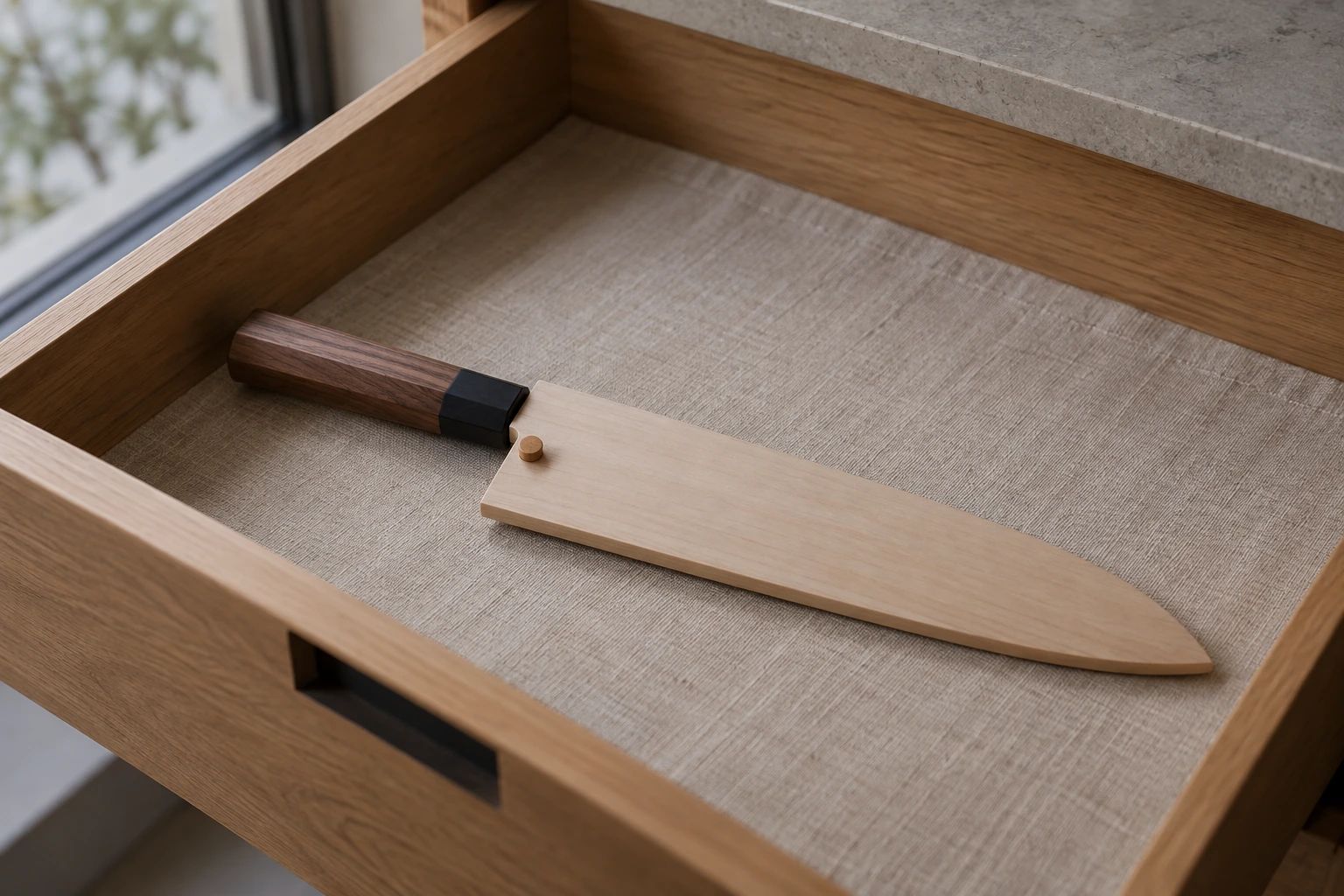
Table of Contents
TL;DR
Knife storage's job is to protect the edge and the handle. The best options are a wooden block or a magnetic strip. Drawer storage requires a saya — bare blades dropped in a drawer chip on contact.
- Magnetic strip = best visibility, no edge contact, easy to clean.
- Wooden block = good aesthetics, watch for dust accumulation.
- Drawer storage needs a saya — bare blades chip.
- Carbon steel needs airflow plus a saya; closed plastic traps moisture.
- Avoid glass and ceramic plates — they dull the edge fast.
Most people choose knife storage based on what looks good on the counter. Cooks who keep their edges sharp choose based on three things: does it protect the edge from contact damage, does it keep the blade dry, and does it stay clean enough to handle food. Get those three right and your knives stay sharp twice as long.
This guide compares the four main storage systems used in Japanese kitchens — knife block, magnetic strip, drawer with edge guards, and the traditional saya — plus the special humidity rules that apply to carbon steel.
Why storage matters more than people think
After the cutting board, storage is the second-biggest factor in how long a Japanese knife stays sharp. A knife that is sharpened to perfection and then dropped into a cluttered drawer can lose its edge in a single week. The damage comes from four distinct mechanisms:
- Edge contact damage — the cutting edge touches another hard object (another knife, a metal utensil, the side of a slot) and develops microchips invisible to the eye but very visible at the cutting board.
- Corrosion — moisture trapped against the blade causes rust spots, surface pitting, or galvanic-style staining where dissimilar metals touch.
- Handle damage — wooden wa-handles warp, crack, or develop hairline splits in dry environments or near heat sources.
- Cross-contamination and household accidents — knives loose in a drawer are a hand-injury risk and a food-safety risk.
Each of these problems has a clean solution, and the best storage system is the one that solves all four for your specific kitchen.
The four storage options at a glance
Before drilling into each system, here is the comparison matrix our editors use when advising new buyers:
| Method | Edge protection | Convenience | Hygiene | Carbon-steel-OK | Price |
|---|---|---|---|---|---|
| Knife block | Medium | Excellent | Poor (dust traps) | Use caution | ¥5,000–25,000 |
| Magnetic strip | High (technique-dependent) | Excellent | Excellent | OK | ¥3,000–15,000 |
| Drawer with edge guards | High | Good | Good | OK with sheath | ¥1,000–5,000 |
| Saya (per blade) | Highest | Lower (open/close) | Excellent | Best | ¥3,000–15,000 each |
| Knife roll | Highest (transit) | Poor at home | Good | OK | ¥5,000–30,000 |
There is no single winner. A serious home cook with five knives and a humid summer climate will lean toward magnetic strip plus saya for the carbon piece. A studio apartment with two knives and no wall space will lean toward drawer plus edge guards. Match the system to the kitchen.
Knife block: convenient but dusty
The knife block is the most familiar Western storage system: a heavy wood block with vertical or angled slots, kept on the countertop. It fits 6–12 knives, looks tidy, and gets the knives off the counter and out of drawers. Pros: instant access, knives are individually separated, classic kitchen aesthetic. Cons: dust and crumbs fall into the slots, the slot walls rub the blade with every insertion, and a humid block can hold moisture against the blade.
If you use a block, build three habits:
- Invert weekly — flip the block over the bin to dump out dust and debris.
- Wash the slots quarterly — most blocks have removable inserts; warm soapy water and a bottle brush, then dry thoroughly before reinserting.
- Insert dry, not wet — if the blade is even slightly damp, water gets locked into the slot and stays there.
Premium blocks from Wusthof, Henckels Pro, and Shun are well-built and many offer angled slots that contact the spine rather than the edge. Universal blocks with bristles instead of slots (the Kapoosh-style design) avoid edge contact entirely and are easier to clean — a worthwhile upgrade if you must use a block.
Magnetic strip: visible, ergonomic, technique-dependent
The magnetic strip is the workhorse of professional Japanese kitchens and a favourite of serious home cooks. A wall-mounted bar holds knives by their blade, leaving the entire knife visible and dust-free. Pros: excellent visibility, no dust accumulation, knives air-dry naturally between uses, easy to add or remove knives without disturbing others. Cons: requires wall space and a careful pickup technique, and the strip itself can scratch a polished blade if mishandled.
The technique matters. To place a knife on the strip, lift the spine to the bar first and roll the edge in — never let the cutting edge contact the magnet. To remove, do the reverse: rock the spine off first and let the edge swing away last. A few weeks of practice and it becomes automatic.
Material choice matters too. Hardwood-faced magnetic bars (Asahi natural oak or walnut, ¥8,000–15,000) are far gentler on the blade than bare ferrous metal strips. The wood face also looks better in a residential kitchen. Avoid the magnetic strips with grooves that align with the blade spine — they are intended for thicker Western knives and the spine of a Japanese gyuto can sit awkwardly in them.
Saya: the traditional Japanese wooden sheath
The saya (鞘) is the traditional Japanese knife sheath: a custom-fitted wooden cover, typically magnolia (ho-no-ki) or paulownia. The wood is selected for three reasons — it is light, mildly antibacterial, and it absorbs and releases moisture in a way that protects the blade. A premium honyaki yanagiba is sold with a saya as standard, and that saya is part of the knife.
Key facts about saya:
- Custom-fitted to one specific blade — a saya from a 240mm gyuto will not fit a 270mm.
- Usually held closed with a small bamboo pin; some are friction-fit.
- Magnolia and ho-wood are slightly porous, allowing the blade to ventilate rather than trapping humidity like plastic does.
- Required for safe storage of single-bevel knives — the asymmetric grind of a yanagiba or deba needs the saya to protect the edge from contact damage.
- Available aftermarket from ¥3,000 for a basic factory saya up to ¥15,000+ for a hand-fitted custom piece.
For carbon-steel single-bevel knives, the saya is non-negotiable. For everyday double-bevel home knives, it is a useful upgrade if you are forced to use drawer storage, and a beautiful presentation piece for prized knives even on a magnetic strip.
Carbon steel: humidity is the real enemy
Carbon-steel Japanese knives — white paper steel (shirogami), blue paper steel (aogami), and traditional honyaki — are dramatically less rust-tolerant than stainless. They demand a stricter storage discipline:
- Bone-dry before storage — carbon steel can develop a rust spot in fifteen minutes if stored damp.
- Camellia (tsubaki) oil before long storage — a thin film applied with a clean cloth before sheathing protects against humidity.
- Separate from stainless in damp environments — when dissimilar metals are stored in close contact in humidity, the carbon steel will rust faster. Spacing them apart on a magnetic strip is sufficient; do not bundle them in cloth together.
- Saya or paper-wrap recommended — for long storage, an acid-free paper wrap inside a saya is the traditional method.
- Avoid sealed plastic — plastic guards can trap condensation. If you use them, ensure the blade is fully dry and the kitchen is not humid.
Patina is fine and even desirable on carbon steel — that grey-blue layer is a protective oxide. Active red rust is not. The storage system is what determines which one you get.
Drawer storage done right: the underrated option
Drawer storage gets a bad reputation because most people do it badly — knives loose among other utensils. Done correctly, with individual sheaths or a molded insert, drawer storage is one of the safest and most space-efficient systems available. It is the dominant approach in many modern Japanese apartment kitchens where wall space is at a premium.
Three drawer-storage formats work well:
- Saya per blade in a shallow drawer — each knife in its own wooden sheath, drawer lined with a thin felt or paulownia base. The most respectful approach for premium knives.
- Bamboo or plastic in-drawer organiser with individual slots — a tray with parallel cutouts holds each blade independently. Look for organisers with a soft liner; raw bamboo edges can scratch a polished finish over time.
- Saya-style edge guards (wood or felt-lined) — an aftermarket option from makers like Misuzu Hamono. Pricier than plastic but considerably safer for the blade.
The drawer itself matters too. Choose a drawer that opens fully (not a half-extension), is not directly under the sink (humidity), and is not subject to slamming (vibration loosens fittings and can shift sheaths). Line the bottom with felt or thin cork to absorb vibration and prevent the saya from sliding.
The knife roll: for transit, not for daily home use
The knife roll is a fabric or leather case with sewn slots that holds a complete knife collection rolled up for transport. Professional chefs use them to carry their kit between kitchens, between jobs, or to culinary school. As a daily home storage system the roll is poor — opening and closing it adds friction, and rolled-up fabric can hold humidity against carbon steel.
What the roll does well: protect blades during travel, keep a complete kit organised when moving house, and store a backup knife collection neatly in a closet. What it does badly: serve as the primary access point for the knife you reach for ten times a day. If you travel with knives — to family kitchens, holiday rentals, or cooking classes — invest in a quality canvas or waxed cotton roll (¥5,000–15,000) with at least one slot per knife and a tie closure. Avoid leather rolls for long trips; leather can hold humidity and the chrome-tanned variety can react with carbon steel.
Climate considerations: humid summers and dry winters
Japan is humid in summer (often above 70% relative humidity in coastal cities) and dry in winter (often below 30% in heated apartments). The same storage system that works in May can fail in August. A few seasonal adjustments:
- Summer (high humidity) — wipe blades after every use rather than relying on air drying. Add a silica gel packet to closed drawers. Inspect carbon steel weekly for early rust spots.
- Winter (heating-driven dryness) — wooden wa-handles can develop hairline cracks in heated rooms. Apply a small amount of food-grade mineral oil to the handle every few weeks. Saya can shrink slightly in extreme dryness; do not force a tight fit.
- Coastal kitchens — salt air accelerates rust on every steel. Magnetic strip mounted away from the window, plus camellia oil on carbon steel weekly.
- Apartment kitchens with poor ventilation — invest in a small dehumidifier or ensure the cabinet that holds knives is not adjacent to a steaming kettle or rice cooker.
What to avoid: storage mistakes that wreck edges
The list of practices that quietly destroy Japanese knives is short but consistent across every shop we spoke to:
- Loose in a drawer — the cutting edge will contact other utensils every time the drawer opens. Microchipping is guaranteed.
- On the wall behind the sink — splash zone, constant humidity. Move the strip at least 60cm from the sink edge or onto a different wall.
- Above the stove — direct heat warps wooden wa-handles and dries the blade glue. Same applies to mounting near the dishwasher exhaust.
- Bundled in a cloth long-term — natural fibres can hold acid residues from cleaning, which then transfer to the blade.
- Plastic edge guards in humid weather — condensation gets trapped between the plastic and the blade. Worse on carbon steel.
- Leaving the kitchen tap dripping toward the strip — sounds silly, but seen often during shop visits. A single drip per minute will rust a carbon blade in days.
Mounting a magnetic strip safely
A 60cm magnetic strip with three or four knives weighs about 1.5–2.5 kg. The strip itself adds another 1–2 kg. Drywall anchors alone are not enough — find a stud or use heavy-duty toggle anchors rated for at least 15 kg pull strength. Mount at a height where you can see the entire blade at eye level when standing at your prep station, typically 140–160 cm from the floor.
Mount checklist:
- Stud finder used to confirm wall structure
- Distance from sink edge: minimum 60cm (avoid splash zone)
- Distance from stove: minimum 90cm (avoid heat and grease)
- Mounted level (a tilted strip can let knives slowly walk along the bar)
- Pre-test the magnet strength with the heaviest knife in your collection before final mounting
For renters who cannot drill, freestanding magnetic blocks (¥10,000–25,000) sit on the counter and provide the same advantages without wall mounting. Brands like Yamazaki Tower and Kuhn Rikon offer slim countertop magnetic blocks designed for Japanese knives.
Organising a multi-knife collection
Once you own four or more Japanese knives, the question shifts from "what storage" to "how do I lay them out". A few principles from professional kitchens:
- By frequency of use — daily knives at eye level and dominant-hand side, weekly knives below, monthly knives at the far end.
- By user — if anyone else uses the kitchen, dedicate a section that is "everyone's" and a section that is "yours only", with the prized single-bevel knives in the second.
- By hand — left-handed knives (single-bevel ground for left hand) clearly separated from right-handed counterparts. They look almost identical but are not interchangeable.
- By steel type — keep carbon and stainless on the same strip but spaced apart, with carbon ones positioned where they air-dry best.
Recommended layout for a six-knife home collection: 60cm magnetic strip with a 240mm gyuto and a 170mm santoku at the centre, a small petty knife on the dominant-hand end, a bread knife on the far end, and the carbon yanagiba and deba in their saya in a nearby drawer. Total cost of the storage system: ¥10,000–20,000 depending on materials.
A storage system, once it is in place, becomes invisible. The point is not to admire it but to forget about it — and to notice, three months from now, that your knives are still as sharp as the day you sharpened them. That is the test of a good system, and the reason this guide exists.
For more on knife systems, see our maintenance guide, the rust care guide, and the dedicated comparison of knife block vs magnetic strip. Choosing the knives that go into the system is covered in our knife types guide and wa vs yo handle guide.