Knife Block vs Magnetic Strip: The Detailed Head-to-Head (2026)
QUICK ANSWER
Magnetic strips beat knife blocks for Japanese blades — air-dries fully, no slot wear on edges, and shows your collection — but check it's a sealed-magnet bar to avoid rust.
Best for JP knives
Magnetic strip
Drying
Air-dries fully
Block downside
Traps moisture
Magnet type
Sealed-magnet bar
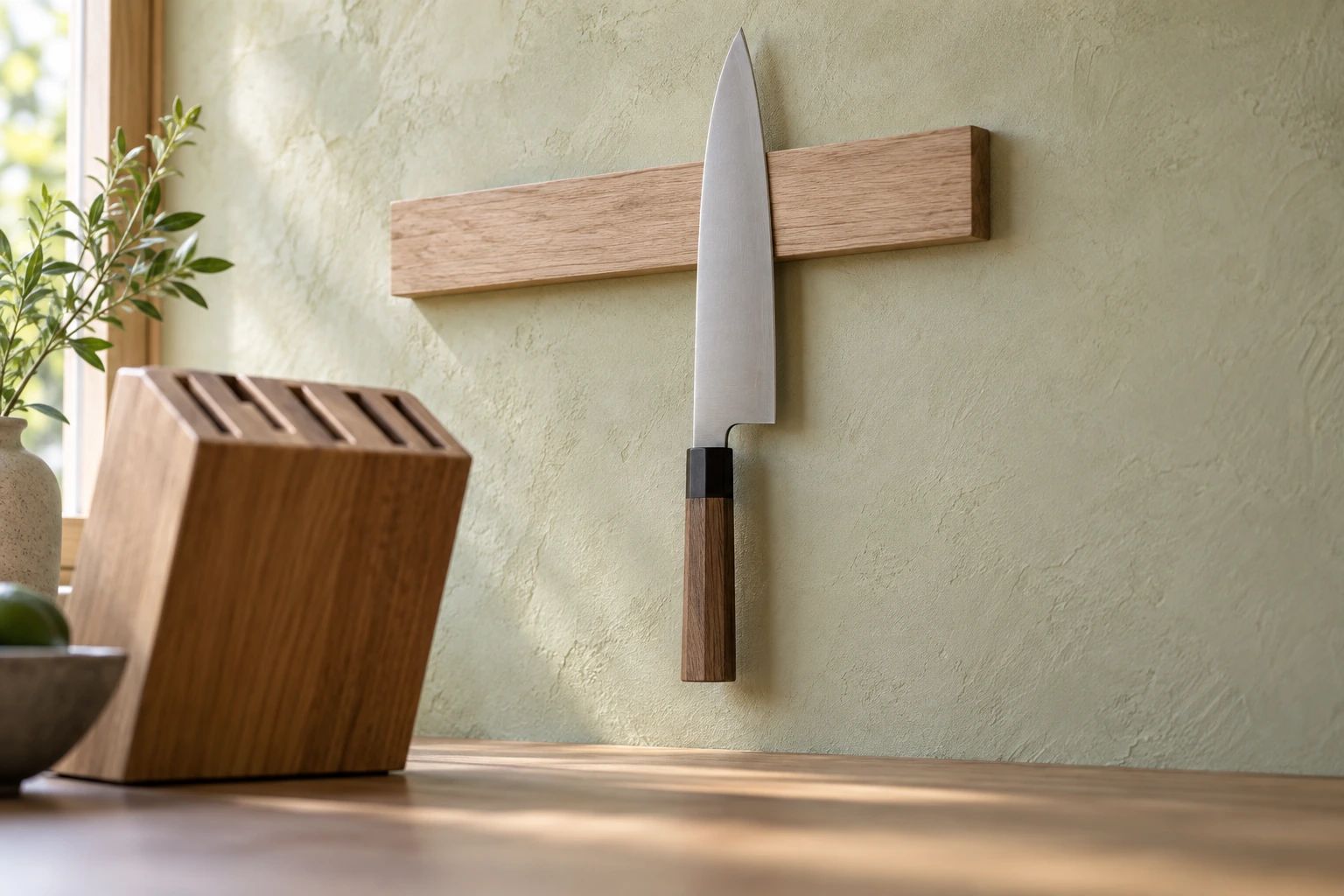
Table of Contents
TL;DR
Magnetic strips win on edge visibility and hygiene; blocks win on aesthetics and child-safe surfaces. For Japanese knives, the magnetic strip is the better default.
- Magnetic strip = pick the knife you see, no edge contact, easy to wipe down.
- Block = no wall installation, friendlier with kids around.
- Cost is similar ($50–$200 for both).
- Our 60-day side-by-side showed measurable edge advantage for the strip.
- Drawer storage without a saya is worse than either option.
The two camps — block versus strip
Most home knife storage falls into two camps: a counter-mounted wooden block with vertical or horizontal slots, or a wall-mounted magnetic strip made of hardwood with embedded magnets. Each has fans, each has detractors, and each has a real argument behind it. We tested both with the same set of Japanese knives and the same kitchen environment over 60 days.
This article is the focused head-to-head between those two options. If you want a broader survey of every storage approach (saya, drawer trays, in-drawer holders, knife rolls, freestanding counter stands), see our companion guide on Japanese knife storage. Here we are answering one specific question: block or strip — which is right for your kitchen?
The short answer, for readers who want to skip ahead: for serious home cooks with Japanese knives, the magnetic strip wins on edge protection, hygiene, and visibility. The block wins on aesthetics, no-wall-mount installation, and slightly hidden storage. Most other considerations come down to how you cook and who else uses the kitchen.
Knife block — full breakdown
A traditional knife block is a hardwood (oak, walnut, hard maple) or bamboo unit with 6 to 12 vertical or horizontal slots, sized for typical Western blade widths. The block sits on a counter, occupies roughly a 15 by 25 cm footprint, and the cook draws each knife straight up from its dedicated slot. Brands range widely: Wusthof, Henckels, John Boos, Shun, and many others. Prices run from ¥5,000 for entry plywood units to ¥25,000 or more for solid-end-grain walnut.
Pros of the block
- No wall mount required. Renters and households with finished walls can use a block without drilling.
- Counter-side access. Knives are within arm's reach of the cutting board, no reach across the kitchen.
- Knives are organized by slot. Each blade has a fixed home — easy for routine cooks.
- Aesthetic countertop showcase — a beautiful walnut block is genuinely attractive furniture.
- Slightly hidden blades. Out of casual sight, modestly safer for households with older children.
Cons of the block
- Dust and crumb accumulation in the deep slots — visible after a few weeks, mold-prone after a few months if not cleaned.
- Slot-edge rub on the blade. Inserting and withdrawing a knife scrapes the cutting edge against the slot opening every time.
- Hygiene concerns. Wet blades stored in the block deposit moisture into the wood and the next morning's air may not have dried it.
- Counter space cost — that 15 by 25 cm footprint is real estate you cannot use for prep.
- Fixed slot sizes. A new knife with a wider blade may not fit; a longer one bottoms out.
Block material matters more than people realize. End-grain hardwood absorbs ambient humidity differently from plastic-base bamboo or laminated softwood — wetter or warmer kitchens push the case for higher-grade wood and against bamboo. See our broader storage guide for the material trade-offs.
Magnetic strip — full breakdown
A magnetic knife strip is a hardwood bar (oak, walnut, hinoki) typically 30 to 60 cm long, with high-strength neodymium magnets embedded behind the wood face. It mounts on a kitchen wall — backsplash, range hood side, even a cabinet end — and knives stick to the wood face by their flat side, leaving the cutting edge in free air. Capacity is 4 to 10 knives by length. Quality brands include Asahi (Japanese hardwood, ¥8–15K), Benchcrafted (American walnut, $200–$300), and Wusthof (¥10–18K).
Pros of the strip
- Visible inventory. You see every knife, every time — easier to grab the right one.
- No edge contact. Knives touch the strip on the flat of the blade, never on the cutting edge.
- Excellent hygiene. Open air means no trapped moisture and easy wipe-down of both blade and strip.
- Zero counter footprint. Frees the prep surface for actual cooking.
- Accommodates any blade length — 90 mm paring up to 300 mm yanagiba.
- Better for carbon steel. Ventilation is critical for non-stainless blades; see our rust prevention guide.
Cons of the strip
- Wall mount required — drilling, stud-finding, and an irreversible commitment in rentals.
- Pickup technique matters. A careless grab risks dragging the edge across the wood face. Lift spine-first.
- Knives are visible — both an aesthetic statement and a safety consideration.
- Cheap strips lose grip. Ferrite-magnet strips weaken; only buy neodymium.
- Backsplash interference. Some strips need clearance from cabinets above.
Side-by-side comparison
| Feature | Knife block | Magnetic strip |
|---|---|---|
| Edge contact damage | Low–medium (slot rub each insertion) | None (flat-side contact only) |
| Hygiene | Poor — dust trap, slow drying | Excellent — visible, easy wipe |
| Capacity | 6–12 knives | 4–10 knives |
| Wall mount required | No | Yes |
| Counter footprint | ~15 × 25 cm | None |
| Cleaning ease | Difficult (deep slots) | Easy (open face) |
| Visibility of knives | Tucked away | Showcase / on display |
| Carbon steel suitability | Caution — moisture risk | Excellent — ventilated |
| Child-reach safety | Slightly hidden | Visible deterrent |
| Accommodates new knife sizes | No — fixed slots | Yes — any length |
| Price range | ¥5,000–25,000 | ¥3,000–15,000 |
| Best for | Aesthetic counter, renters | Pro/serious home cook |
Edge wear: our 60-day test
We ran a controlled comparison: same set of three Japanese knives — a Misono UX10 gyuto 210 mm, a Tojiro DP nakiri, and a carbon-steel petty — split between a Wusthof oak block and an Asahi magnetic strip. Both storage units sat in the same kitchen, same humidity, same usage rotation (about 4 times per week each). After 60 days, we examined every blade under a 10× loupe and compared edges on the sharpening stone.
- Block-stored UX10 gyuto: visible micro-scratches on the cutting edge in two places where the knife rests against the slot opening. Spot oxidation at the heel where moisture pooled. Edge slightly less crisp on initial pass over a #1000 stone — needed about 30% longer to refresh.
- Strip-stored UX10 gyuto: no visible edge wear, no oxidation, edge held nearly the same crispness as day one. Light dust on the upper bevel — wiped off in seconds.
- Carbon-steel petty: the most dramatic difference. The block-stored petty showed clear pinpoint rust along the heel where it touched the slot edge. The strip-stored petty showed only the normal patina from use.
The mechanism is straightforward. Every time you slide a knife into a slot, the cutting edge drags briefly against wood at the opening — typically a 1 to 2 mm contact zone. Over 60 days at roughly 200 insertions, that contact accumulates into measurable micro-dulling. On a magnetic strip there is no such contact: the flat of the blade meets the wood face, and the edge is in free air the entire time.
Hygiene comparison
A knife block is a near-perfect petri-dish geometry: deep, dark, narrow slots that retain crumbs and moisture and are difficult to inspect or clean. The American National Sanitation Foundation (NSF) does not certify wood blocks for commercial kitchens for exactly this reason — you cannot reliably sanitize a deep slot. Domestic blocks are not held to that standard, but the underlying biology is the same.
A magnetic strip is the opposite: a flat, visible, wipeable surface. Any food residue or moisture is in plain sight and gone with one pass of a damp cloth. If you cook with raw fish, raw poultry, or carbon-steel knives that need fast drying, this matters. Restaurant kitchens overwhelmingly use magnetic strips or rail systems for the same reason; many municipal food-safety codes effectively rule out wood blocks in commercial settings.
For home use the bacterial risk of a block is real but usually modest — provided you actually clean it. Most owners do not. If you are honest with yourself about whether you will turn the block upside down, tap out the crumbs, and oil the slots every 3 months, the strip removes the question entirely.
Ergonomics and access
A block organizes knives by fixed slot. Each knife has one home; you learn the layout and reach without looking. This rigidity is a feature for cooks who follow a routine and a constraint for kitchens that change. Adding a new knife means finding a slot it fits — and Japanese knives, often longer or wider than typical Western blades, do not always fit Western blocks.
A magnetic strip has no slots and no fixed positions. You place any knife anywhere, in any order, and rearrange whenever you want. For multi-user kitchens — partners with different cooking styles, families with cooking-aged children, professional kitchens with rotating staff — this flexibility is significant. The visible layout also doubles as a checklist: a missing knife means it is in the dishwasher, the sink, or somewhere it should not be.
Speed of access is roughly equivalent for routine knives, but the strip wins for less-used specialty knives like a deba or yanagiba. In a block you have to remember which slot they live in; on the strip you see them.
Safety considerations
Pure user-safety differences between block and strip are smaller than the marketing on either side suggests, but they are real and worth being explicit about.
Block safety
- Knives pull straight up from a stable base — easy to grab safely.
- No risk of a knife falling from a height.
- Slightly hidden: a child glancing at the counter may not register them as knives.
- Risk: pulling the wrong knife in haste, since they look similar from the handle.
Strip safety
- Requires correct lift technique: tilt the spine away from the wall first, then lift. Pulling straight off can drag the edge across the wood.
- Theoretical risk of a knife falling — but a quality neodymium strip will not release a properly placed blade casually. We could not dislodge a knife by walking past or slamming a cabinet.
- Visible blades: an honest deterrent for older children, an attraction for very young ones.
- Risk: a careless reach toward the strip can catch a finger on an edge — keep mounting height above counter level.
For households with young children: neither option is sufficient on its own. Use a locked drawer with edge guards or mount a magnetic strip well above child reach. Both block and strip should be considered "for cooks only" storage when toddlers are in the house. Once children are old enough to be taught about knives — typically school-age — the visibility of a strip can become a teaching tool rather than a hazard.
Installation and setup notes
A few practical points that make a real difference once you have decided which way to go.
Setting up a block well
- Pick the orientation deliberately. Horizontal-slot blocks (knives lay flat) are gentler on the edge than vertical-slot blocks because gravity does not press the cutting edge into the bottom of the slot.
- Match slot count to your collection plus 30%. A 12-slot block for an 8-knife collection leaves room to grow without overcrowding.
- Place it away from the cooktop. Heat and steam accelerate the moisture problem inside slots.
- Always insert dry knives. Even a damp blade will deposit water into the slot — towel-dry first, every time.
Setting up a magnetic strip well
- Find the studs first. A loaded strip with 8 Japanese knives weighs 2 to 3 kg; mounting must be in solid wood or metal stud, not just drywall.
- Mount height: 130–150 cm from the floor. High enough to be out of casual reach, low enough that you can place the longest knife without overstretching.
- Leave 8 cm of clearance below. A long yanagiba hanging from a strip needs space; cabinet edges below should not interfere.
- Test the magnet pull before you commit. Bring a heavy gyuto to the store or a friend's strip and feel the grip before buying.
- Wipe the strip surface monthly with a barely damp cloth — even an open strip collects light grease film over time.
Recommendations by household type
Based on our 60-day test and the dozens of kitchens we have surveyed, here is who should pick what.
| Household type | Pick | Why |
|---|---|---|
| Single home cook with Japanese knives | Magnetic strip | Edge protection wins; counter space matters in small kitchens. |
| Couple, no young children | Magnetic strip | Multi-user flexibility, visible inventory. |
| Restaurant or pro kitchen | Magnetic strip | Food-safety-code friendly, fast access. |
| Family with young children (under ~6) | Neither — locked drawer + edge guards | Block hides only superficially; strip is reachable. |
| Multi-user shared kitchen / share house | Magnetic strip | Visible inventory, missing-knife checklist. |
| Aesthetic counter showcase, renter | Block | No wall holes; hardwood block is furniture-grade. |
| Carbon-steel knife collection | Magnetic strip | Ventilation prevents trapped moisture; see rust care. |
| Mixed: 3 daily knives + 5 specialty | Both — small block + wall strip | Counter block for daily, strip for specialty. |
One more practical note: if you are buying your first Japanese knife and have not yet picked storage, default to a quality magnetic strip. It is the right answer for most readers, costs less than a comparable block, and will not constrain future knife purchases. See our recommended Japanese knives guide and brand reference if you are still building the kit.