Wa-Handle vs Yo-Handle: Japanese vs Western Knife Handles Explained (2026)
QUICK ANSWER
Wa (Japanese) handles are octagonal/D-shape magnolia, light and replaceable; yo (Western) handles are riveted laminate, heavier and water-resistant.
Wa shape
Octagonal / D-shape
Yo shape
Riveted laminate
Weight
Wa lighter
Water resistance
Yo higher
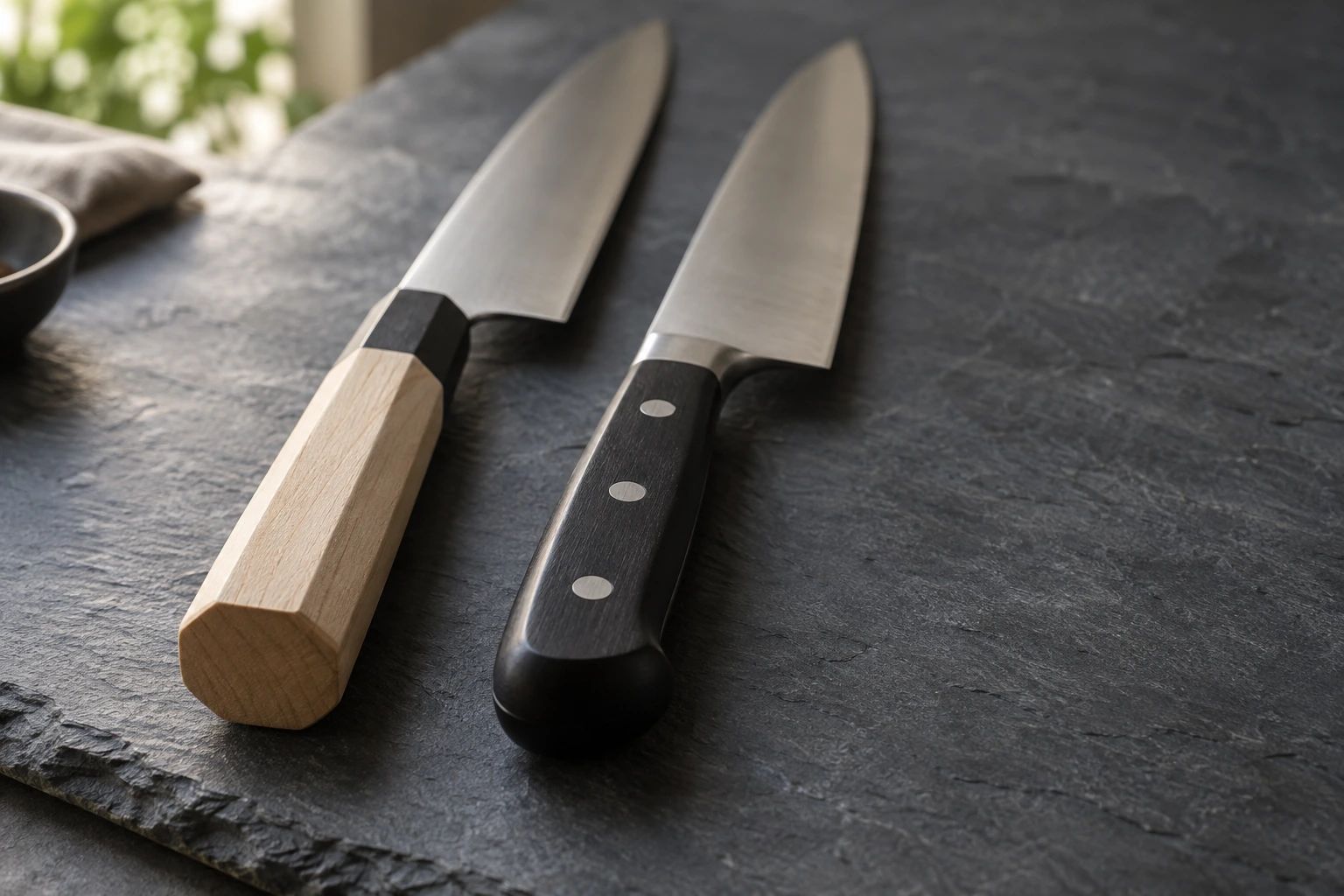
Table of Contents
TL;DR
The wa-handle (Japanese) is the traditional light, forward-balanced design with a hidden tang; the yo-handle (Western) is full-tang, riveted, heavier and rear-balanced. Choose by cooking style.
- Wa: octagonal or D-shape, 80-130g, hidden tang, replaceable every 5-10 years.
- Yo: full-tang riveted, 150-250g, sealed for the life of the knife.
- Wa = forward balance (blade-leading); yo = rear balance (knife-as-tool).
- Wa: built by traditional Japanese makers (Sakai, Kyoto, Echizen).
- Yo: easy switch from a Western chef knife - no learning curve.
Two design philosophies, one blade in your hand
The handle is the half of the knife most buyers under-weight. The blade gets the photographs - the handle decides whether you can still feel your wrist after an hour of prep. Japanese wa-handles (和柄) and Western yo-handles (洋柄) come from different traditions and answer the same question - "how should the knife sit in the hand?" - in opposite ways.
A wa-handle is light wood, hollow, and friction-fitted to a partial tang. It pushes the knife's center of gravity forward, toward the blade, and weighs almost nothing on its own. A yo-handle is two scales riveted to a full-length steel tang, often with a forged bolster, and shifts the balance back into the palm. Same blade, different cooking. This guide covers both, when each wins, and why so many serious cooks end up with one of each. For the broader question of Japanese vs German knives, our types of Japanese knives overview, and tang construction, follow the linked guides.
At-a-glance comparison
The headline differences between wa- and yo-handles, side by side:
| Feature | Wa-handle (Japanese) | Yo-handle (Western) |
|---|---|---|
| Construction | Hidden / partial tang, friction-fit | Full tang, 3-5 rivets |
| Weight | 80-130g | 150-250g |
| Balance point | Forward, toward the blade | Rearward, toward the hand |
| Common materials | Magnolia (ho), oak, ebony, rosewood + buffalo-horn ferrule | Pakka wood, micarta, POM, G-10 |
| Replaceable | Yes - expect 5-10 yr handle life | No - sealed riveted construction |
| Symmetry | Octagonal symmetric, D-shape asymmetric, oval | Symmetric, contoured to either hand |
| Best for | Push/pull cuts, precision, long shifts | Rocking cuts, heavy tasks, mixed users |
| Daily care | Wipe dry, occasional camellia oil | Wash and dry, mostly maintenance-free |
| Failure mode | Wood splits, tang loosens in socket | Rivets loosen, scales chip or delaminate |
| Repair cost | ¥2,000-¥15,000 to refit | Usually unrepairable when rivets fail |
| Hand feel | Blade-leading, neutral palm | Tool-in-hand, secure grip |
Wa-handle: hidden tang, light wood, replaceable
A wa-handle starts with a block of light, stable wood - most often ho-no-ki (Japanese magnolia), sometimes kuromigaki oak, ebony, or rosewood for premium versions. The block is bored, a shaped hole burned or drilled to match the partial tang, and a buffalo-horn ferrule is fitted at the bolster end to reinforce the wood against the tang's wedging force. The blade tang is then heated and driven home; as it cools, the wood grips the metal. No rivets, no glue.
Cross-section shapes: octagonal, D-shape, oval
Three cross-sections dominate. Octagonal (hakkaku) is the most versatile - symmetric, rotation-tolerant, and the default on most modern gyuto and santoku. The eight flats give the fingers reliable orientation cues without demanding a single grip. D-shape places a deliberate ridge along one side that locks the index finger of the dominant hand; you see it on right-handed yanagiba and deba, where blade orientation is fixed for the whole stroke and the asymmetry helps drive the long cut straight. Oval is older and softer, mostly seen on traditional country knives and older santoku patterns.
Common woods and their character
| Wood | Weight / hardness | Look | Used on |
|---|---|---|---|
| Ho-no-ki (Japanese magnolia) | Very light, soft | Pale cream, almost grain-less | Standard kitchen knives, all price points |
| Kuromigaki oak | Light, medium-hard | Smoke-darkened brown, visible grain | Mid-tier and gift-grade knives |
| Shitan (rosewood) | Heavier, hard | Deep red-brown, fine grain | Premium and ceremonial knives |
| Kokutan (ebony) | Heaviest, very hard | Near-black, mirror polish possible | Top-tier and presentation knives |
| Pakkawood (resin-stabilised) | Heavier than ho, very stable | Layered colour bands | Modern Western-style and hybrid knives |
The point most buyers miss: the wa-handle is a wear part. Spend long enough with a knife and the wood will check, the ferrule will loosen, or you will simply want to upgrade. Any competent maker - or any of the Kappabashi specialty shops - will refit a new handle for roughly ¥2,000-¥15,000 depending on wood. The blade outlives the handle, often several times.
Yo-handle: full-tang, riveted, sealed
A yo-handle is the Western answer: take the blade steel, leave it full-length and full-width through the handle, and rivet a pair of scales to it. Three rivets is standard; five appears on heavier German-style knives. The construction is sealed - the rivets pass through the tang and clinch on both sides - so disassembly is not part of the design.
Bolsters: full, half, or none
The bolster is the forged transition between blade and handle. Full bolsters (Wusthof Classic, traditional Henckels) extend down to the cutting edge, add 30-50g of rear weight, and shield the index finger - but they require a grinder to sharpen the heel of the blade. Half bolsters (Wusthof Classic Ikon, Miyabi) leave the heel exposed for easier home sharpening while keeping a finger guard. No-bolster designs (most Japanese-made yo-handles, including Misono UX10, Tojiro DP) treat the handle as a separate component and are the easiest to maintain on a whetstone.
Rivet count and what it tells you
Rivet count is a rough proxy for handle weight and intent. Three rivets is the modern standard, sufficient for a balanced kitchen knife. Five rivets usually signal a heavier German-style design with a full bolster and thicker scales - the extra fasteners are not strictly needed for strength, but they read as "professional" and tighten the scales against thermal expansion. Two rivets appear on small paring knives and on some minimalist Japanese yo-handles where weight savings matter. Mosaic or decorative rivets are a styling choice and don't affect function.
Common scale materials are pakkawood (resin-impregnated layered wood, dimensionally stable), micarta (linen or canvas in resin, very tough), G-10 (fiberglass in resin, near-indestructible), and POM plastic for budget and food-service knives. Premium lines may use stabilised burl wood or natural ebony for visual character.
The trade-off is mass and inertia. A 210mm gyuto with a wa-handle weighs 150-180g; the same blade with a yo-handle weighs 200-230g, and a forged German chef knife at the same length easily reaches 250-280g. That mass is a feature when you want the blade to bite into hard squash or push through chicken joints; it is a tax when you spend an hour mincing herbs.
Balance, feel, and fatigue: the 30-minute test
The clearest way to feel the difference: pinch-grip both knives at the bolster (or at the heel for a wa-handle), let go with the other hand, and see where the blade points. A wa-handled gyuto pitches the tip down - the balance is forward of the grip. A yo-handled chef knife sits flat or pitches up - balance is in the palm. That single difference reshapes how the knife is used.
Forward balance favors push and pull cuts - the cuts a Japanese knife is designed for - because the blade leads the motion and the wrist is mostly steering. Rear balance favors rocking cuts because the heel pivots naturally on the board and the heavier rear lets the blade pop back up. Try to rock-chop with a pure wa-handled gyuto and the knife feels nose-heavy; try to push-cut with a heavy bolstered chef knife and the lift on each stroke wears the wrist.
The fatigue gap is real and shows up around the 30-minute mark of continuous prep. The 50-100g less mass per knife is small in isolation, but multiplied by hundreds of strokes, it adds up to noticeably less wrist fatigue. Sushi-bar prep cooks have known this for two centuries; modern home cooks discover it the first time they spend a Saturday afternoon prepping for a dinner party.
Maintenance and longevity
Wa-handle care is straightforward but ongoing. Wash under running water and dry the handle with the same towel as the blade. Avoid soaking and never use the dishwasher - the wood swells, the ferrule joint loosens, and a heat-fit tang in a wet socket eventually rusts in place. Every two or three months, wipe a small amount of food-safe camellia or mineral oil onto the wood; the ho-no-ki absorbs it and resists checking. Expect a 5-10 year life for the handle on a daily-driver knife, longer for occasional use.
Yo-handle care is mostly the absence of care. Wash, dry, store; the sealed riveted construction tolerates the kind of treatment wa-handles cannot. The failure modes when they come are different: rivets occasionally loosen on heavily-used knives, pakkawood scales can chip if dropped on a hard floor, micarta can delaminate at the rivet edge after decades. None of these are normally repairable - when a yo-handle fails, the knife is usually retired or used as a beater.
The asymmetry is worth pausing on. A wa-handle is maintainable - consumable handle, durable blade. A yo-handle is maintenance-free until it isn't - nothing to do until the day something fails permanently. Different philosophies of ownership, both valid.
A word on storage
Both handle types prefer the same storage: magnetic bar, in-drawer tray, or saya (wooden sheath), never loose in a drawer. Wa-handles especially benefit from a saya - the cover protects the wood from kitchen humidity and the blade from contact damage. Wooden knife blocks work for both but trap moisture; if you use one, dry the knife thoroughly first and prefer blocks with horizontal slots that drain.
Hybrid handles: where the line blurs
Modern makers have spent the last twenty years collapsing the distinction. Shun Classic uses a contoured pakkawood D-shape on a full-tang Western construction - Japanese steel and geometry, Japanese-feeling grip ridge, but Western rivet structure underneath. Miyabi (Zwilling's Seki-made line) takes the opposite path: full-tang Western build with restrained, Japanese-aesthetic micarta scales and a forward-shifted balance.
Misono UX10 remains the cleanest case study: the same blade is offered with a traditional yo-handle (full-tang, riveted, ~230g total) and with a wa-handle (hidden tang, magnolia and buffalo horn, ~180g total). Same steel, same grind, different cooking. Most professional buyers eventually own one of each.
The hybrid trend means the question is rarely "Japanese knife or Western knife" and almost always "which handle on which blade." Brand provenance no longer maps cleanly to handle style.
A second pattern worth noting: retrofit handles. Several Kappabashi shops and online specialists in Sakai will fit a custom wa-handle onto a Western-built blade if you provide a measured tang. Conversion the other way (yo-handle onto a Japanese hidden-tang blade) is harder because the partial tang is too short for safe riveting, and is not generally offered. The asymmetry is informative: wa-handles are designed to be replaced and fitted, yo-handles are designed once at the factory.
Which handle should you choose?
The decision turns on four practical factors:
| Your situation | Lean toward | Why |
|---|---|---|
| Long prep sessions, precision work | Wa-handle | Forward balance and lower mass reduce wrist fatigue |
| Mixed kitchen, multiple users, heavy tasks | Yo-handle | Tolerates rocking cuts, occasional bone contact, varied grips |
| Small hands, light grip | Wa-handle | Lighter knife is less tiring; octagonal cross-section suits smaller fingers |
| Large hands, firm grip | Yo-handle | Contoured scales fill the palm; bolster gives a positive index-finger stop |
| Willing to maintain (oil, replace handle) | Wa-handle | Replaceable handle = longer total knife life |
| Want zero maintenance | Yo-handle | Sealed construction; nothing to do until failure |
| Right-handed sushi/sashimi work | Wa D-shape | Asymmetric ridge locks blade orientation for the full stroke |
| First Japanese knife, replacing a Western one | Wa octagonal or hybrid | Octagonal is the easiest transition; hybrids preserve familiar grip |
Our practical recommendation for most home cooks: start with a wa-handled octagonal gyuto or santoku as the everyday knife, keep a yo-handled Western chef knife for heavy tasks, and add specialist wa-handles (yanagiba, deba) only when the cooking calls for them. For curated picks at each price tier, see our best Japanese knives guide and brand directory.
A note for left-handed cooks
Octagonal wa-handles, oval wa-handles, and almost all yo-handles work equally well in either hand - the symmetry was never accidental. D-shape wa-handles, however, are handed. A standard right-handed D fights a left-handed grip; the ridge sits against the wrong finger and the blade twists during the cut. Most Sakai-based makers offer left-handed (sayuri) D-shape handles on yanagiba and deba on request, typically at no surcharge but with a 4-8 week wait. Single-bevel knives compound the issue because the bevel itself is also handed, so confirm both handle and bevel orientation when ordering.