Japanese Knife Rust Care: Prevention, Removal, and the Patina vs Rust Distinction (2026)
QUICK ANSWER
Remove fresh rust with a wine-cork-and-Bar-Keepers-Friend rub, then re-oil with camellia oil; prevent by drying within 60 seconds of every wash.
Fresh rust fix
Cork + abrasive
Re-oil
Camellia oil
Prevent
Dry in 60 sec
Carbon vs stainless
Carbon needs daily care
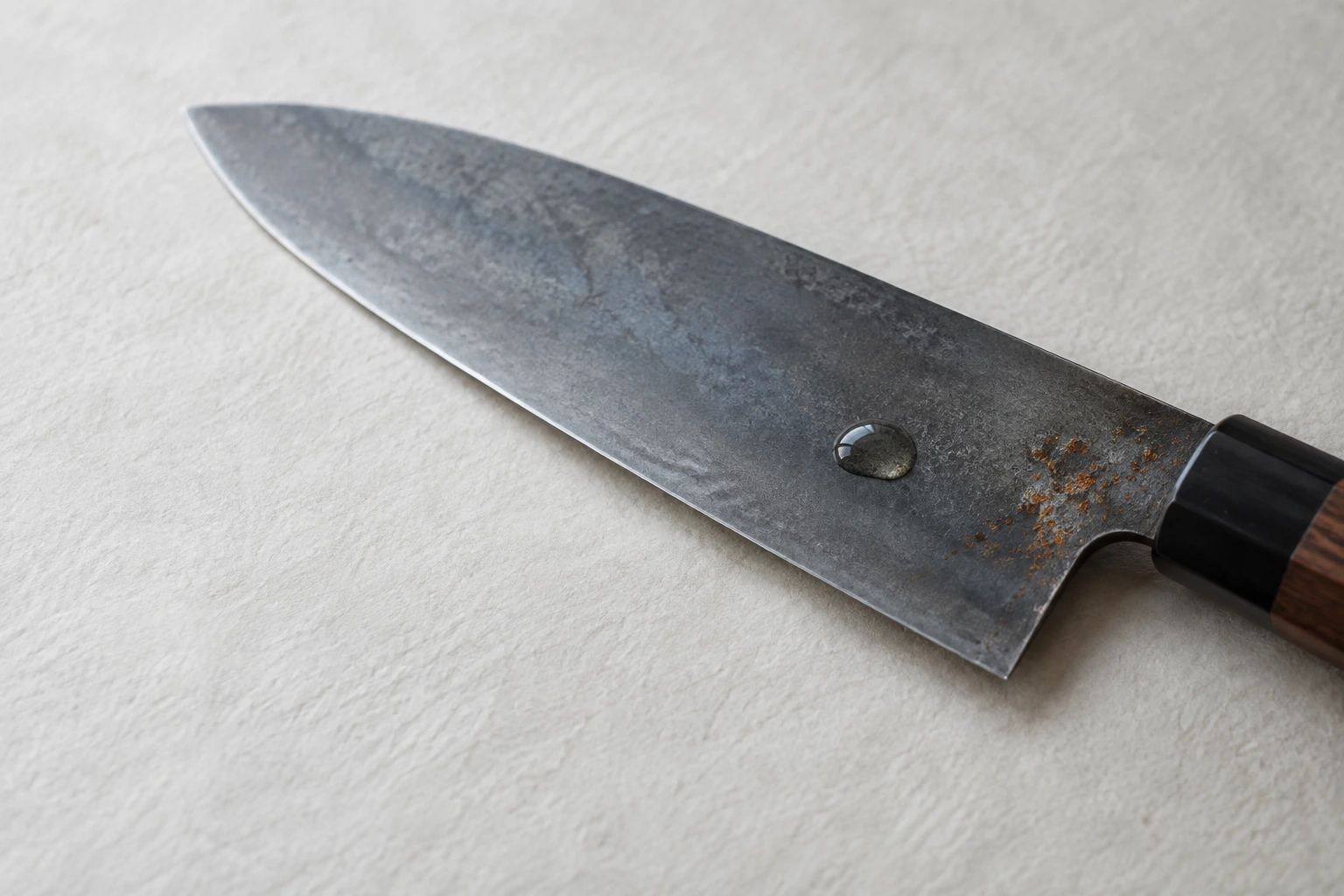
Table of Contents
Why Carbon-Steel Knives Rust
Rust is a chemical process, not a manufacturing defect. When iron (Fe) meets oxygen (O₂) in the presence of water (H₂O), the iron atoms surrender electrons and form iron oxide hydrate (Fe₂O₃·H₂O) — the orange-red, flaky material we call rust. Carbon-steel Japanese blades like shirogami (white paper steel) and aogami (blue paper steel) contain 1.0–1.5% carbon and almost no chromium, which is precisely why they take a sharper edge than stainless and precisely why they oxidise so willingly.
Three accelerators turn slow oxidation into a same-day problem: acid (tomato juice, citrus, vinegar — they strip the blade's protective oxide layer), salt (electrolytes carry electrons across the steel surface, multiplying corrosion rates), and standing water (a continuous water film keeps the reaction supplied with O₂). A blade left wet next to onion peels overnight can pick up rust pits that no amount of polishing will fully remove. For background on which alloys resist this, see our steel types guide; for the pre-purchase decision between carbon and stainless, our Japanese vs German comparison walks through the trade-off in detail.
Patina vs Rust: The Critical Distinction
Owners new to carbon steel often panic at the first sign of discoloration and try to scrub it away. That is usually a mistake. Patina is your friend; rust is your enemy. Both are iron oxides, but they behave in opposite ways.
| Property | Patina (good) | Rust (bad) |
|---|---|---|
| Chemistry | Fe₃O₄ (magnetite), tightly bonded to steel | Fe₂O₃·H₂O (hydrated hematite), loose |
| Colour | Blue-grey, slate, charcoal, occasionally purplish | Orange, red-brown, sometimes pitch-black flakes |
| Texture | Smooth — invisible under your fingertip | Fluffy, grainy, crumbles under pressure |
| Behaviour on a paper towel | Does not transfer | Smears orange/brown |
| Effect on the steel | Forms a passive layer that blocks further oxidation | Continues to consume iron until the metal pits |
| What to do | Leave it alone — it is protecting your knife | Remove immediately with abrasive, rinse, dry, oil |
A useful field test: drag a fingernail across the spot. Patina is flush with the surface and you feel only smooth steel. Rust catches your nail and leaves an orange smudge. Patina that has matured over months of cooking onions, fish, and steaks looks gorgeous — slate grey with a faint topographic map of past meals — and the craftsmen we visited consider it a sign that the owner has been using the knife properly. They are unhappy when a customer brings back a polished-looking carbon blade, because that polish has come at the cost of removing the protective layer.
Daily Prevention Routine
The one-minute care ritual after every use prevents 95% of rust problems before they start. The sequence is non-negotiable:
- Wipe immediately while cooking. Keep a folded clean cloth next to the cutting board. Between tasks — especially after acidic ingredients — wipe both sides of the blade. Do not wait until plating.
- Hand-wash with neutral detergent. Warm water, mild dish soap, soft sponge. Never the dishwasher. Heat, alkaline detergent, and impacts with other cutlery will destroy a Japanese knife within months.
- Dry the blade immediately. Before you put away the cutting board, before you pour another glass of wine, before anything else. A clean, lint-free cotton or microfibre cloth, blade pointed away from you, both sides plus the spine plus the choil. The handle can air-dry; the blade cannot.
- Air-rest for 30 seconds. Even a "dry" blade has microscopic moisture in the grind lines. Lay it on a clean cloth (not on a wet drying mat) for half a minute before storing.
- Apply a thin film of oil. A few drops of camellia oil or food-grade mineral oil on a paper towel, wiped along the entire blade surface. This is the step most home cooks skip and most professional kitchens do religiously.
- Store dry, with airflow. A magnetic strip in a dry part of the kitchen, a saya (wooden sheath) with airflow, or a dedicated knife rack — never a damp drawer or a wet cutting board face-down on the spine. See our care and maintenance guide for storage specifics.
That is the full routine. It takes under sixty seconds and it is the single highest-leverage skill a Japanese-knife owner can build.
Camellia Oil (Tsubaki-yu) and Other Oils
Tsubaki-yu — pressed from camellia seeds — has been the traditional Japanese blade oil for centuries because it is food-safe, dries to a thin non-rancid film, and does not transfer flavour to ingredients. A 100ml bottle from a Sakai or Seki specialist costs around ¥1,500 and lasts a household two to three years. Apply two to three drops to a folded paper towel and wipe along the blade after the final dry. The film should be invisible — if you see streaks, you have used too much.
Acceptable substitutes: food-grade mineral oil (sold for cutting boards), fractionated coconut oil, or refined grapeseed oil. Avoid: olive oil, sesame oil, butter, or any unrefined oil that will go rancid on the steel and produce a sticky residue. Avoid 3-in-1 oil and motor oil — they are not food-safe.
Frequency depends on the construction. A shirogami or aogami honyaki (full carbon, no cladding) deserves oil after every wash. A san-mai blade (carbon core, stainless cladding) only exposes carbon along the cutting edge and the choil, so a quick wipe of those areas suffices daily, with full oiling weekly. Stainless knives like VG-10 or SG2 need oil only if you are storing them long-term (over a month unused) or in a humid environment near the sea.
How to Remove Existing Rust
The right method depends entirely on severity. Diagnose first, then act.
Light surface rust (orange film, no pits)
Cut a wine cork in half lengthwise to expose the soft cellular structure. Sprinkle a small amount of Bar Keepers Friend powder on the rusted area, wet the cork, and rub along the blade's length (never across) with light pressure. Rinse, dry, oil. The traditional Japanese alternative is a wine cork plus a pinch of kitchen ash (or the ash from incense), which works through similar mild abrasion without the chemical bleaching effect.
Moderate rust (small pits, scattered spots)
Step up to a 1500-grit rust eraser (sold under brand names like Naniwa or Dialux) or 1500-grit waterproof sandpaper wrapped around a cork. Work along the blade's length only, in straight strokes, until the orange is gone. Move to 3000-grit to blend the area back into the surrounding finish. Rinse, dry, oil. Expect a slightly lighter patch where you worked — that is the bare steel that will re-patina over the next few weeks.
Heavy rust (deep pits, structural damage)
Stop. Do not attempt to grind out a pit deeper than ~0.5mm yourself — you will warp the geometry and ruin the cutting edge. Send the knife to a professional sharpener (a togishi) or back to the maker. Many Sakai and Seki forges offer restoration for a few thousand yen plus shipping, and they have the belt grinders, original blade profiles, and decades of experience to bring a damaged blade back. A botched home repair costs more than professional restoration.
For technique on the post-restoration sharpening, see our whetstone sharpening guide and sharpening stones guide.
Steel Type Rust Risk Matrix
Not every Japanese knife demands the same level of vigilance. Use this matrix to calibrate your care routine to the steel you actually own.
| Steel | Construction | Rust risk | Required care |
|---|---|---|---|
| Shirogami #1 / #2 | Honyaki or full carbon | Very high | Wipe + oil after every use; never leave wet |
| Aogami #1 / #2 / Super | Honyaki or full carbon | Very high | Wipe + oil after every use; never leave wet |
| San-mai (carbon core, stainless cladding) | Three-layer laminate | Edge only — moderate | Wipe edge and choil; weekly full oiling |
| Ginsan / Gin-3 (silver paper) | Stainless carbon | Low | Standard wash and dry; oil monthly |
| VG-10 | Stainless or san-mai | Low | Standard wash and dry |
| AUS-10 / AUS-8 | Stainless | Low | Standard wash and dry |
| SG2 / R2 (powdered stainless) | Stainless or san-mai | Very low | Standard wash and dry |
A yanagiba in shirogami honyaki and a santoku in VG-10 san-mai are different beasts. Match the routine to the steel.
Common Rust-Causing Mistakes
Almost every rust catastrophe we see at restoration counters is one of the following, often in combination:
- Leaving the knife in the sink. Wet, often with food residue, sometimes with another metal touching it (which creates galvanic corrosion). The single biggest killer of carbon-steel blades.
- Lemon, lime, or vinegar contact left to sit. Acid accelerates oxidation by an order of magnitude. Wipe between cuts.
- Tomato or onion juice dried on the blade. Both contain organic acids that bond with iron and produce dark stains that look like rust but are actually intermediate compounds — they still feed the corrosion process.
- Dishwasher use. Heat plus alkaline detergent plus tumbling against other cutlery — the trifecta of destruction.
- Storing on a wet cutting board. Especially face-down. Capillary action wicks water along the entire blade.
- A wet wooden saya. Wooden sheaths must be fully dry before re-sheathing — otherwise they trap moisture against the blade for hours. Never sheathe a freshly washed knife.
- Skipping the oil step on shirogami / aogami. The single most common omission among home cooks who own honyaki blades. Oil is not optional on full-carbon steel.
- Storing in a humid drawer near the dishwasher or sink. Microclimates matter. A knife is happiest on a magnetic strip in a dry part of the kitchen with good airflow — see our storage guide for details.
Avoid those eight, follow the daily routine, and even a shirogami honyaki will outlive you. Skip them, and a beautiful blade can be ruined in a weekend.