Santoku vs Nakiri: Which Japanese Knife Should You Buy? (2026)
QUICK ANSWER
Buy a santoku if you want ONE knife for meat, fish, and vegetables; buy a nakiri if you cook lots of vegetables and already own an all-rounder.
The santoku is a pointed-tip all-rounder (~165-180mm) with a slight curve that allows a little rocking. The nakiri is a tall, flat-edged double-bevel vegetable specialist built for pure push-cutting with full knuckle clearance.
Santoku
All-rounder, pointed tip
Nakiri
Vegetable specialist, flat edge
Pick one knife
Santoku
Add a veg knife
Nakiri
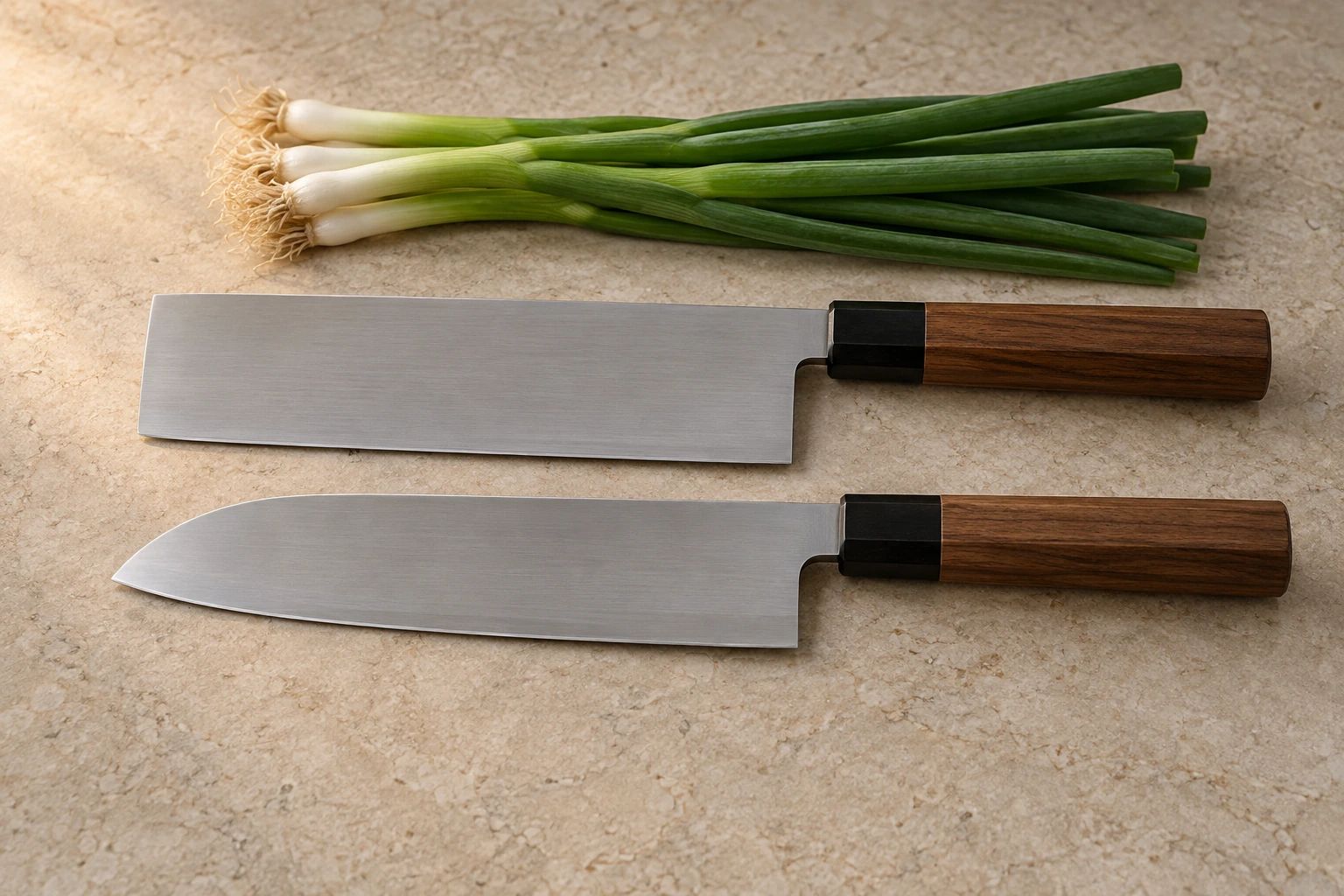
Table of Contents
Santoku and nakiri look like cousins — both are flat-ish, wide-bladed Japanese knives in the 165-180mm range — but they are built for different jobs. The santoku is a pointed-tip all-rounder that handles meat, fish, and vegetables. The nakiri is a tall, flat-edged double-bevel knife built for one thing only: vegetables. This guide puts them head-to-head — shape, cutting motion, versatility, and knuckle clearance — so you can decide which one belongs in your kitchen first.
The short verdict
If you only have room (or budget) for one knife, buy the santoku. Its slight curve, pointed sheepsfoot tip, and all-purpose design mean it covers nearly everything a home cook does — slicing chicken, portioning fish fillets, dicing onions, mincing herbs. The name itself, 三徳 ("three virtues"), refers to handling meat, fish, and vegetables equally.
Buy the nakiri when you already own a capable all-rounder (a santoku, gyuto, or Western chef's knife) and you cook a lot of vegetables. Its completely flat edge and tall blade make high-volume vegetable prep faster, cleaner, and more comfortable than any all-rounder can match — but it is a specialist, not a do-everything knife.
Neither is "better" in the abstract. The santoku wins on range; the nakiri wins on focused vegetable work. The right answer depends entirely on what else is in your knife block.
Santoku vs nakiri at a glance
| Feature | Santoku | Nakiri |
|---|---|---|
| Primary role | All-rounder (meat, fish, vegetables) | Vegetable specialist |
| Blade profile | Mostly flat with a slight curve near the tip | Completely flat, straight edge |
| Tip | Pointed sheepsfoot tip | Squared / rounded — no point |
| Blade length | 165-180mm | 165-180mm |
| Blade height | ~45-50mm | ~48-60mm (taller) |
| Bevel | Double-bevel | Double-bevel |
| Cutting motion | Push-cut, with a little rocking possible | Pure push-cut / straight chop |
| Vegetable performance | ★★★★ | ★★★★★ |
| Versatility | ★★★★★ | ★★★ |
| Best as your… | First / only knife | Second knife (veg specialist) |
Blade shape & profile
The clearest difference is the silhouette. The santoku has a mostly flat edge that gently curves up at the front to meet a pointed sheepsfoot tip — the spine drops down to join the edge. That slight curve near the tip is small but meaningful: it lets the knife do a little rocking and gives you a point for detailed work, like scoring skin or separating segments.
The nakiri takes a different approach entirely. Its blade is essentially a tall rectangle with a completely flat, straight edge and a blunt, squared-off (or softly rounded) end — no tip at all. Every millimeter of the edge sits in the same plane, so when you push down, the whole edge meets the board at once. There is nothing to pierce with, because piercing isn't the job; clean, full-contact downward cuts are.
In short: the santoku trades a sliver of flatness for a usable tip and a touch of rocking. The nakiri commits fully to a flat edge and gives up the tip in exchange.
Cutting motion
Both knives are happiest with a push-cut — pushing the blade forward and down in one motion rather than rock-chopping like a Western chef's knife. But the degree differs.
- Santoku — primarily a push-cutter, but the slight curve near the tip allows a little rocking motion when you want it. This flexibility is part of why it feels so natural as an all-rounder: you can push-cut vegetables, then switch to slicing a chicken breast without changing knives.
- Nakiri — a pure push-cut and straight up-and-down chopper. Because the entire flat edge contacts the board on every stroke, you get clean, complete cuts with no "accordion" effect where slices stay joined at the bottom. There is no rocking — you lift straight up and bring the blade straight down, or push forward and down for thin slices.
For someone cutting a board full of cabbage, daikon, or onions, the nakiri's full-contact stroke is genuinely satisfying and efficient. For mixed prep that jumps between proteins and vegetables, the santoku's slightly more versatile motion wins.
Versatility & range
This is where the santoku pulls decisively ahead. As an all-rounder, it is designed to handle the three big categories of home cooking:
- Vegetables — dicing onions, slicing cucumbers, mincing garlic, julienning carrots, chopping cabbage
- Proteins — slicing boneless chicken, cutting fish fillets, portioning tofu, slicing cooked meats
- Herbs & fruit — mincing parsley, slicing apples, supreming citrus
The nakiri, by contrast, is a dedicated vegetable knife. It is excellent — arguably best-in-class — at slicing, dicing, julienning, and chopping vegetables, but it is not designed for meat or fish. There is no tip for detail work, and the geometry is optimized purely for board-contact vegetable cuts.
So if versatility is your priority, the santoku is the obvious pick. If you've already covered protein and detail work with another knife and want a vegetable specialist that does that one job better, the nakiri earns its place. Note that, like all hard Japanese knives, neither should be used on bones, frozen food, or hard winter squash — those tasks call for a heavier, dedicated knife such as a deba.
Blade height & knuckle clearance
The two knives are similar in length (both commonly 165-180mm), but the nakiri is taller. A nakiri blade typically stands around 48-60mm tall, versus roughly 45-50mm for a santoku. That extra height does two useful things for vegetable prep:
- Knuckle clearance — the taller blade keeps your knuckles comfortably above the board during repetitive chopping, so you can work quickly with a claw grip without scraping.
- A natural guide — the flat, tall side acts as a visual and physical guide, helping you keep cuts straight and uniform.
The santoku's slightly shorter height is a fair trade for its all-round balance — it still has plenty of clearance for everyday cuts — but for marathon vegetable sessions, the nakiri's taller blade is the more comfortable tool.
Both knives also have a wide blade face that doubles as a scoop for transferring cut ingredients from board to pan.
Who each knife suits
Choose the santoku if you…
- Want a single knife that does almost everything in a home kitchen
- Cook a mix of vegetables, meat, and fish
- Are buying your first Japanese knife
- Value a usable pointed tip for detail work
- Want one purchase to cover the most ground
Choose the nakiri if you…
- Already own an all-rounder (santoku, gyuto, or chef's knife)
- Cook a lot of vegetables, often in volume
- Want the cleanest, most efficient vegetable cuts
- Like the secure feel of a tall blade and full knuckle clearance
- Enjoy a dedicated tool for a job you do often
Should you own both?
For many home cooks, yes — eventually. The two knives complement each other rather than overlap. A common and sensible progression is:
- Start with a santoku as your one do-everything knife.
- Add a nakiri once you notice you're spending most of your prep time on vegetables and want that work to be faster and cleaner.
With both in the block, you reach for the nakiri on vegetable-heavy days and the santoku whenever meat or fish enters the picture. They cover each other's gaps neatly. But there's no rush — a single good santoku will carry a kitchen for years on its own.
If you want to go deeper on the vegetable-specialist side, the nakiri also has a single-bevel professional cousin: see nakiri vs usuba. And if you're weighing the santoku against the longer Japanese chef's knife, the gyuto is the other all-rounder worth knowing.
How to choose
- One knife only → santoku. It covers meat, fish, and vegetables. There isn't a better single-knife answer for most home kitchens.
- Lots of vegetables + you already own an all-rounder → nakiri. The flat edge and tall blade make veg prep noticeably better.
- Size: both work best at 165-180mm. A 165mm suits most hands and standard cutting boards; 180mm suits larger hands or bigger boards.
- Steel & care: both are typically double-bevel and come in the same steels (VG-10 stainless for easy care, Shirogami/Aogami carbon for ultimate sharpness). Hand-wash, dry immediately, never the dishwasher.
- Sharpening: both are double-bevel and beginner-friendly on a whetstone at 10-15° per side. The nakiri's flat edge is among the easiest profiles to sharpen.
Still unsure? Buy the santoku first — it's the more versatile knife and the one you'll use for the widest range of tasks. For specific models and prices, see our best santoku knife guide and best nakiri knife guide.