Japanese Utility Knife: When You Need More Than a Petty (2026 Guide)
QUICK ANSWER
A Japanese utility knife is a 150-180mm petty-extended blade — between a petty (120-150mm) and santoku (165-180mm) in length.
Length
150-180mm
Bevel
Double-bevel
Best for
In-between work
Steel
VG10 / White #2
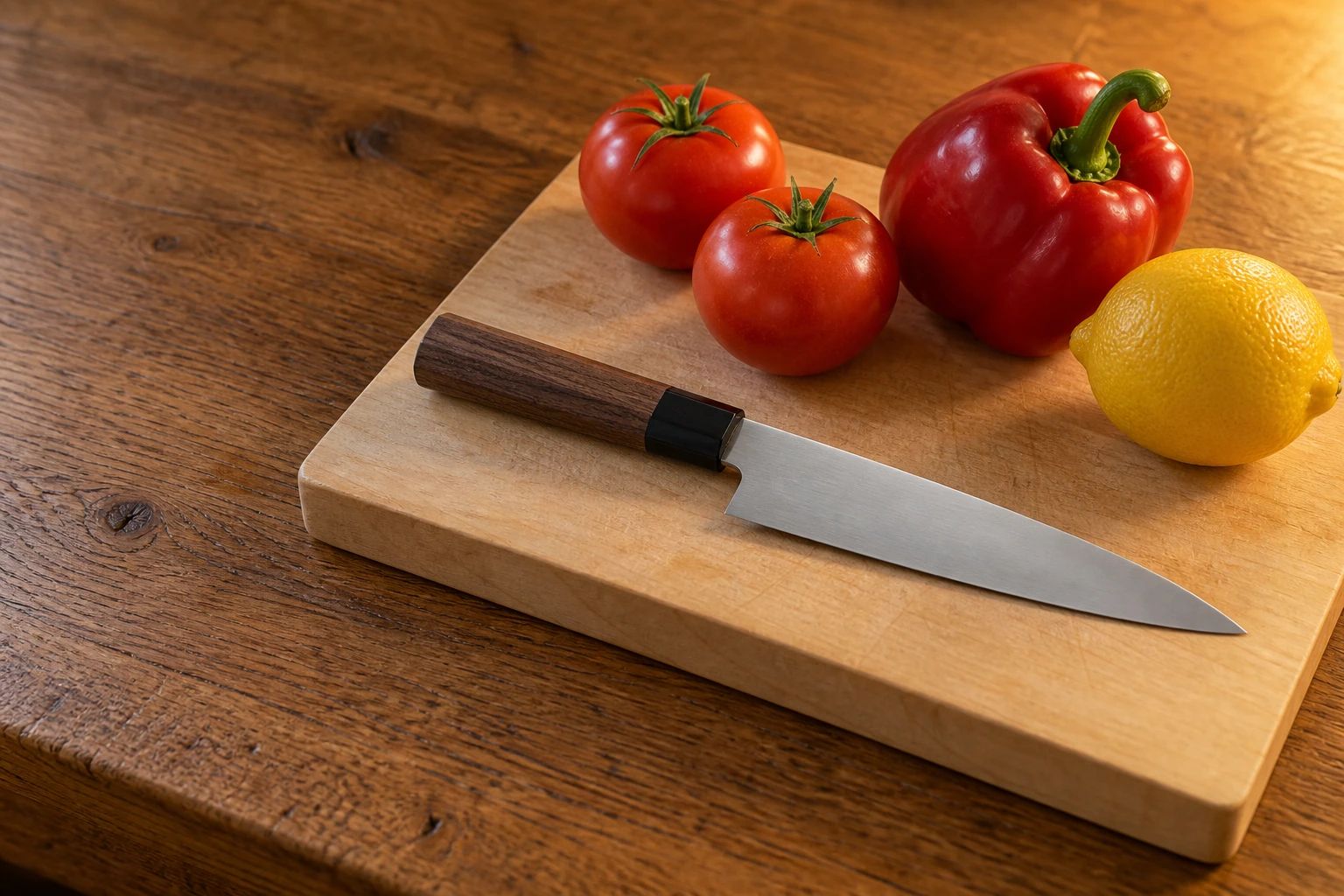
Table of Contents
TL;DR — what a utility knife is for
The Japanese utility knife is a 150-180mm mid-size all-rounder that bridges petty (120-150mm) and santoku (165-180mm). Narrower blade height than a santoku, longer than a petty — a unique geometry that excels at medium-sized food.
- Size — 150-180mm (most brands offer 150, 165, 180)
- Blade height — 30-38mm (narrower than santoku, taller than petty)
- Excels at — tomato, chicken breast, peppers, fruit, ham, sandwich ingredients, mid-size produce
- Struggles with — whole cabbage, large kabocha, big roasts, bone-in meat
- Best fit — main knife for a 1-2 person home, or sidekick to a santoku
- Hero models — MAC Superior 7", Tojiro DP utility, Sakai Takayuki Ginsan utility
Short version: a specialist for "too big for petty, too small for santoku" work. A minor category in Japan but a load-bearing piece of the three-knife setup most Western kitchens use.
What a Japanese utility knife is
Utility knife is the English-language term for a mid-size all-rounder. In Japan it doesn't have a single accepted name — brands variously call it "medium knife," "long petty," or "semi-santoku." The 150-180mm length overlaps santoku, but width and shape are different.
Three defining features:
- Slim blade height — 30-38mm vs santoku's 45-50mm. Lower weight (120-160g), nimbler in the hand.
- Gentle curve — not as flat as a santoku, not as curved as a chef knife. Allows light rocking alongside the standard push-cut.
- Pointed tip — sharp, not rounded like a santoku. Lets you do precise tasks: fruit cores, fat trim, pepper seed removal.
This combination shines for "in-hand" work — holding a tomato in your left hand and peeling with the utility in your right is impossible with a santoku but natural with this geometry.
Utility vs petty
A utility is often described as "a big petty," but the differences are real.
- Length — petty 120-150mm, utility 150-180mm. The 30mm gap meaningfully changes use range.
- Target food size — petty handles "one-hand objects" (garlic, strawberry, shallot). Utility handles "too big for one hand but small enough to cut without a board" (tomato, pepper, chicken breast, half apple).
- Cutting style — petty is a precision knife driven by fingertips. Utility moves between board cutting and in-hand cutting.
- Weight — petty 60-90g, utility 120-160g. Roughly double — the utility cuts with more stability.
If you already own a petty and find yourself thinking "I wish it were a little bigger for chicken breast," that's the natural step-up signal to a utility. See our petty knife guide.
Utility vs santoku
Similar lengths, different philosophies.
- Blade height — santoku 45-50mm, utility 30-38mm. Santoku is about 12-15mm taller.
- Tall produce — santoku handles whole cabbage; on a utility the cabbage stands taller than the blade.
- Strength — santoku for big prep volumes and large produce; utility for precise mid-size cutting.
- Weight — santoku 140-180g, utility 120-160g. Utility feels lighter and quicker.
- Movement style — santoku is a board-only knife. Utility is comfortable in-hand too.
Family of four doing daily volume prep → santoku wins decisively. 1-2 person kitchen with mostly fruit, sandwiches, light produce → a single utility is often more pleasant. See our santoku uses guide.
Main uses and cutting motion
Ten tasks where the utility shines:
- Tomato slicing — sharp tip enters the skin without crushing pulp. Perfect for sandwich slices.
- Chicken breast cutlets — one breast into five or six even pieces. Thin blade releases fat cleanly.
- Pepper seed removal — sharp tip cores the membrane in one stroke.
- Apple/pear coring — quarter the fruit, then angle-cut the core out of each piece.
- Ham and cheese slicing — thin, even slices for sandwich or charcuterie plating.
- Citrus supreming — removing membrane from orange/grapefruit segments.
- Garnish slicing — lemon, lime, cucumber decoration cuts.
- Small fish trim — sardines, smelt, anchovy belly cuts and head removal.
- Mushroom prep — trimming stems, halving or quartering caps.
- Bacon fat-lean separation — slicing just the lean while leaving the fat intact.
Default motion is "push-cut with light rocking." Not as strictly push-cut as a santoku, not as rock-heavy as a Western chef knife — the utility moves naturally between the two.
How to pick a size
Three sizes, three roles.
150mm: the petty border. For people who find a petty slightly short but don't need full utility size. Fruit, garlic, herbs, small produce. 120-140g.
165mm: the sweet spot. Tomato, chicken breast, pepper — handles all medium-sized food comfortably. Ideal as the main knife in a 1-2 person home or as a santoku sidekick. 140-160g.
180mm: the santoku border. Can handle medium food plus smaller cabbages and half-kabocha. For cooks who want a slimmer all-rounder than a santoku. 150-180g.
Default recommendation: 165mm. The widest brand selection, the most stable pricing.
Recommended models
1. MAC Superior 7" (SK-70) (~$120)
The Western-market default. 185mm (measured ~177mm), 36mm blade height, proprietary high-carbon Mo-V steel at HRC 59-61. Thinner and lighter (~150g) than MAC's Professional line, very nimble. Edge retention is legendary — many owners say they've "never sharpened it yet."
2. Tojiro DP Utility 150mm (~$60)
Best value. VG-10 core, 13-layer cladding, HRC 60. The reliability of the DP series at a manageable 150mm size. ~130g, riveted yo handle, water-resistant. Perfect for "I have a petty but want one size up."
3. Sakai Takayuki Ginsan Utility 165mm (~$110)
Sakai forged, Ginsanko stainless, HRC 60. Wa-style octagonal magnolia handle with traditional Japanese feel. The sweet-spot 165mm length and a notably thin blade (1.9mm spine). For cooks who care about aesthetics.
Other options: Global G-2 (~$100, 200mm — borders chef knife territory); Misono UX10 Petty 150mm (~$180 — premium step-up).
Petty / utility / santoku comparison
| Spec | Petty | Utility | Santoku |
|---|---|---|---|
| Length | 120-150mm | 150-180mm | 165-180mm |
| Blade height | 20-28mm | 30-38mm | 45-50mm |
| Weight | 60-90g | 120-160g | 140-180g |
| Edge profile | Gentle curve | Gentle curve + pointed tip | Mostly flat + rounded tip |
| Primary use mode | In-hand | In-hand + board | Board only |
| Food range | Small / precise | Mid-size produce | Large / high-volume prep |
| Signature tasks | Fruit peel, garlic mince | Tomato, chicken breast, ham | Cabbage julienne, onion dice |
| Standard home size | 130-135mm | 165mm | 170mm |
| Good as first knife? | No — supplemental | Yes, for 1-2 person home | Yes, for 3+ person home |
| Price band | $40-200 | $60-250 | $70-300 |
Ideal home setup: petty (130mm) + utility (165mm) or santoku (170mm) as the two-knife core. Add the other if budget allows for a third.