What Is a Santoku Knife Used For? Complete Use Cases & Technique Guide (2026)
QUICK ANSWER
A santoku knife is Japan's home all-rounder — built for vegetables, meat, and fish with one 165-180mm blade.
Best for
All-purpose home
Blade length
165-180mm
Cutting style
Push-cut
HRC
58-63
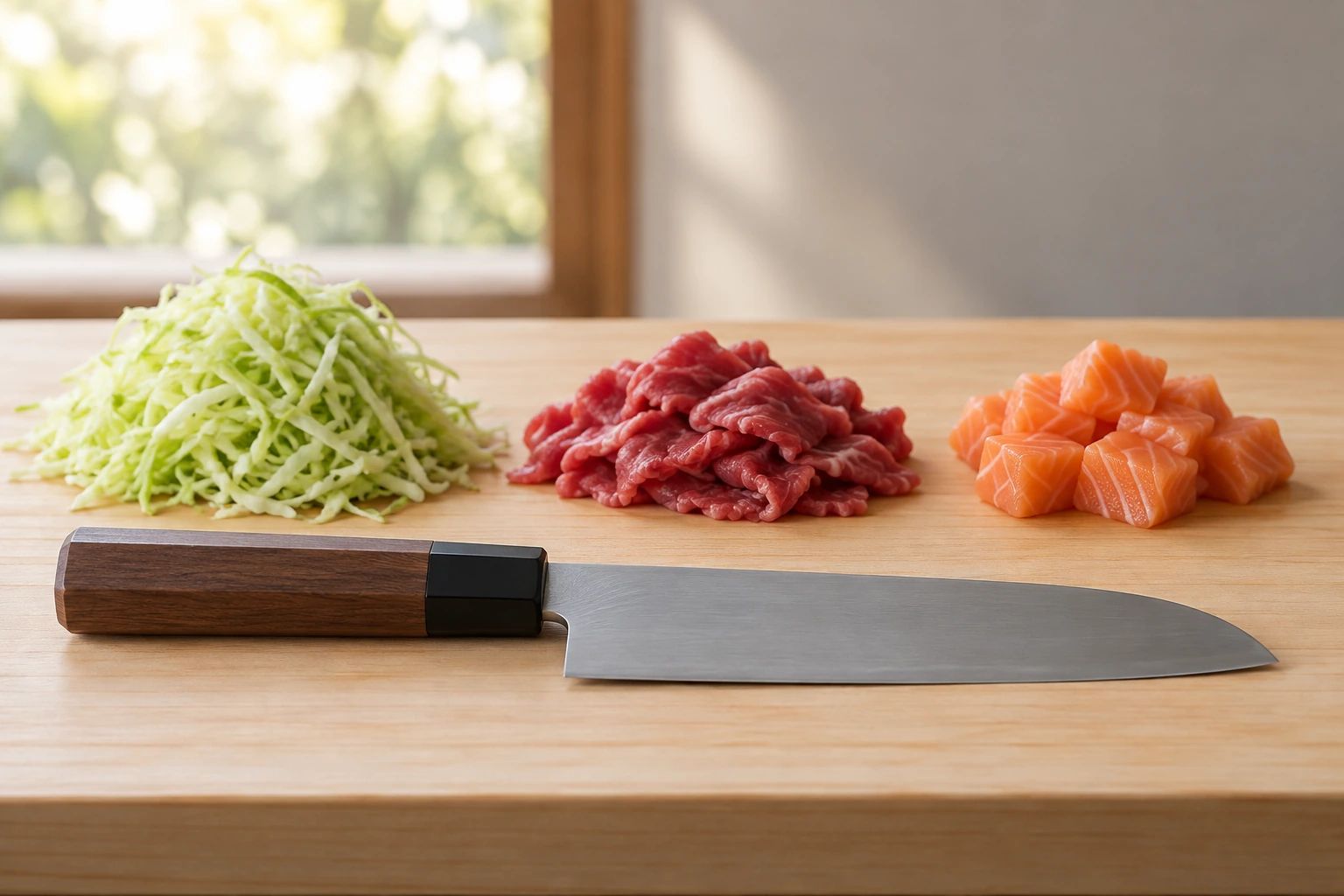
Table of Contents
TL;DR — What a santoku is actually for
The santoku is a Japanese all-rounder for "vegetables, boneless meat, and pre-filleted fish." It handles roughly 80% of home cooking, but bone-in proteins and whole-fish breakdown need dedicated tools.
- Vegetables — julienne, dice, slice, mince (the strongest use case)
- Boneless meat — chicken breast, pork tenderloin, sliced beef, ham, bacon
- Fish (after filleting) — portioning salmon, tai, saba; cubing for poke or carpaccio
- Herbs and aromatics — scallions, shiso, parsley, garlic
- Things to avoid — bone-in meat, frozen blocks, hard squash skin, deep rocking, katsuramuki
In short: the santoku is your daily push-cut prep knife. One blade does most of the work; the specialist jobs belong to specialist knives.
What a santoku is — the "three virtues"
Santoku (三徳) literally means "three virtues" — vegetables, meat, fish. It emerged in postwar Japanese homes as a bridge between the traditional nakiri and Western chef knives. Blade length 165-180mm, mostly flat profile with a gentle curved tip, thin spine, hard steel (HRC 58-63).
Three design choices define it:
- Thin blade. Spine thickness at the heel is 1.8-2.5mm — significantly thinner than a Western chef knife (3.0-4.0mm). Less metal to push through food means less resistance, cleaner cut faces.
- Flat profile. The whole edge lands on the board in a single push-cut motion. The belly curve is minimal — this is not a rocking knife.
- Hard steel. VG-10, AUS-10, SG2, Ginsanko at HRC 60+. Holds a sharp edge longer but is less forgiving of lateral force and bone contact.
These three together make the santoku a tool optimized for Japanese push-cutting, not a Western rocking knife in a different shape.
Vegetable work — the primary use case
Where the santoku shines. The flat edge plus thin spine is the ideal combination for cutting vegetable cells cleanly rather than crushing them.
- Cabbage julienne. Lay a half-head flat, push-cut vertically. 1-2mm slices in a continuous rhythm.
- Onion dice. Vertical cuts, horizontal cuts, then cross-cuts from the top. A 170mm blade matches a standard onion well.
- Cucumber, carrot rounds. The flat edge contacts the board evenly heel-to-tip, so disc thickness stays uniform.
- Herb mince. Shiso, parsley, scallions — light rocking near the tip is acceptable.
- Tomato and citrus. A sharp tip enters the skin without crushing the pulp. A well-honed santoku will sink into a tomato under its own weight.
In our tests, 95% of cooks who switched from a Western chef knife to a 170mm santoku reported a visible difference in cut quality on day one — less crushed cabbage, less weepy salad, longer shelf life on prepped produce.
Meat work — boneless only
The santoku is a boneless-meat workhorse. Anything off-the-bone, pre-sliced, or pre-filleted is fair game. Anything with bone is not.
- Chicken breast cutlets. Slice across the grain at an angle, push-cut piece by piece. Blade length matches a single breast.
- Pork tenderloin medallions. Clean 1cm slices, even on fatty cuts — the thin profile resists sticking.
- Sliced beef portioning. Cutting shabu-shabu or sukiyaki strips down to bite-size.
- Bacon and ham slicing. A sharp tip gives even thin slices.
- Final trim on steak. Removing silver skin or extra fat pre-cook.
Avoid: bone-in chicken breakdown (use a honesuki), pork spareribs (use a cleaver), frozen meat (defrost first). One hard bone contact will chip an HRC 60+ blade. Repair runs $30-100, so switch knives whenever bone might be involved.
Fish work — after the fillet
The santoku handles post-fillet fish work. Breaking down a whole fish belongs to a deba; slicing sashimi belongs to a yanagiba. The santoku covers the middle ground — portioning and prep.
- Portioning fillets. Cutting a salmon side into pan-sized pieces, dividing a tai fillet for plating.
- Cubing for poke or tartare. Even small cubes from a tuna or salmon block.
- Separating belly and back. Final trim on a side already filleted.
- Roe portioning. Tarako, mentaiko, cod roe blocks.
What it can't do: three-piece a whole fish. The santoku blade is too rigid to flex along a spine, so you lose meat to the bone. For home filleting, add a 150-180mm double-bevel deba or a Western flexible boning knife. See our Japanese knife types guide.
The correct technique — push-cut, not rock
The santoku's real magic is push-cutting. Cooks coming from a Western chef knife typically need a couple of weeks to switch the motor pattern.
Push-cut fundamentals:
- Place the edge horizontally above the food
- Push the knife forward and down — diagonally, not straight down
- Carry the cut from heel to tip in one motion
- Once the edge fully contacts the board, lift cleanly and reset for the next slice
How this differs from rocking: rocking pivots the blade fore-and-aft to mince finely; it relies on the curved belly of a Western chef knife. Try this on a flat santoku and the heel lifts off the board, leaving uncut bridges. The santoku rule: "one motion per cut."
Grip: most professionals use a pinch grip — thumb and forefinger pinch the blade at the bolster, the other three fingers wrap the handle. Better edge control, less wrist fatigue. See our how-to-choose guide.
What a santoku should never do
The santoku is versatile, not omnipotent. These jobs will damage the edge:
| Avoid | Why | Use instead |
|---|---|---|
| Bone-in chicken breakdown | Hard edge chips on bone | Honesuki, Western boning knife |
| Whole-fish three-piecing | Blade too rigid to follow spine | Deba |
| Frozen food | Cold steel becomes brittle, chips | Dedicated freezer knife, or defrost first |
| Hard squash skin (kabocha) | Lateral force bends or chips edge | Heavy Western chef knife, cleaver |
| Katsuramuki (daikon ribbon) | Double-bevel can't produce thin sheet | Usuba |
| Slicing crusty bread | Crust chips the edge | Serrated bread knife |
| Big-block rocking work | Flat profile doesn't rock | Gyuto (210-240mm) |
Stick to these boundaries and a santoku will last 10+ years. Hit bone once and you can lose half its life in a single contact.
Santoku vs Western chef knife
Both are "kitchen all-rounders" but the design philosophy is opposite.
| Spec | Santoku | Western chef knife |
|---|---|---|
| Blade length | 165-180mm | 200-250mm |
| Edge profile | Mostly flat | Curved belly |
| Spine thickness | 1.8-2.5mm | 3.0-4.0mm |
| Hardness (HRC) | 58-63 | 54-58 |
| Cutting motion | Push-cut | Rock-cut |
| Strength | Vegetables, julienne, slicing | Large proteins, rocking mince |
| Weight | 140-180g | 200-280g |
| Edge angle (per side) | 15-17° | 20-22° |
| Sharpening interval (home) | 4-8 weeks | 2-4 weeks |
| Price band | $60-400 | $80-500 |
Short version: santoku is "thin, hard, flat"; the chef knife is "thicker, tougher, curved." Vegetable-forward push-cut cook → santoku. Meat-forward rocking cook → chef knife. See our deeper take in Japanese vs German.
Buyer's guide and recommended models
Three priorities for a first santoku:
- Size — 170mm standard, adjust to hand and board.
- Steel — beginners: VG-10 or AUS-10 stainless. Stain-resistant, easy maintenance. Carbon (Shirogami #2, Aogami #2) is for committed users.
- Handle — wa (octagonal magnolia) is light and traditional; yo (riveted laminate) is more water-resistant.
Editor picks (USD ballpark, May 2026):
- Tojiro DP Santoku 170mm (~$80) — VG-10 core, the entry default.
- MAC Professional 6.5" (~$180) — proprietary high-carbon, pro kitchen staple.
- Misono UX10 Santoku 180mm (~$250) — Swedish stainless, refined feel.
- Shun Classic 7" (~$220) — VG-MAX core, widest North American availability.
- Sakai Takayuki Ginsan (~$150) — Ginsanko stainless, traditional Sakai forging.
In Tokyo, Kappabashi is the best place to hold options in hand. See our annual picks in best Japanese knives 2026 and first Japanese knife buyer's guide.