Bunka Knife: The K-Tip All-Rounder, Explained (2026)
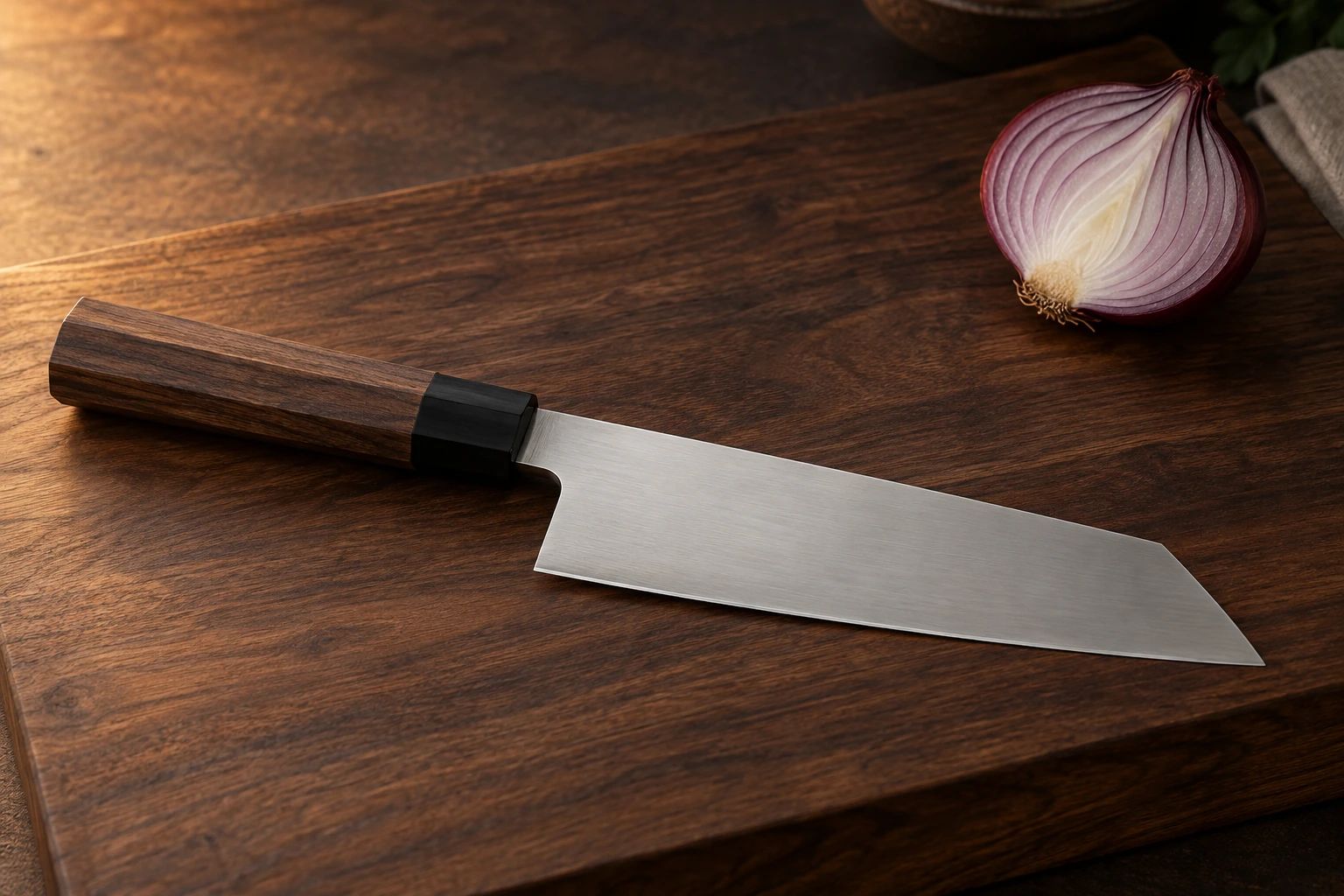
Table of Contents
The bunka knife is one of Japan's best-kept kitchen secrets — a versatile, all-purpose blade that combines the everyday practicality of a santoku with the precision tip work of a chef's knife. With its distinctive angular k-tip and flat edge profile, the bunka (文化包丁) has surged in popularity among knife enthusiasts and home cooks looking for something that goes beyond the standard santoku.
This guide covers everything you need to know about the bunka knife: its history, what makes the k-tip blade unique, how it compares to the santoku and gyuto, which steels and sizes to choose, our top recommendations, and how to care for it properly.
What Is a Bunka Knife?
A bunka knife (文化包丁, bunka bōchō) is a general-purpose Japanese kitchen knife typically measuring 165-180mm (6.5-7 inches). It shares many characteristics with the santoku — a flat edge profile, double-bevel grind, and an all-purpose design meant for meat, fish, and vegetables. What sets the bunka apart is its k-tip: an angular, reverse tanto point that creates a sharp, defined tip where the spine drops to meet the edge.
This tip geometry gives the bunka enhanced precision for detailed knife work — scoring fish skin, making fine cuts into proteins, trimming fat, and performing intricate vegetable cuts that a santoku's rounded tip cannot match. Think of the bunka as a santoku that gained a scalpel-like point without losing any of its everyday versatility.
What Does "Bunka" Mean?
The word bunka (文化) translates to "culture" in Japanese. The full name, bunka bōchō (文化包丁), literally means "culture knife." This name was given during the post-war period when Japan was rapidly adopting Western culinary influences — the bunka represented the new "cultural" approach to cooking that blended Japanese and Western techniques.
The name carries the same spirit as other Japanese terms from that era: bunka jutaku (文化住宅, "culture housing") referred to modernized apartment buildings, and bunka nabe (文化鍋, "culture pot") described new-style cooking pots. The "bunka" prefix signaled modernity and Western-influenced innovation.
History of the Bunka Knife
The bunka knife emerged in Japan during the late 1940s and 1950s, alongside the santoku, as part of the same wave of kitchen knife innovation. After World War II, Japanese home cooking underwent a dramatic shift. The traditional diet — built around rice, fish, and vegetables — expanded to include Western-style meat dishes, bread, dairy, and new cooking techniques.
Japanese households had traditionally used specialized single-purpose knives: the deba for breaking down fish, the nakiri for vegetables, and the yanagiba for slicing sashimi. But this new, diverse cuisine demanded a single, versatile knife that could handle everything. Knifemakers in regions like Seki (Gifu Prefecture) and Sakai (Osaka Prefecture) responded by developing general-purpose double-bevel knives inspired by Western chef's knives but adapted for Japanese cutting techniques.
Two designs emerged from this period: the santoku, with its rounded sheepsfoot tip, and the bunka, with its angular k-tip. Both served the same purpose, but the bunka retained more of the aggressive, pointed geometry that Japanese cooks valued for precision work. Over time, the santoku became the dominant general-purpose knife in Japanese homes, while the bunka remained popular in certain regions and among cooks who preferred its sharper tip.
In recent years, the bunka has experienced a global renaissance. Western knife enthusiasts — many already familiar with the santoku — discovered the bunka's k-tip design and recognized its advantages for precision cutting. Today, virtually every major Japanese knife brand offers at least one bunka model, and artisan blacksmiths in Sakai, Takefu, and Tosa produce handcrafted bunka knives that command premium prices.
The K-Tip: Bunka's Signature Blade Shape
The defining feature of a bunka knife is the k-tip — a sharp, angular point created by the spine dropping down at an angle to meet the cutting edge. This geometry is sometimes called a reverse tanto because it mirrors the tanto-style tip found on Japanese tactical knives, but inverted.
The k-tip provides several practical advantages over the santoku's rounded sheepsfoot tip:
- Precision tip work: The sharp point allows you to score fish skin, pierce packaging, make starter cuts, and perform fine detail work with surgical accuracy.
- Better food release: The angular spine creates more clearance between the blade and your knuckles, reducing contact with food as you cut.
- Aesthetics: The k-tip gives the bunka a distinctive, aggressive appearance that many knife enthusiasts find visually striking.
- Versatility: The tip is useful for tasks that would normally require a petty knife — trimming silver skin, deveining shrimp, or making small incisions.
Reverse Tanto Geometry
The "reverse tanto" name describes the angular meeting point of the spine and the secondary bevel at the tip. In a standard tanto (as seen on Japanese short swords), the bottom edge angles upward to meet the spine. In a reverse tanto, the spine angles downward to meet the edge — creating the bunka's characteristic angular silhouette.
This geometry strengthens the tip compared to a fine, tapered point like a gyuto's. The extra material behind the edge near the tip makes it more resistant to chipping — an important consideration given that Japanese knives use harder, more brittle steels (typically 60-66 HRC). The result is a tip that is both precise and durable.
Bunka vs Santoku vs Gyuto
The bunka sits between the santoku and gyuto in terms of capability. Here is how the three most popular Japanese all-purpose knives compare:
| Feature | Bunka | Santoku | Gyuto |
|---|---|---|---|
| Typical length | 165-180mm | 165-180mm | 210-270mm |
| Tip shape | K-tip (reverse tanto) | Sheepsfoot (rounded) | Pointed, tapered |
| Edge profile | Flat | Flat | Slight curve (belly) |
| Weight | 110-170g | 100-170g | 140-220g |
| Cutting technique | Push cut, chop, tip work | Push cut, chop | Push cut, rock chop, slice |
| Precision tip work | ★★★★★ | ★★★ | ★★★★ |
| Vegetable cutting | ★★★★★ | ★★★★★ | ★★★★ |
| Protein slicing | ★★★★ | ★★★ | ★★★★★ |
| Beginner-friendly | ★★★★ | ★★★★★ | ★★★★ |
| Best for | Versatility + precision | Everyday home cooking | Professional kitchens, large cuts |
Choose a bunka if you want an all-purpose knife with superior tip precision. Choose a santoku if you want the safest, most forgiving all-rounder. Choose a gyuto if you need a longer blade for larger proteins and professional volume.
How to Use a Bunka Knife
The bunka knife is designed for the same push-cutting and chopping techniques as the santoku, but with the added ability to use the tip for detail work. Mastering a few core techniques will unlock the full potential of this knife.
Cutting Techniques
- Push cut: The primary technique. Place the blade on the ingredient and push forward and down in a single, smooth motion. Lift, reposition, repeat. The flat edge ensures full contact with the cutting board for clean, complete cuts through vegetables and boneless proteins.
- Tap chop: For herbs, garlic, and small ingredients, use a rapid up-and-down chopping motion. The flat profile keeps the blade parallel to the board, producing an even mince.
- Tip scoring: Use the k-tip to score fish skin before pan-searing (preventing curling), make shallow incisions in meat for marinades, or create decorative cuts in vegetables. The angular point provides far more control than a rounded tip.
- Draw cut: For slicing proteins like chicken breast or sashimi-grade fish, pull the blade toward you in a long, smooth stroke. While a bunka is not as long as a sujihiki or yanagiba, its sharp edge handles draw cuts effectively at shorter lengths.
What Is a Bunka Best For?
The bunka truly shines in these kitchen tasks:
- Daily vegetable prep: Onions, carrots, daikon, cabbage — the flat edge and tall blade make quick work of any vegetable.
- Scoring and trimming: Fish skin scoring, fat trimming, silver skin removal — the k-tip excels where rounded tips falter.
- Precision cuts: Brunoise, chiffonade, fine julienne — the angular tip gives you a defined starting point for detailed cuts.
- All-in-one meal prep: When you are preparing a complete meal and need one knife to handle everything from proteins to garnishes, the bunka is the ideal single-knife choice.
Steel Types for Bunka Knives
The steel in a bunka knife determines its sharpness, edge retention, toughness, and maintenance requirements. Japanese bunka knives are available in a wide range of steels.
Carbon Steel
Carbon steel bunka knives take the sharpest edges and are favored by professional chefs and knife enthusiasts. The trade-off is that they are reactive — they will develop a patina (discoloration) and can rust if not dried after each use.
- Shirogami (White Steel) #2: Pure, fine-grained carbon steel. Takes an extremely sharp edge and is easy to sharpen. Moderate edge retention. The classic choice for traditional Japanese knives.
- Aogami (Blue Steel) #2: Contains chromium and tungsten additions for better edge retention and toughness than white steel. Slightly harder to sharpen but holds its edge longer. The most popular carbon steel for mid-range to premium bunka knives.
- Aogami Super: The highest-performing carbon steel, with vanadium added for exceptional edge retention. Harder to sharpen than Blue #2 but holds an edge significantly longer. Found in premium artisan knives.
Stainless Steel
Stainless steel bunka knives offer convenience — they resist corrosion and require less maintenance. Modern Japanese stainless steels perform remarkably well.
- VG-10: The workhorse of Japanese stainless steels. Excellent sharpness, good edge retention, and easy maintenance. Used by Shun, Tojiro DP, and many mid-range brands. The best choice for most home cooks.
- AUS-10: Similar to VG-10 but slightly tougher and easier to sharpen. Found in value-oriented Japanese knives.
- SG2 / R2 (Powder Steel): A premium powdered stainless steel with exceptional edge retention — comparable to the best carbon steels while remaining stain-resistant. Used in high-end lines from Miyabi and others. Expensive but outstanding.
- Ginsan (Silver-3): A stainless steel that sharpens like carbon steel. Popular with Sakai artisans. Offers a unique middle ground between the sharpening ease of carbon and the convenience of stainless.
For a detailed breakdown of every steel type, see our complete guide to Japanese knife steels.
Bunka Knife Size Guide
Bunka knives typically range from 160mm to 180mm. Unlike the gyuto, the bunka is not designed to be a large knife — its strength lies in the combination of compact size and precision. Here is how to choose:
| Size | Best For | Notes |
|---|---|---|
| 165mm (6.5") | Smaller hands, compact kitchens, precision work | The most maneuverable size. Excellent as a secondary knife alongside a gyuto. |
| 170mm (6.7") | Most home cooks, all-purpose daily use | The most popular and recommended size. Balances versatility and control perfectly. |
| 180mm (7") | Larger hands, bigger cutting tasks, sole kitchen knife | Extra blade length provides more surface area for scooping food and cutting larger vegetables. |
If this is your only knife, go with 170mm or 180mm. If you already own a gyuto or chef's knife and want the bunka as a precision companion, 165mm works beautifully.
Best Bunka Knives 2026
Our recommendations span every budget, from accessible entry-level knives to artisan-forged collectibles.
Best Budget Bunka (Under $80)
Tojiro DP Bunka 170mm — VG-10 stainless steel with a laminated construction. Excellent sharpness out of the box, a well-defined k-tip, and outstanding value. The Tojiro DP line is the benchmark for budget Japanese knives, and the bunka version is no exception. A perfect starting point.
Best Mid-Range Bunka ($80-$180)
Makoto Kurosaki AS Bunka 170mm — Aogami Super core with stainless cladding. Hand-forged in Takefu Knife Village by one of the region's most talented young blacksmiths. The nashiji (pear-skin) finish reduces food sticking, and the Aogami Super steel delivers exceptional edge retention. A knife that punches well above its price.
Best Premium Bunka ($180-$350)
Yu Kurosaki Senko Bunka 165mm — SG2/R2 powder steel with a striking hammered finish. Made by Yu Kurosaki, one of Takefu's most acclaimed blacksmiths. The SG2 steel holds an edge for weeks of daily use, and the thin grind produces effortless cuts. A knife that is as beautiful as it is functional.
Best Artisan Bunka ($350+)
Yoshimi Kato SG2 Damascus Bunka 170mm — 33-layer Damascus cladding over an SG2 core. Kato-san is one of Takefu Knife Village's master blacksmiths, and every knife is hand-forged individually. The Damascus pattern is unique to each piece, and the SG2 core delivers world-class performance. A collector's knife that also happens to be an exceptional daily tool.
Care & Maintenance
Proper care will keep your bunka knife performing at its best for decades. Japanese knives use harder steels than Western knives, which means they hold sharper edges but require more thoughtful handling.
- Hand wash only: Never put a bunka knife in the dishwasher. The heat, detergents, and contact with other items will damage the edge and handle. Wash with warm water and mild soap immediately after use, then dry thoroughly.
- Dry immediately: Especially important for carbon steel bunka knives. Even stainless steel benefits from prompt drying to prevent water spots and mineral buildup.
- Use the right cutting surface: Always use a wooden or soft plastic cutting board. Avoid glass, ceramic, marble, or bamboo boards — these will dull and chip the hard Japanese steel.
- Store properly: Use a magnetic knife strip, a knife block with horizontal slots, or blade guards. Never store loose in a drawer where the edge can contact other utensils.
- Sharpen with whetstones: Use a 1000-grit whetstone for primary sharpening and a 3000-6000 grit stone for polishing the edge. Avoid pull-through sharpeners, which remove too much material and cannot match the geometry of the k-tip. Maintain a 10-15 degree angle per side.
- Avoid hard ingredients: Do not use a bunka to cut through bones, frozen foods, hard squash shells, or coconuts. The hard, thin steel can chip. Use a deba or Western chef's knife for heavy-duty tasks.
For the complete care guide, see our Japanese knife maintenance article.