Usuba Knife: The Professional Japanese Vegetable Knife
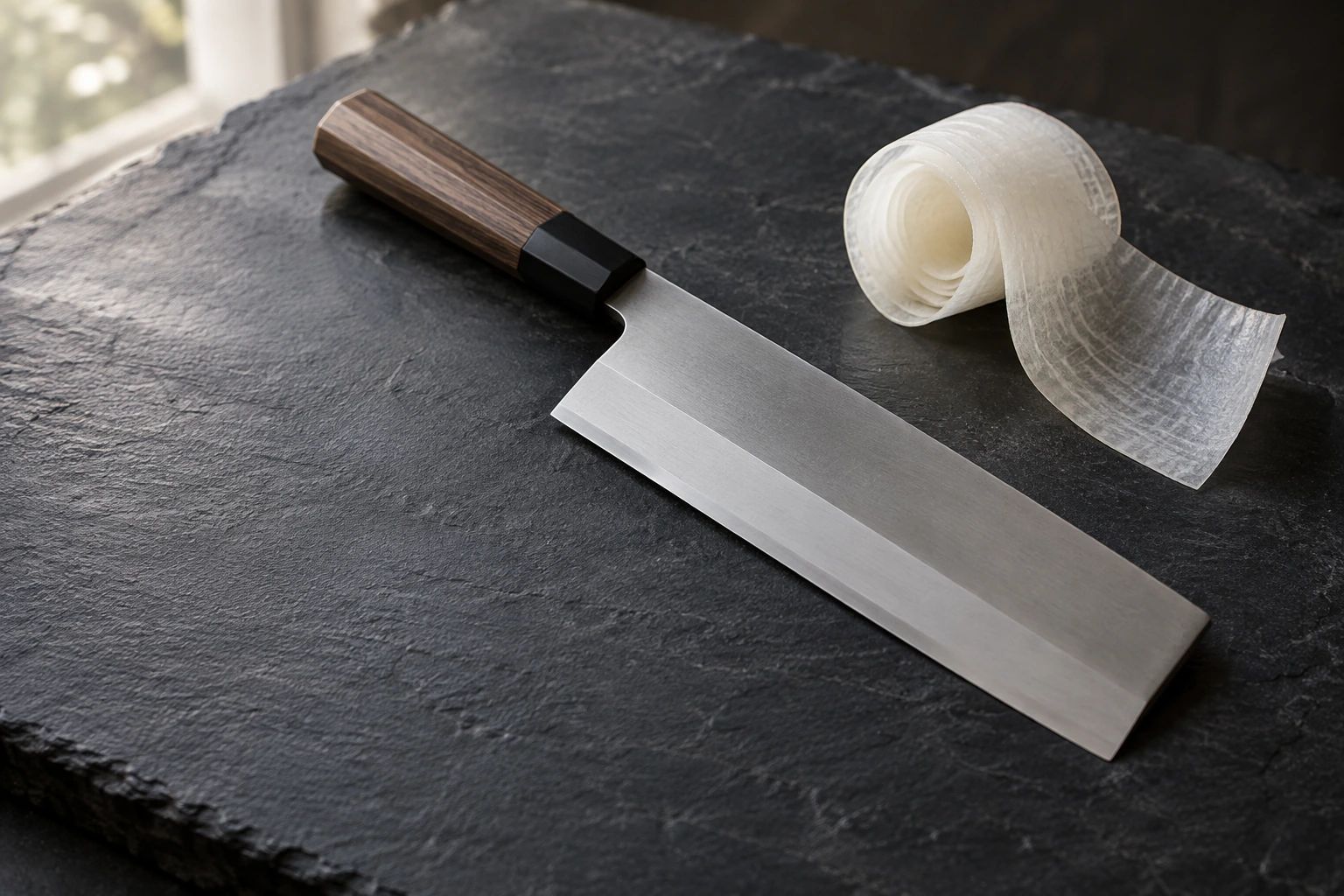
Table of Contents
The usuba knife (薄刃包丁, "thin blade knife") is the professional Japanese vegetable knife — a single-bevel blade designed for katsuramuki, decorative cuts, and the precision vegetable work demanded in high-end Japanese cuisine. Where the nakiri is the home cook's vegetable knife, the usuba is its professional counterpart, requiring skill and discipline but rewarding the user with cuts that no other knife can produce.
What Is an Usuba Knife?
The usuba (薄刃, literally "thin blade") is a single-bevel Japanese kitchen knife with a tall, rectangular blade typically ranging from 165mm to 210mm. Unlike double-bevel knives that are sharpened on both sides, the usuba is ground on one side only, creating an extremely acute cutting edge that can produce paper-thin, translucent vegetable slices.
The knife's defining characteristics are:
- Single bevel (kataba) — sharpened on the right side only (for right-handed users), with a hollow-ground concave back (ura)
- Tall, rectangular blade — provides knuckle clearance and enables the long, continuous cuts needed for katsuramuki
- Thin edge geometry — the single bevel produces a more acute angle than any double-bevel knife, enabling cuts as thin as 1mm
- Flat blade profile — full contact with the cutting board for clean, precise push cuts
- Carbon steel construction — traditionally forged from Shirogami (White Steel) or Aogami (Blue Steel) for maximum sharpness
In professional Japanese kitchens, the usuba is one of the three essential traditional knives (alongside the deba for fish and the yanagiba for slicing sashimi). Every apprentice training in washoku (Japanese cuisine) must master the usuba to progress.
History: Kanto vs Kansai Styles
The usuba evolved differently in Japan's two great culinary centers, producing two distinct styles that remain in use today:
Kanto Style (Tokyo) — Edo Usuba
The Kanto usuba, also called Edo usuba after Tokyo's former name, has a squared-off tip with a perfectly rectangular blade profile. This is the most common usuba style and what most people picture when they hear "usuba knife." The square tip is well-suited for precise push cuts and provides maximum blade surface for katsuramuki. Kanto-style usubas are the standard in Tokyo's culinary schools and are the style most commonly exported internationally.
Kansai Style (Osaka) — Kamagata Usuba
The Kansai usuba, known as kamagata usuba (鎌形薄刃, "sickle-shaped thin blade"), has a distinctive pointed tip that curves slightly downward. This pointed profile originated in the Osaka-Kyoto region, where chefs use the tip for intricate decorative cuts (kazari-giri) — carving vegetables into flowers, leaves, and other ornamental shapes for kaiseki cuisine. The kamagata usuba excels at detail work that the square-tipped Kanto style cannot match, making it the preferred choice for chefs specializing in kaiseki presentation.
Which to choose: If you primarily need the usuba for katsuramuki and general vegetable prep, the Kanto style is more versatile. If you plan to pursue decorative vegetable carving, the kamagata usuba's pointed tip is essential.
Single-Bevel Design Explained
The usuba's single-bevel construction is what separates it from the nakiri and gives it unique cutting capabilities. Understanding this design is essential for using and maintaining the knife properly.
The Cutting Side (Omote)
The right face of the blade (for right-handed knives) is ground at approximately 10-15 degrees to form the cutting edge. This single-sided grind creates an edge angle roughly half that of a comparable double-bevel knife, producing a significantly sharper cutting surface.
The Flat Back (Ura)
The left face of the blade features a shallow concave hollow (urasuki) — a deliberate concavity that reduces surface contact between the blade and food. This hollow grind serves three purposes: it reduces friction during cutting, helps food release from the blade, and makes it easier to sharpen the back side flat. The ura should never be aggressively sharpened; only gentle, flat strokes are needed to remove the burr formed when sharpening the omote.
Cutting Behavior
Because the blade is ground on one side only, it naturally steers away from the flat back during cutting. For a right-handed usuba, this means the blade drifts slightly to the left. Experienced users compensate for this drift instinctively, but beginners will find the blade pulling off-line. This is the primary reason the usuba is considered a professional tool — mastering the drift compensation takes practice.
Katsuramuki Technique
Katsuramuki (桂剥き) is the defining technique of the usuba knife — a continuous rotary peeling motion that transforms a cylinder of daikon radish into a single, unbroken sheet of translucent vegetable. This technique is the foundation of professional Japanese vegetable preparation and is considered the benchmark test of a chef's knife skills.
The process involves:
- Preparation — Cut a section of daikon into a cylinder roughly 10-15cm long and trim both ends flat
- Initial cut — With the bevel facing the daikon, position the blade so it barely catches the surface
- Rotation — Slowly rotate the daikon with your left hand while feeding the blade forward with your right thumb. The sheet should peel off in a continuous ribbon roughly 1-2mm thick
- Control — Maintain consistent thickness by controlling blade pressure through your right thumb. The single bevel guides the blade along the cylinder's surface naturally
A skilled chef can produce a katsuramuki sheet thin enough to read newspaper print through it. The resulting sheet is then stacked and cut into ultra-fine julienne (katsura-muki ken) for sashimi garnish — the delicate strands of daikon served alongside raw fish at every sushi restaurant.
Why only the usuba works: The single-bevel edge naturally follows the curve of the daikon, producing a sheet of even thickness. A double-bevel nakiri would require constant manual adjustment and produce an uneven sheet. Katsuramuki is, in practical terms, impossible with any knife other than a properly sharpened single-bevel usuba.
Usuba vs Nakiri
| Feature | Usuba | Nakiri |
|---|---|---|
| Bevel | Single (one side only) | Double (both sides) |
| Skill level | Professional / advanced | All levels |
| Katsuramuki | Yes — designed for it | Not possible |
| Decorative cuts | Excellent (especially kamagata) | Limited |
| General vegetable prep | Excellent (with skill) | Excellent |
| Sharpening difficulty | High — single-bevel technique required | Easy — standard double-bevel |
| Steel | Typically carbon (Shirogami, Aogami) | Carbon or stainless (VG-10, AUS-10) |
| Blade drift | Yes — steers away from flat back | No — cuts straight |
| Price range | $120-500+ | $50-300 |
| Maintenance | High — rust prevention, precise sharpening | Low to moderate |
Bottom line: The nakiri is the right vegetable knife for 95% of home cooks. The usuba is for serious practitioners who want to perform katsuramuki, decorative cuts, or simply work at the professional level. We cover this comparison in depth in our dedicated usuba vs nakiri guide.
Steel Types
Traditional usubas are forged from carbon steel, which takes and holds a finer edge than stainless. The two main families used in usuba production:
Shirogami (White Steel)
- Shirogami #2 (White #2) — The most common usuba steel. Pure high-carbon steel with no alloying elements. Takes an exceptionally keen edge and is the easiest carbon steel to sharpen. Ideal for learning single-bevel sharpening. The trade-off: lower edge retention than Blue Steel, requiring more frequent sharpening
- Shirogami #1 (White #1) — Higher carbon content than #2 for slightly better edge retention and hardness. Sharpens almost as easily. A step up for experienced users
Aogami (Blue Steel)
- Aogami #2 (Blue #2) — Contains tungsten and chromium additions that improve edge retention and toughness. Holds an edge longer than White Steel but is slightly more difficult to sharpen. The professional's choice for daily-use usubas
- Aogami #1 (Blue #1) — Higher carbon and tungsten than #2. Excellent edge retention at the cost of slightly more challenging sharpening
- Aogami Super (Blue Super) — The highest-performance carbon steel available. Maximum edge retention and hardness. Noticeably harder to sharpen. Reserved for experienced users who want the best possible cutting performance and do not mind the sharpening challenge
Recommendation: Start with Shirogami #2 if this is your first usuba. It is the most forgiving to sharpen and still produces an extraordinary edge. Move to Aogami #2 once you are confident in your single-bevel sharpening technique.
Size Guide
| Size | Use Case | Who It's For |
|---|---|---|
| 165mm | Compact prep, smaller vegetables | Home cooks, smaller hands |
| 180mm | Standard professional size | Most users — the default recommendation |
| 195mm | Larger daikon, cabbage prep | Professional chefs with space |
| 210mm | High-volume professional work | Experienced professionals |
180mm is the standard. It provides enough blade length for katsuramuki on standard daikon while remaining manageable for general vegetable prep. If you are unsure, choose 180mm.
Best Usuba Recommendations
Best Entry-Level: Tojiro Shirogami Usuba (180mm) — ~$120
White #2 steel, traditional hon-kasumi finish. Tojiro's entry usuba offers genuine single-bevel performance at a price that makes it accessible for cooks exploring professional-level vegetable work. The edge quality is surprisingly good for the price, and White #2 is the most forgiving steel to learn single-bevel sharpening on.
Best Mid-Range: Sakai Takayuki Kasumitogi Usuba (180mm) — ~$180
White #2 steel with soft-iron cladding, hon-kasumi finish. Sakai Takayuki is one of Sakai's most established makers, and their kasumitogi (mist finish) usuba represents the sweet spot between price and professional quality. The balance and edge geometry are refined enough for serious katsuramuki practice.
Best Professional: Masamoto KS Usuba (180mm) — ~$280
White #2 steel, made by one of Tokyo's most respected knife houses. Masamoto's KS series is the workhorse of professional sushi kitchens across Japan. The fit, finish, and edge geometry are impeccable. This is the usuba that culinary school instructors use to demonstrate katsuramuki — a benchmark knife that performs at the highest level day after day.
Best Premium: Ashi Hamono Usuba (180mm) — ~$350
Swedish steel core, hand-forged in Sakai by one of the region's finest craftsmen. Ashi Hamono's usubas are renowned among professionals for their exceptional thinness and edge quality. The Swedish steel used offers a balance between the pure sharpness of Japanese carbon steel and slightly improved corrosion resistance. A chef's knife in the truest sense.
Best Kamagata: Sukenari Aogami Super Kamagata Usuba (180mm) — ~$400
Blue Super steel, Kansai-style pointed tip. For chefs who need both katsuramuki capability and a pointed tip for decorative vegetable carving. Sukenari Co., Ltd. (trademark 佑成) forges in Toyama City, not Echizen, and has done since 1933, and the Blue Super core provides edge retention that minimizes sharpening interruptions during service. The kamagata tip enables kazari-giri work that flat-tipped usubas simply cannot perform.
Care & Maintenance
Single-Bevel Sharpening
- Sharpen the bevel side (omote) at 10-15 degrees on a 1000-grit whetstone. Use long, even strokes along the full length of the stone. Maintain consistent angle throughout
- Remove the burr from the flat back (ura) by laying the blade completely flat on the stone and making 2-3 light passes. Critical: do not lift the spine — the ura must remain flat
- Polish on 3000-6000 grit using the same technique. The finer grit refines the edge for the clean, polished cuts that usuba work demands
- Strop or use an 8000+ grit stone for the final edge. Professional usuba users often finish on natural stones (tennen toishi) for the ultimate refinement
Rust Prevention for Carbon Steel
All traditional usubas are carbon steel and will rust if not properly cared for:
- Wipe immediately after use — never leave the blade wet, even for a few minutes
- Hand wash only — never use a dishwasher; the harsh detergents and moisture will cause severe rust and damage the handle
- Dry thoroughly before storing. Use a clean, dry cloth and ensure the blade is completely dry, including the area where blade meets handle
- Apply a thin coat of camellia oil (tsubaki oil) before storage, especially if the knife will not be used for several days
- Store in a knife roll, saya (wooden sheath), or on a magnetic rack — never loose in a drawer where it can contact other metal
A natural patina will develop on the blade over time as the carbon steel reacts with food acids. This patina is normal and actually helps protect against further rust. Do not try to remove it.