Best Japanese Cleaver 2026: The Chukabocho, Honestly Reviewed
QUICK ANSWER
The best "Japanese cleaver" is the chukabocho — a thin, light all-purpose vegetable cleaver. The Sugimoto No.6 (~$120-160) is the benchmark. It is not a bone chopper: never use it on bone.
What it is
Thin vegetable cleaver
Benchmark (JP)
Sugimoto No.6
NOT for
Chopping bone
Price range
~$40-200
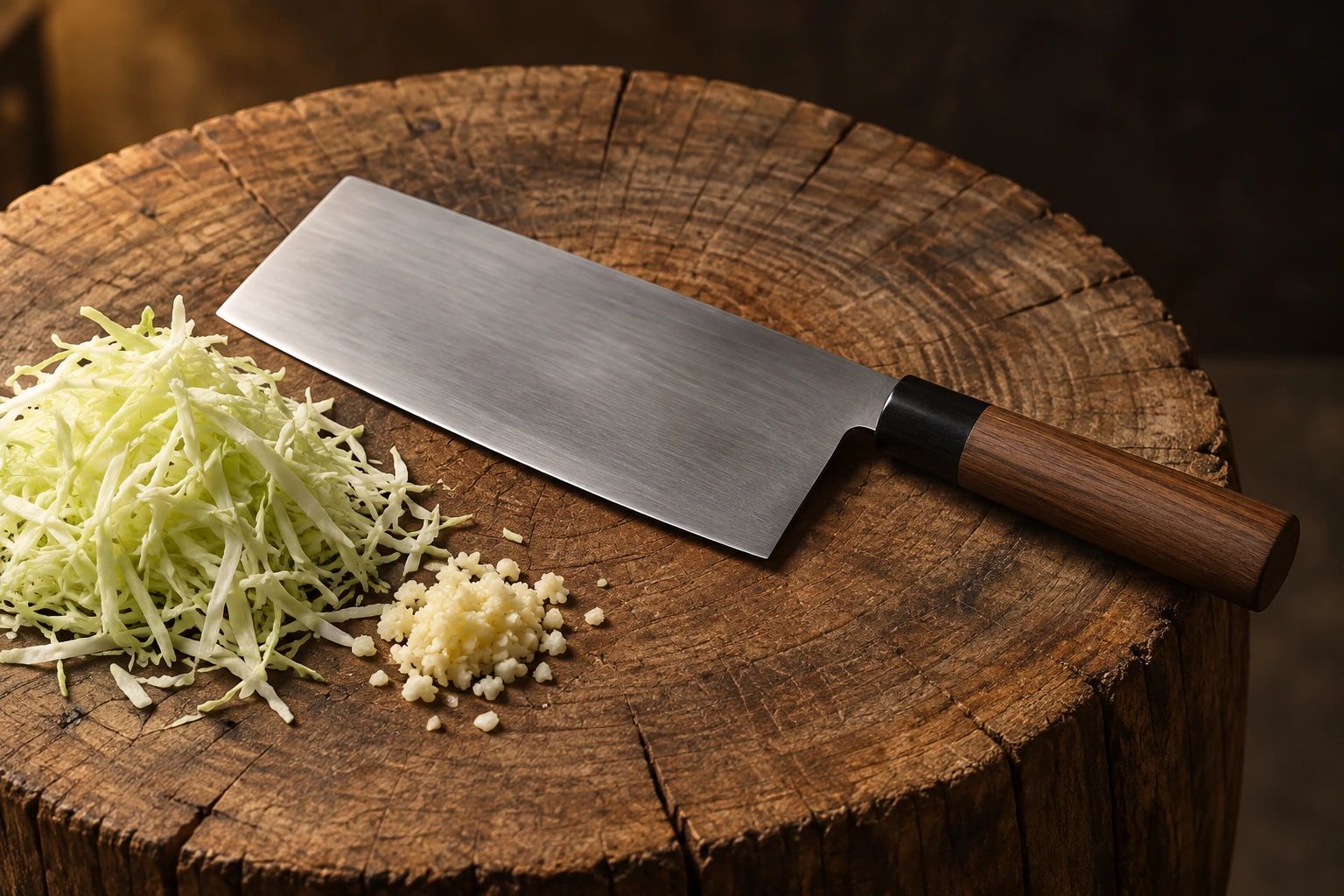
Table of Contents
TL;DR — what to buy
The benchmark Japanese cleaver is the Sugimoto No.6 chukabocho (~$120-160). It is the famous, restaurant-standard thin Chinese-style cleaver from a respected Tokyo maker — and the knife most people mean when they say "best Japanese cleaver."
- Best Japanese chukabocho — Sugimoto No.6 (~$120-160) — the editor's pick
- Best value, Chinese maker — Shibazi stainless cleaver (~$40-70) — label it Chinese, not Japanese
- Carbon enthusiast, Chinese maker — CCK (Chan Chi Kee) carbon slicer (~$50-90) — a Hong Kong classic
- Most cooks, honestly — buy a nakiri instead (see below)
- Need to chop bone? — that is a heavy Western butcher cleaver, not any knife on this page
Short version: if you want the big-blade, scoop-and-cut style, the Sugimoto No.6 is the one to beat. If you just want clean vegetables in a normal kitchen, a nakiri or santoku is the smarter buy.
Read this first: not a butcher cleaver
This is the single most important point on the page, so we are leading with it. A chukabocho is a thin, light, finely-ground vegetable and all-purpose cleaver — its edge geometry is far closer to a nakiri than to a chopper. The cleaver shape (a tall rectangular blade) fools people into thinking it is a bone tool. It is not.
A real bone-chopping cleaver — the heavy Western butcher's cleaver — is thick at the spine, soft in steel, and ground to a blunt, obtuse edge precisely so it can survive impact with bone without chipping. A chukabocho is the opposite: relatively thin, harder steel, an acute edge built for clean slicing. Take that thin edge to a chicken bone, frozen meat, or a dense kabocha squash and you will chip, roll, or even crack it.
- Chukabocho (this page) — thin, light, acute edge → vegetables, herbs, boneless meat, garlic crush, scoop-and-transfer.
- Western butcher cleaver (not a pick) — thick, heavy, obtuse edge → bone, joints, hard splitting.
The two share a silhouette and nothing else. Never use any knife on this page on bone. If bone work is your goal, buy a dedicated heavy butcher cleaver and keep it separate.
How we tested
Our protocol mirrors the rest of our field tests, adapted to the big-blade format:
- Same-food prep — quarter cabbage julienne, one onion and a daikon section diced, two tomatoes sliced, a head of garlic crushed and minced, a bunch of herbs minced, plus boneless chicken thigh portioned.
- Scoop-and-transfer — the chukabocho's signature move: how cleanly the wide face lifts a full board of prep into the pan.
- Clean-cut release — whether slices fall away cleanly or stick and "accordion" together.
- Balance and knuckle clearance — 20 minutes of continuous prep, comparing wrist fatigue and how comfortably the tall blade clears the board.
- Edge and sharpening — feel out of the box, then a session on a #1000 stone judging how readily a long, tall edge comes back.
- Maintenance reality — stainless wipe-and-go vs carbon dry-and-oil upkeep.
No bone, no frozen food, no abuse tests — because none of these knives are built for that, and pretending otherwise would be irresponsible.
Japanese chukabocho — Sugimoto
Editor #1: Sugimoto No.6 chukabocho (~$120-160)
Maker nationality: Japanese. Sugimoto Hamono is a long-established Tokyo knife maker, and the No.6 is its famous thin Chinese-style cleaver — a fixture in professional Chinese and Japanese kitchens and, for many cooks, the definition of a "Japanese cleaver." It pairs a thin, well-balanced blade with the kind of fit-and-finish you expect from an established Japanese workshop. Exact dimensions and weight vary by the specific model in the line, so check the listing, but the character is consistent: a thin vegetable/all-purpose cleaver, not a chopper. The classic No.6 is carbon (white) steel — it takes a keener edge than a stainless cleaver but must be wiped dry and lightly oiled after use, or it will rust and patina.
- Strengths — benchmark reputation, thin and nimble for a cleaver, excellent clean-cut release, strong resale of skill (it is the model tutorials reference)
- Weaknesses — premium price for the category, the tall edge takes patience to sharpen, the carbon steel needs dry-and-oil upkeep, distribution outside Japan can be patchy
- Buy if — you specifically want the iconic Japanese chukabocho and the big-blade scoop-and-cut workflow
One honesty note: among Japanese smiths, the chukabocho is a relative niche. Most Japanese makers pour their craft into the nakiri and usuba — the country's traditional vegetable knives — rather than the Chinese-style cleaver. That is exactly why Sugimoto stands out: it is one of the few Japanese names with a genuinely iconic chukabocho, instead of treating it as an afterthought.
Chinese cleavers — CCK and Shibazi
Search "Japanese cleaver" and you will inevitably meet two famous Chinese makers. We include them because they share this exact shelf and are often the better-value pick — but we label them clearly: these are Chinese makers, not Japanese.
Value pick: Shibazi stainless cleaver (~$40-70)
Maker nationality: Chinese. Shibazi (十八子作) is one of China's largest and best-known knife brands, and its stainless thin cleavers are a runaway value: a genuinely usable, low-maintenance vegetable cleaver for a fraction of the Sugimoto price. Fit-and-finish is more utilitarian and the steel is softer than a premium Japanese blade, but for a first taste of the big-blade style it is hard to argue with the cost.
- Strengths — outstanding value, stainless and forgiving, widely available, great way to try the format
- Weaknesses — softer steel dulls sooner, finish is basic, model lineup is sprawling and inconsistent
- Buy if — you want to experiment with a chukabocho without committing real money
Carbon classic: CCK (Chan Chi Kee) carbon slicer (~$50-90)
Maker nationality: Chinese (Hong Kong). Chan Chi Kee is a storied Hong Kong maker whose thin carbon-steel slicing cleavers have a cult following for taking a screaming edge. The trade-off is upkeep: carbon steel must be wiped dry and lightly oiled after every use or it rusts and patinas fast. It rewards a cook who enjoys maintenance and disappoints one who does not.
- Strengths — superb keen carbon edge, beloved by enthusiasts, fair price for the performance
- Weaknesses — carbon rust risk, needs diligent drying and oiling, supply is variable model-to-model
- Buy if — you already enjoy carbon-steel care and want a thin slicing cleaver with character
Two reminders that apply to both: these are thin slicing/vegetable cleavers, and they are Chinese-made. Neither one is a bone chopper, and neither one is Japanese — even though both turn up under "best Japanese cleaver."
The heavy Western cleaver (for contrast)
This section exists only as a contrast — it is not a pick on this page. If your actual need is splitting chicken backs, cutting through small bones, or portioning bone-in cuts, none of the thin cleavers above will do. That job belongs to a heavy Western butcher cleaver: a thick-spined, heavy, soft-steel blade with a deliberately obtuse edge that survives impact with bone. It chops by mass and momentum, not by a fine edge.
The reason we draw the line so firmly: people buy a beautiful thin chukabocho expecting it to do butcher-cleaver work, then chip it on the first chicken bone. They are different tools for different jobs. Want bone work? Buy a dedicated butcher cleaver and keep your chukabocho for vegetables. Want clean vegetable prep? Read on — and stay thin.
Honest take: should you buy a nakiri instead?
For most readers of a Japanese-knife site, the honest answer is: probably, yes. A nakiri does the same clean vegetable push-cut as a chukabocho, in a smaller, lighter, easier-to-store, easier-to-sharpen package — and it is what most Japanese smiths actually specialize in. A santoku goes one further and handles meat and fish too. Either is the more sensible single-knife answer for a typical kitchen.
So who should buy the chukabocho? The cook who genuinely enjoys the big-blade workflow: the tall face for knuckle clearance, the wide blade to scoop a whole board of diced onion into the wok in one motion, the satisfying flat-of-the-blade garlic crush, the sheer coverage per stroke. If that style appeals to you, the chukabocho is a joy and the nakiri will feel small. If it does not, you will reach for the nakiri every time and the cleaver will gather dust. Be honest with yourself about which cook you are. For the broader category, see our best Japanese knives roundup.
Full comparison table
| Model | Maker origin | Type | Steel | Price range (USD) | Bone-safe? |
|---|---|---|---|---|---|
| Sugimoto No.6 | Japanese | Thin chukabocho | Carbon (white steel) | ~$120-160 | No — vegetables only |
| Shibazi stainless cleaver | Chinese | Thin vegetable cleaver | Stainless | ~$40-70 | No — vegetables only |
| CCK (Chan Chi Kee) slicer | Chinese (HK) | Thin slicing cleaver | Carbon | ~$50-90 | No — vegetables only |
| Western butcher cleaver | Western (contrast) | Heavy bone chopper | Soft, thick | Varies | Yes — its only job |
Prices are typical street ranges and shift with model, retailer and country; treat them as guidance, not quotes. The "bone-safe" column is the whole point: only the heavy Western cleaver — which is not a pick here — belongs anywhere near bone.
Prices are approximate ranges, not live pricing — they vary by retailer, availability, tax and exchange rate. Always confirm with the seller before buying.
How to choose without regret
- Want the icon → Sugimoto No.6. The benchmark Japanese chukabocho, and the model tutorials reference. Worth the premium if the big-blade style is for you.
- Want value → Shibazi. A Chinese-made stainless cleaver for a fraction of the price — the low-risk way to find out whether you love the format.
- Love carbon care → CCK. A Hong Kong classic with a keen edge, for cooks who already dry-and-oil their carbon blades.
- Not sure → buy a nakiri. Same clean vegetable cuts, smaller and easier, and it is what most Japanese makers do best.
- Need bone work → buy a heavy Western butcher cleaver, separately. None of the thin cleavers here will survive bone.
- Mind the origin. "Japanese cleaver" results mix Japanese (Sugimoto) and Chinese (CCK, Shibazi) makers. Both are legitimate — just know which you are buying.
- Buying in Japan? Tokyo's Kappabashi kitchenware street lets you hold a chukabocho in hand before you commit, and is usually the cheapest place to buy one.
Stuck? If the big-blade style excites you, buy the Sugimoto No.6. If you just want clean vegetables, buy a nakiri. And whatever you choose here, keep it well away from bone.