Knife Tang Types: Full, Partial, and Hidden Tang Construction Explained (2026)
QUICK ANSWER
Japanese wa-handles use a hidden partial tang held by friction; Western yo-handles use a full or half tang with rivets — both are reliable when properly fitted.
Wa-handle
Hidden partial tang
Yo-handle
Full / half tang
Weight
Wa is lighter
Replacement
Wa-handle replaceable
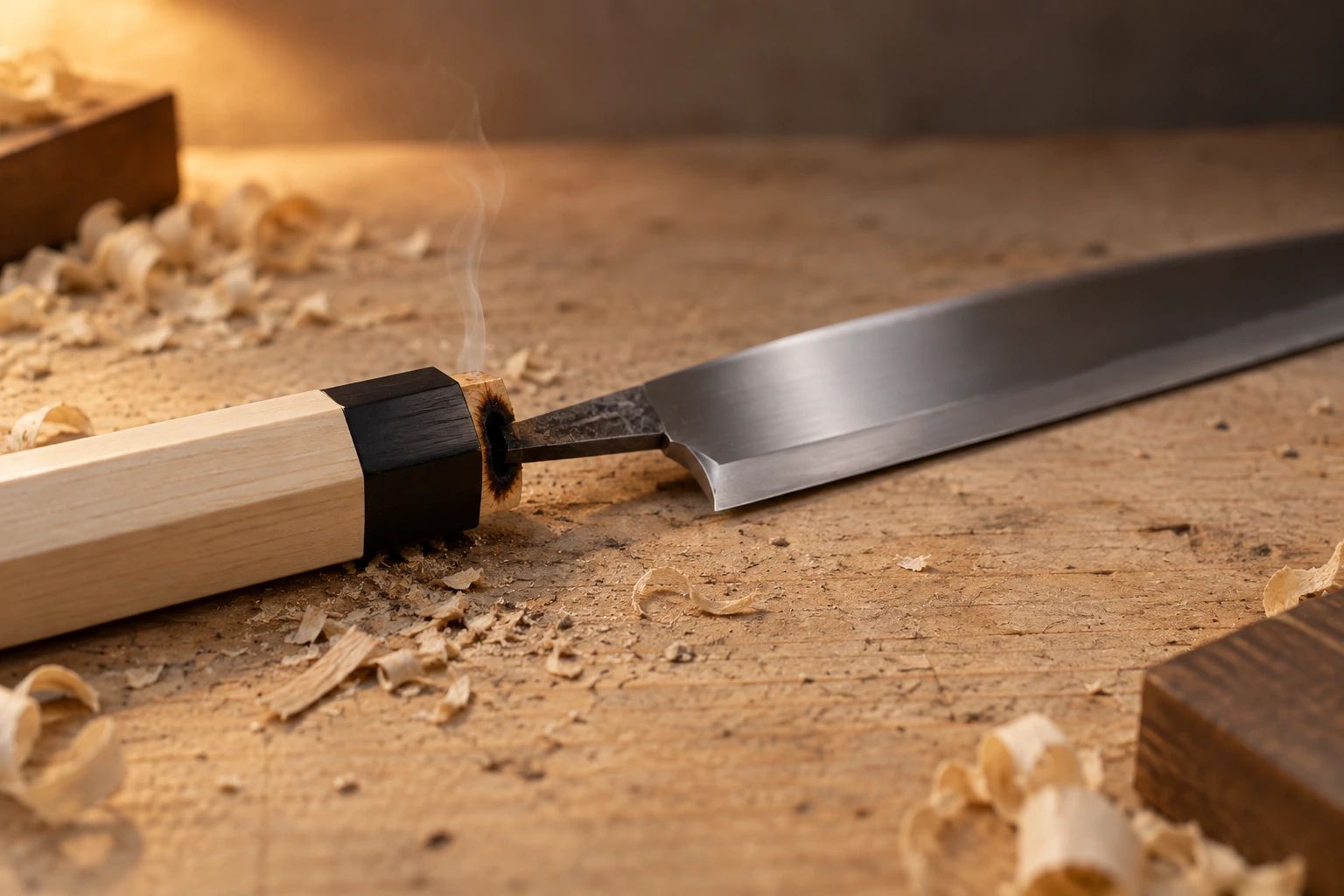
Table of Contents
What is a tang, and why does it matter?
The tang is the part of the blade that extends backward into the handle. It is invisible in the finished knife, which is exactly why it is undervalued by buyers who judge knives by what they can see. Yet the tang determines three things that matter every time you pick the knife up: balance (where the weight sits in your hand), durability (whether the handle stays attached under stress), and repairability (whether you can swap the handle when wood splits or rust creeps in).
Three constructions dominate the global knife market: full tang (Western chef knives), partial tang (budget knives), and hidden tang (Japanese wa-handle knives). Each represents a different answer to the question of how blade and handle should be joined. None is universally correct — they are tools optimized for different priorities. This guide explains what changes when you change the tang.
One more reason to read past the marketing: the word "full tang" appears on packaging because it sells. It is not a guarantee of quality on its own. A poorly heat-treated full-tang blade is still a poorly heat-treated blade. Conversely, the absence of a full tang on a hand-forged Sakai yanagiba is not a defect — it is the entire point of the design.
Tang construction comparison table
The three dominant tang styles, side by side.
| Tang type | Construction | Balance | Replaceable? | Failure risk | Used by |
|---|---|---|---|---|---|
| Full tang | Steel runs full length of handle, two scales riveted on each side | Rear-heavy | Difficult — rivets must be drilled out | Loose rivets (rare); scale separation under heat | Wusthof, Henckels, Shun Classic, most Western chef knives |
| Partial / push tang | Steel extends partway into handle, glued or epoxied | Variable, often blade-heavy in unhelpful way | No — disposable | Glue failure under heat, lateral stress, dishwasher use | Budget knives under roughly 5,000 yen |
| Hidden tang (wa-handle) | Tapered tang inserted into burned hole in wooden handle, friction-fit | Forward toward blade | Yes — designed for it (5-10 year cycle) | Wood splitting at ferrule, rust migration into handle | Yanagiba, deba, usuba, traditional sushi knives |
Full tang: the Western standard
In a full-tang knife, the blade steel is forged or stamped as a single piece that runs the entire length of the handle, edge to butt. Two pieces of handle material — wood, micarta, or polymer "scales" — are glued and then mechanically riveted through the tang on both sides. You can usually see two or three rivet heads on the handle, and a thin strip of steel visible along the top and bottom edges where the scales meet.
Why Western makers chose it: European kitchens demand a knife that survives industrial use. Full tang is structurally redundant — even if the glue fails, the rivets hold; even if one rivet loosens, the others carry the load. Wusthof, Zwilling J.A. Henckels, and Shun Classic all use full-tang construction as standard. The construction also produces a deliberate rear-heavy balance, often emphasized by a thick bolster between blade and handle, which suits the rocking cut motion European cooks use.
The trade-off: a full tang is essentially permanent. When the handle scales eventually wear, crack, or stain beyond cleaning, the knife is hard to refurbish — drilling out rivets damages the tang, and matching new scales is a specialist job. Most Western knives are simply replaced when their handles fail. The blade's life is tied to the handle's life.
Partial tang and push tang: the budget compromise
A partial tang (also called push tang or rat-tail tang) extends only partway into the handle — sometimes just 30-50% of the handle length — and is held in place by epoxy or glue, occasionally with a small pin. From the outside, a partial-tang knife can look identical to a full-tang knife: same shape, same handle profile, sometimes even fake rivet heads stamped into the polymer.
Where it lives: almost exclusively in budget knives under roughly 5,000 yen — supermarket house brands, mid-tier kitchen sets, and entry-level fillet knives. The construction saves steel and labor, which is the only reason it exists.
The failure mode is real. Heat (dishwasher cycles, hot tap water held against the handle) softens the epoxy. Lateral stress (prying, twisting through bone) breaks the bond. Once the bond fails, the blade rotates inside the handle or pulls free entirely — sometimes mid-cut, which is genuinely dangerous. A partial-tang knife that has been hand-washed and used carefully can last many years, but the failure is not a question of if under hard use, only when. For a knife you intend to keep, this construction is a poor choice.
Hidden tang: the Japanese wa-handle answer
Traditional Japanese knives — yanagiba, deba, usuba, and the wa-handle versions of gyuto and santoku — use a fundamentally different construction. The tang is narrow, tapered, and triangular in cross-section. The handle is a single piece of wood (most commonly ho magnolia, sometimes ebony or rosewood for premium knives) with a hole burned and shaped to match the tang exactly. The tang is driven in by hand, friction-fit, with at most a small smear of pine pitch or natural resin to seal the wood.
No rivets, no glue dependency, no metal scales. The handle is held on by precise wood-to-steel friction and the slight expansion of the wood around the tang. A handle maker in Sakai or Kappabashi can fit a new handle to a thirty-year-old yanagiba in about five minutes — heat the old wood to release the resin, tap the blade out, burn a fresh hole in a new ho-wood blank, drive the blade in. Done.
Why this design exists: the philosophy is that the blade — hand-forged, multi-week heat treatment, 62-67 HRC carbon steel — is the permanent part of the knife. The handle is wood, exposed to water and salt every day, and is expected to wear out. Making the handle cheaply replaceable means the blade can outlive several handles. A serious yanagiba blade owned by a sushi chef may be on its third or fourth handle by the time it retires.
Balance, weight, and how tang shapes feel
Tang construction is the single largest factor in how a knife feels in the hand, larger than blade length, larger than handle shape. A full tang puts steel through the entire handle. A typical 8-inch Wusthof Classic chef knife weighs about 230 grams, with the balance point sitting behind the bolster, in the front third of the handle. The knife wants to fall back into your palm. You cut by rocking, letting weight do work.
A hidden tang in a wa-handle knife is a thin steel splinter inside a light wooden cylinder. A 210mm wa-handle gyuto often weighs 140-170 grams — sometimes 90 grams less than its Western equivalent — and the balance point sits forward, at or in front of the heel. The knife wants to lead with its tip. You cut by pushing or pulling the blade through food, with the wrist providing direction rather than force.
This is not a small difference. A cook who has spent a decade with rear-heavy German knives often finds wa-handle Japanese knives feel "wrong" — light, tip-heavy, unstable — for the first hour. After a week, the same cook usually cannot go back. The forward balance is what makes precise julienne and fish-skin removal feel effortless. Neither feel is correct in the absolute; they are correct for different cutting traditions.
Replacing a wa-handle: the consumable-handle philosophy
If you own a Japanese knife with a hidden tang, you should expect to replace the handle at some point. This is not failure — it is the design working as intended. Plan for it.
Cost: a basic ho-wood replacement handle with a plastic ferrule costs roughly 2,000-4,000 yen at Kappabashi shops or in Sakai. A premium handle in kuro-mizuki ebony with a buffalo-horn ferrule runs 8,000-15,000 yen. Octagonal handles cost more than D-shaped (right-handed asymmetric) handles. Custom-shaped handles fitted to your hand are available from specialty makers for 20,000 yen and up.
The procedure: a handle maker either (a) heats the old handle to soften any resin, then taps the blade out from the spine side using a wooden mallet, or (b) splits the old handle off with a chisel if it is already cracked. The handle maker then burns a hole in the new wood blank using a heated tang of similar shape, tests the fit, drives the blade in dry, and sometimes seals with a tiny amount of pine pitch. The whole operation takes 5-10 minutes for an experienced craftsman.
When to do it: see the failure modes below. As preventive maintenance, every 5-10 years for a daily-use knife is reasonable. A yanagiba used only for special occasions can go fifteen years on one handle.
Failure modes: how each tang style breaks
Each construction has a characteristic failure pattern. Knowing what to look for catches problems early, while they are still cheap to fix.
| Tang type | Failure mode | Detection | Repair |
|---|---|---|---|
| Full tang | Loose rivets; scale separation; tang corrosion under scales | Rivets sit slightly proud or loose; visible gap at scale-tang seam; rust streaks along seam | Specialist re-handle (rare); usually replaced |
| Partial tang | Glue failure; blade rotates or pulls free | Wobble when pressing tip against cutting board; gap between blade and handle | None — discard and replace knife |
| Hidden tang | Wood splits longitudinally near ferrule; rust migrates up tang into handle | Visible vertical crack in wood; black ring around ferrule; slight wobble | Replace handle (5-10 minutes, 2,000-15,000 yen) |
Wobble is the universal warning sign. Hold the knife with the spine vertical and press the tip lightly against a cutting board. Any side-to-side movement at the handle means something has loosened — rivet, glue bond, or wood fit. A loose handle is dangerous and gets worse, never better. Address it within the week. For wa-handles, replacement is so cheap and quick that there is no excuse to keep using a wobbly knife. For full-tang Western knives, take it to a shop or replace.
Routine care prevents most of these failures: hand-wash and dry immediately, never dishwasher, never leave knives soaking, and for carbon-steel hidden-tang knives, dry the area where blade enters handle especially carefully — water trapped at the ferrule is the leading cause of premature handle replacement.
What to take from this: tang construction is not a marketing checkbox. It is a structural decision that defines how the knife behaves, how long it lives, and what kind of relationship you can have with it over time. Buy a Western full-tang knife knowing the blade and handle are one purchase. Buy a Japanese hidden-tang knife knowing the blade is the asset and the handle is a perishable wrapper. Avoid partial-tang construction in any knife you intend to keep. The right tang is whichever one matches the way you actually plan to use, maintain, and eventually pass on the tool.