Petty vs Paring Knife: When Each One Wins (2026 Guide)
QUICK ANSWER
A petty is the Japanese answer to the Western paring knife — 120-150mm vs the Western 75-100mm — same role, more reach.
Petty length
120-150mm
Paring length
75-100mm
Best for
Detail work, peeling
Steel
VG10 / White #2
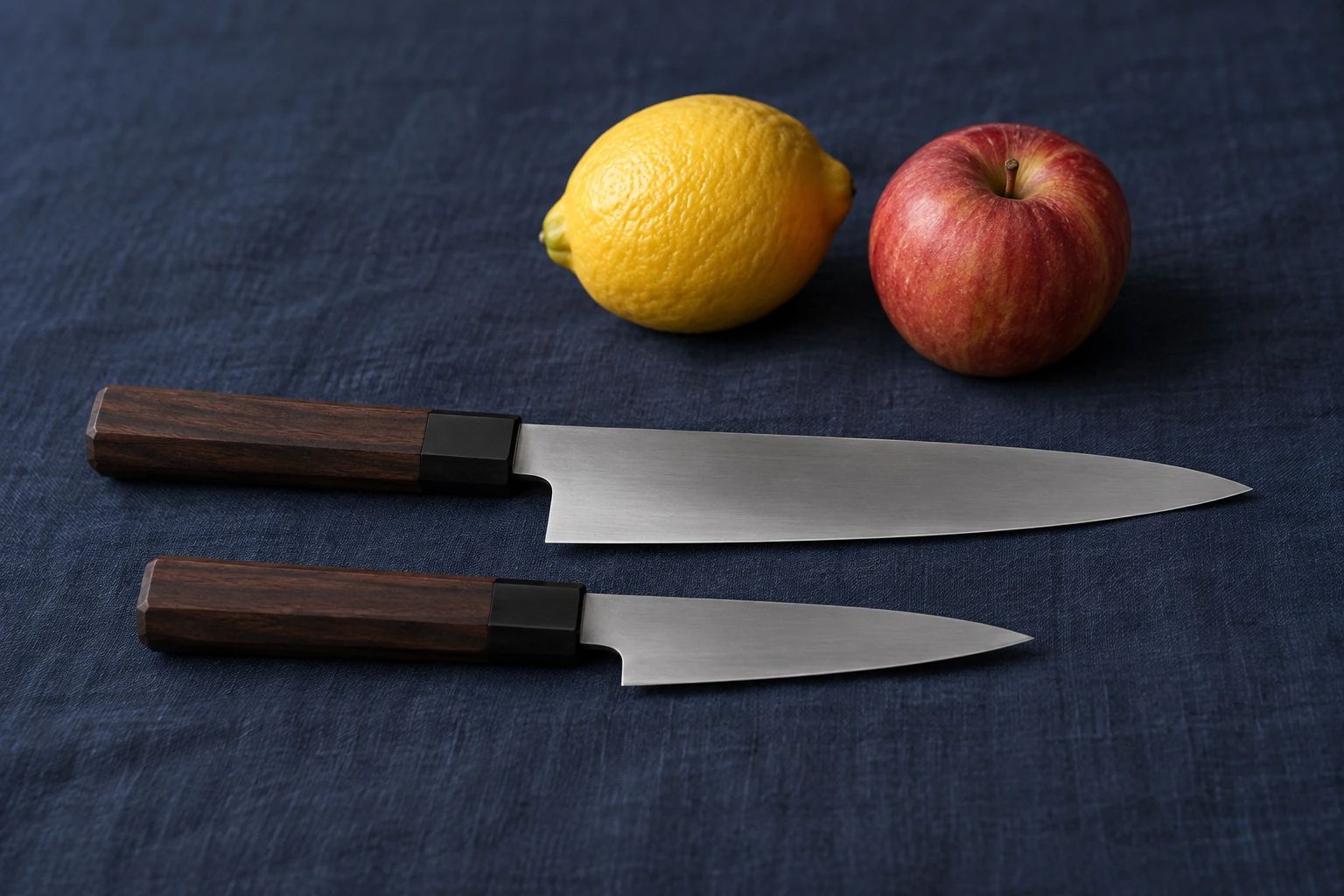
Table of Contents
Petty vs Paring at a Glance
The petty and the paring knife both fill the "smaller than a chef's knife" slot in a kitchen, but they solve the problem differently. The petty (petti, ペティ) is the Japanese mid-range utility blade — typically 120-150mm long, ground thin, balanced like a miniature gyuto. The Western paring knife is shorter, 80-100mm, designed for fruit and detail work where you hold the food in your free hand rather than on a board.
The choice between them is not really "which is sharper" or "which is better steel." It is a question of how you actually cut. If most of your prep happens on a board, a petty replaces a paring knife and adds reach for tomatoes, shallots, and citrus. If you peel apples in your hand, segment oranges over a bowl, or hull strawberries by feel, a paring knife stays better at those specific jobs. This guide breaks down where each one wins, so you can pick the right blade — or decide whether you actually need both.
Complete Comparison Table
The table below summarizes the practical differences across every dimension that matters when you choose between a petty and a paring knife.
| Feature | Petty 120-150mm | Paring 80-100mm |
|---|---|---|
| Origin | Japanese (modern, post-Meiji) | Western traditional |
| Blade Length | 120-150mm (4.7-5.9 inches) | 80-100mm (3.1-3.9 inches) |
| Profile | Slight curve — mini gyuto shape | Straight or slight curve |
| Steel HRC | 58-63 (matches the maker's gyuto) | 54-58 typical |
| Edge Angle (per side) | 12-15 degrees | 15-20 degrees |
| Spine Thickness | Thin (1.5-2mm) | Slightly thicker (1.8-2.5mm) |
| Best for board work | Yes — handles tomatoes, shallots, citrus | No — too short for most board tasks |
| Best for in-hand work | Limited — too long for safe control | Excellent — designed for it |
| Tomato slicing | Excellent | Slow, awkward |
| Apple peeling in hand | Awkward | Excellent |
| Garlic crushing (side of blade) | Yes | No (too small) |
| Edge retention | Excellent — weeks between sharpenings | Good — months between sharpenings |
| Maintenance | Whetstone (1000/3000 grit) | Honing rod plus periodic sharpening |
| Typical price | ¥6,000-25,000 ($45-180) | ¥2,000-15,000 ($15-100) |
Size and Reach: The Single Most Important Difference
The 50-70mm length gap between a petty and a paring knife is small on paper but enormous in practice. A 150mm petty can slice cleanly through a whole beefsteak tomato in one stroke, halve a medium onion, segment a grapefruit, and slice mozzarella at sandwich thickness. Try the same tasks with a 90mm paring knife and the blade is too short to reach across the food — you end up sawing, which crushes soft ingredients and produces ragged cuts.
Conversely, a 90mm paring knife is the right length for tasks where the food is in your hand and the blade only needs to travel a short distance. Peeling an apple, hulling strawberries, scoring tomato skins for blanching, deveining shrimp, removing eyes from potatoes — these are all jobs where a longer blade gets in the way. A 150mm petty held in-hand is also notably less safe; the extra blade length increases the chance of the tip catching your supporting hand or a forearm.
The rule of thumb: if your dominant prep style is board-based, the petty's reach makes it the more useful single knife. If you peel fruit in-hand more than a few times a week, the paring earns its drawer space.
Profile and Cutting Style
A petty has a slight curve toward the tip, almost identical in shape to a gyuto scaled down. This profile supports both push-cutting (the dominant Japanese technique) and gentle rocking, and the curved tip lets you fine-mince herbs or shallots with a quick rolling motion. The flat section near the heel is long enough for clean board contact on bigger ingredients.
A paring knife is shorter and closer to straight. Some makers offer a "bird's beak" curved variant for peeling, but the standard paring profile is essentially a small straight blade. This shape is optimized for controlled detail work: precise cuts at a fixed angle, careful peeling around contours, removing small defects from vegetables. It is not designed to rock through a pile of basil or push-cut a row of carrots.
The result is two different cutting motions. The petty moves with the food — push, draw, gentle rock — the way a chef's knife does on a smaller scale. The paring moves with your hand — short, controlled strokes against a fixed object held in your other hand. Same problem space, different solutions.
Cutting Board vs In-Hand Work
The cleanest way to think about petty vs paring is to map them to the two distinct workflows of small-knife tasks: board work and in-hand work.
Board work means anything where the food sits on the cutting surface and the blade travels through it. Slicing shallots, mincing garlic, segmenting citrus on a board, halving cherry tomatoes, slicing mozzarella for a sandwich, cutting fresh herbs — all of this is petty territory. The blade needs reach (to clear the food in one stroke) and a flat edge section (to make full contact with the board). A 150mm petty handles every one of these tasks better than a 90mm paring.
In-hand work means anything where you hold the food in your free hand and use the blade to remove, peel, or trim. Peeling an apple in a spiral, hulling strawberries, removing potato eyes, deveining shrimp, segmenting an orange over a bowl, trimming silver skin off a tenderloin — all of this is paring territory. The blade needs to be short enough to control with thumb pressure, light enough to maneuver in tight angles, and forgiving enough that it does not bite if it slips. The stubby paring knife is exactly that tool.
Most Western home kitchens have evolved around in-hand work because the chef's knife already covers board reach. Most Japanese home kitchens have evolved around board work because the petty fills the gap below the gyuto or santoku. Neither approach is wrong — they just reflect different prep cultures. Knowing which one your kitchen actually runs on is the best signal for which knife belongs in your drawer.
Steel and Edge Geometry
A Japanese petty is typically built with the same steel as the maker's gyuto line. If the gyuto uses VG-10, so does the petty; if it uses AUS-10, SG2, or a traditional carbon like Aogami, the petty matches. This means a Tojiro DP petty has a VG-10 core hardened to about 60 HRC, a Misono UX10 petty uses Swedish stainless at around 59 HRC, and a high-end SG2 petty reaches 63+ HRC. Edge angles run 12-15 degrees per side, the same as the larger blade.
A Western paring knife sits at a different point on the steel curve. Wusthof and Henckels use X50CrMoV15 hardened to about 56-58 HRC; Victorinox uses a slightly softer X55CrMo14 around 55-56 HRC. Edges are ground at 15-20 degrees per side, with a thicker spine and broader bevel. The combination favors toughness over keenness — the edge handles incidental contact with bone, pits, and hard cutting boards better than a thin Japanese edge would.
What this means for sharpening: a petty wants the same care routine as your gyuto — whetstone touch-ups on a 1000/3000 grit setup, no traditional grooved steel rod. A paring knife is happy on a basic ceramic or fine steel rod between sharpenings, with whetstone work or a pull-through sharpener every few months. The paring is the lower-maintenance tool; the petty rewards more attention with noticeably better cutting feel.
Use-Case Matrix: Which One Wins for What
The table below covers the small-knife tasks that come up most often in a working kitchen. "Wins" is the better tool for that specific job; "OK" means usable but not ideal.
| Task | Petty 150mm | Paring 90mm |
|---|---|---|
| Slicing a whole tomato | Wins — single stroke, clean edge | Slow — too short to clear the fruit |
| Mincing shallot or garlic on a board | Wins — flat edge, good reach | OK for small amounts |
| Peeling an apple in your hand | Awkward — too long to control safely | Wins — built for this |
| Hulling strawberries | OK | Wins — short tip, perfect feel |
| Segmenting citrus over a bowl | OK if the fruit is large | Wins — tighter tip control |
| Slicing mozzarella or fresh cheese | Wins — long cut, no drag | Poor — too short |
| Chopping fresh herbs (small handful) | Wins — gentle rock motion | OK but slow |
| Garnish work and small detail cuts | OK — depends on the cut | Wins — best control for fine work |
| Removing potato eyes | Awkward | Wins — short tip is ideal |
| Deveining shrimp | OK | Wins — precise tip work |
| Crushing a garlic clove (side of blade) | Wins — wider blade surface | Too small to be useful |
| Trimming silver skin off a tenderloin | OK on long sections | Wins for short, controlled cuts |
Counted up, the petty wins most board tasks and the paring wins most in-hand tasks — which lines up exactly with how each knife was designed. There is no "winner overall." There is only the question of which tasks come up more often in your actual cooking.
Pricing and Recommendations
Both knives span a wide price range, but the value sweet spots are well-mapped. Below are the editor-tested picks at each tier — pair these with our 2026 Japanese knife rankings and budget knife guide for further context.
Petty knife recommendations
- Tojiro DP 150mm petty — about ¥6,000 ($45). VG-10 core, 60 HRC, the best entry point in the category and the knife most chefs cite as their first petty. See our brand comparison for full Tojiro lineup notes.
- MAC Superior 130mm petty — about ¥9,000 ($70). Thinner than the Tojiro, slightly more refined, a favorite of working line cooks for its cutting feel.
- Misono UX10 petty 150mm — about ¥18,000 ($135). Swedish stainless, premium fit and finish, the petty most often paired with a UX10 gyuto in professional kitchens.
- Premium tier (SG2/R2) — ¥25,000+ ($180+). Knives from makers like Takamura, Sukenari, or Yu Kurosaki at this tier offer harder steel (HRC 63+) and longer edge retention, but with diminishing returns over the UX10 unless you sharpen often and care about the cutting feel difference.
Paring knife recommendations
- Victorinox Swiss Classic 80mm paring — about ¥2,000 ($15). The reference budget paring knife, used in commercial kitchens worldwide, replaceable without thinking when it dulls or disappears.
- Wusthof Classic 90mm paring — about ¥7,000 ($55). Forged X50CrMoV15, full bolster, lifetime warranty, the matching paring for Wusthof Classic chef-knife sets.
- Tojiro DP 90mm paring — about ¥4,500 ($35). Japanese take on the Western paring profile with VG-10 steel — a useful option if you want one knife system across both blades.
If you can only pick one: get the Tojiro DP 150mm petty. It covers the great majority of small-knife tasks and pairs naturally with any Japanese gyuto or santoku you already own. Add a Victorinox paring knife later, only if you find yourself peeling fruit in-hand often enough to miss the tool. For the broader picture of where the petty sits in the Japanese knife lineup, see our Japanese knife types guide.