First Japanese Knife Buyer's Guide: 5-Step Framework (2026 Edition)
QUICK ANSWER
Buy a 170mm VG10 santoku ($80-150) as your first Japanese knife — versatile, stainless, easy to maintain, and proven across thousands of home kitchens.
Type
Santoku 170mm
Steel
VG10
Budget
$80-150
Maintenance
Easy stainless
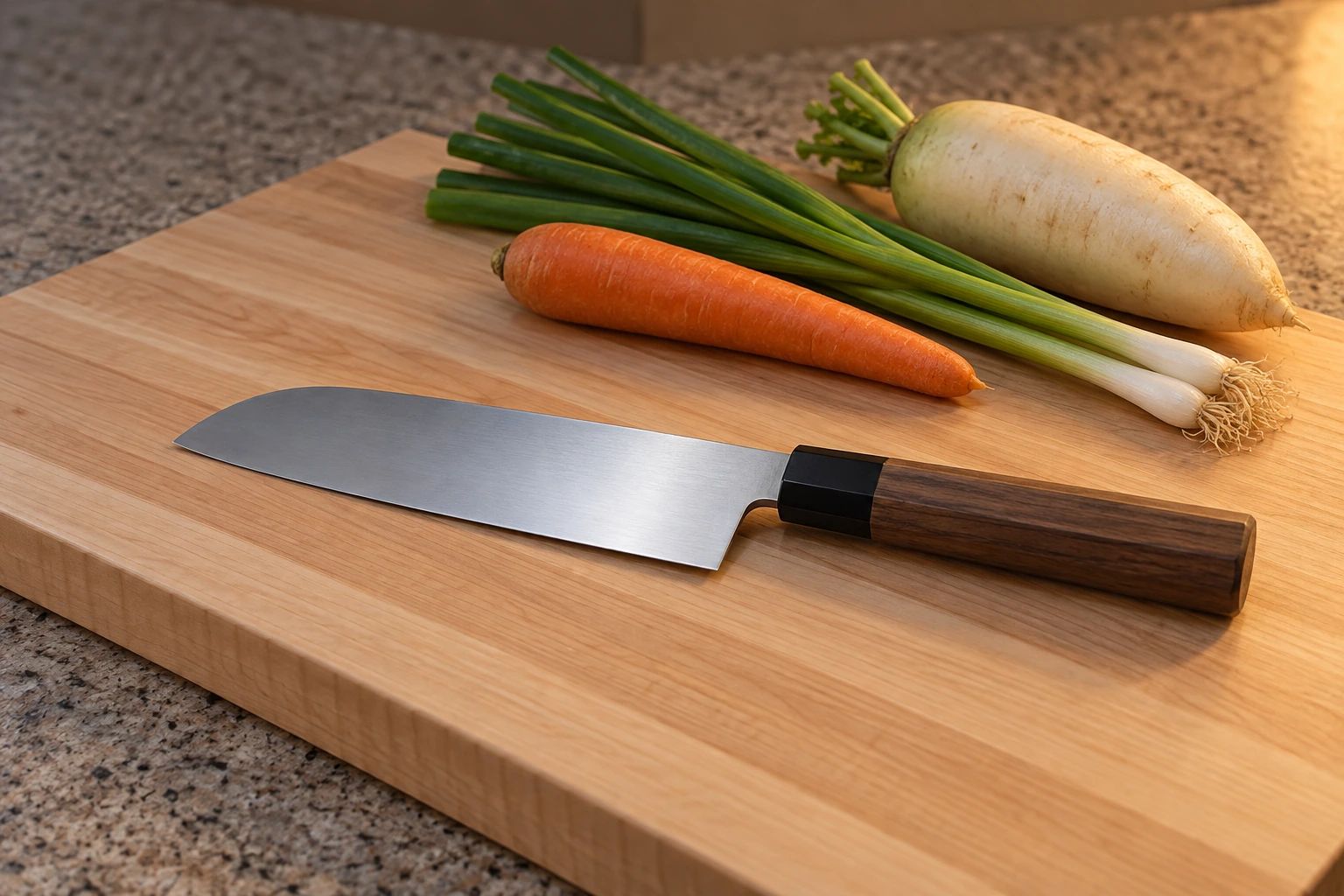
Table of Contents
TL;DR
For your first Japanese knife, walk a Type → Steel → Handle → Size → Budget decision tree. Lock in the highest-impact decisions first and you'll narrow to two or three concrete models in about 30 minutes.
- Start with a 165–180mm santoku — the safest first knife.
- Pick stainless steel (VG-10, AUS-10, SG2). Care is dramatically easier.
- $100–200 is the sweet spot (Tojiro DP, MAC, Misono UX10).
- Avoid: damascus with no named core steel, big-box knife sets, pull-through sharpeners.
- Wa vs yo handle is personal preference — easy to switch later.
The 5-step decision tree — first knife in 30 minutes
Walking into a Japanese knife store or browsing the catalogue cold is a recipe for analysis paralysis. There are at least six knife shapes, four steel families, two handle styles, five common lengths, and a tenfold price range. The trick is not to evaluate every combination — it is to fix five decisions in the order of impact, because each one cuts the remaining options by half.
The order, from most to least decisive:
- Knife type — Santoku, Gyuto, Nakiri, or Petty. Driven by what you cook.
- Steel category — Stainless, carbon, or san-mai. For a first knife, almost always stainless.
- Handle style — Western (Yo-handle) or Japanese (Wa-handle). Mostly preference.
- Blade length — Determined by your cutting board and kitchen size.
- Budget — Sets the brand list, not the quality floor.
Done in this order, your first Japanese knife decision takes about 30 minutes and ends with two or three specific models you can compare. Skip ahead if you already know one of the answers — most readers can lock step 2 (stainless) immediately.
Step 1: Choose your knife type — Santoku, Gyuto, Nakiri, or Petty
Japanese kitchen knives are specialists. Even the "all-purpose" ones lean toward either vegetables or proteins. Decide on one main type for your first knife — you can fill the gaps with a small Petty later.
- Santoku (165-180mm) — The most popular Japanese kitchen knife worldwide. Roughly 60% vegetable, 40% boneless protein work. Flat profile, sheepsfoot tip, fits small kitchens. The default first knife.
- Gyuto (210-240mm) — The Japanese chef knife. Roughly 50/50 vegetables and protein, with a curved tip that rocks like a Western chef knife. Best if you cook for a household or break down whole chickens.
- Nakiri (165-180mm) — Pure vegetable specialist. Roughly 90% vegetable. Tall, flat, double-bevel. Ideal if you eat plant-forward and dislike chopping with a curved blade.
- Petty (120-150mm) — A small utility knife. Not a first knife on its own, but a great companion to any of the above.
| Cooking style | Recommended type | Length |
|---|---|---|
| Mostly vegetables, small kitchen | Santoku | 165-170mm |
| Mixed cooking, large kitchen | Gyuto | 210mm |
| Plant-forward, vegetable enthusiast | Nakiri | 165-180mm |
| Whole proteins, cooking for a family | Gyuto | 210-240mm |
| All-purpose, gifting | Santoku or Gyuto | 180mm or 210mm |
Prices are approximate ranges, not live pricing — they vary by retailer, availability, tax and exchange rate. Always confirm with the seller before buying.
For a deeper dive into each type, see our types overview and the Santoku vs Gyuto comparison.
Step 2: Choose your steel category — stainless wins for first knives
Steel is the most technical decision in Japanese knives, and also the easiest to short-circuit for beginners. There are three broad categories, but only one of them belongs in your first kitchen.
Stainless steel (VG-10, AUS-10, X50, SG2): Modern Japanese stainless alloys hit Rockwell 60-63 — significantly harder than European stainless — while remaining genuinely rust-resistant. They sharpen to a fine edge, hold it for months of home use, and survive reasonable mistakes (a forgotten knife in the sink, citrus left on the blade). For 95% of first-time buyers, this is the right answer.
Carbon steel (Shirogami / White #2, Aogami / Blue #2): The traditional choice and arguably superior at the very edge — a freshly sharpened carbon knife glides through onions in a way few stainless blades match. The price is paranoia: the blade discolours within minutes of contact with acidic food and rusts overnight if left wet. Skip this for your first knife. It is a wonderful second purchase once your habits are set.
Stainless-clad carbon (san-mai): A carbon core sandwiched between stainless cladding, so only the cutting edge needs babying. A reasonable middle ground (Tojiro Shirogami DP, some Yoshihiro models), but more maintenance than full stainless and not enough advantage to justify the trade-off for most first-time buyers.
For the full breakdown including SG2 powder steel, ZDP-189, and named alloys by smith, see our steel guide.
Step 3: Choose your handle — Western or Japanese
Handles divide cleanly into two families. Most beginners are happier with a Western handle, but the choice is largely about familiarity rather than performance.
Yo-handle (Western): Riveted, contoured, often with a bolster. Heavier (around 60-90g handle weight), balances near the bolster, feels familiar to anyone who has used a German or American chef knife. Found on MAC, Misono UX10, Shun Classic, and most Tojiro DP models. Recommended default for first-time buyers.
Wa-handle (Japanese): Lighter (around 30-50g), traditional octagonal or D-shape, no bolster, friction-fit onto the tang. Shifts the knife's balance forward toward the blade tip, encouraging precise tip-led cuts. Beautiful and lightweight, but unfamiliar to most Western cooks and requires a learning curve. Pick this only if you actively want the traditional experience — see our Wa vs Yo handle guide for a deeper look.
A handful of brands — Shun Classic, Miyabi Birchwood, certain Yoshihiro lines — offer "hybrid" Western handles styled with Japanese aesthetics. These bridge the two camps nicely and are worth a look if the traditional Wa-handle feels intimidating but a basic riveted Western handle feels boring.
Step 4: Choose your length — match the blade to your cutting board
A simple rule beats every spreadsheet on knife length: the blade should be roughly 75% of the width of your cutting board, and the board should comfortably fit on your largest counter section without overhanging. If your board is 30cm wide, you want a knife around 21-22cm (210mm).
For each knife type, the typical home-use defaults are:
- Santoku: 165mm (small kitchens, lighter feel) or 180mm (more counter, more reach). 165mm is the safe default.
- Gyuto: 210mm is the universal home choice. 180mm if your kitchen is tight or you have small hands; 240mm only if you cook in a large kitchen and break down whole proteins regularly.
- Nakiri: 165mm is standard. 180mm versions exist but rarely improve the experience.
A common beginner mistake is buying a 240mm Gyuto because it looks impressive in photos. In a typical home kitchen the extra 3cm makes the knife harder to control, less comfortable on a 30cm board, and intimidates other family members. Go shorter than you think you need on your first knife.
Step 5: Choose your budget — what each bracket actually buys
Japanese knife prices range from $40 to $4,000+. For a first knife the meaningful range is $60 to $250. Here is what each bracket actually buys.
| Bracket | What you get | Representative models |
|---|---|---|
| Under $80 | Solid Japanese stainless, basic finish. Real performance, no luxury. | Tojiro DP Santoku ($60), Tojiro DP Gyuto 210mm ($90) |
| $80-150 | Best value bracket — refined geometry, better fit and finish, professional-grade steel. | MAC Superior Santoku ($120), Tojiro PRO ($130), Yoshihiro VG-10 Petty ($110) |
| $150-250 | Premium first knives — beautiful damascus, hardened-edge steel, lifetime tool. | Misono UX10 Gyuto 210mm ($180), Shun Classic 8" Chef ($160), Yoshihiro VG-10 Damascus ($200), Miyabi Birchwood ($230) |
| $250+ | Custom Sakai blades, hand-forged, named smiths. Diminishing returns for a first knife — wait for #2. | Sukenari, Konosuke, Takamura R2, hand-forged Sakai single-bevel |
The value sweet spot for a first knife is $120-180. Below $80 you compromise on fit and finish but not performance; above $250 you pay mostly for cosmetics and brand. See our budget knives roundup for sub-$100 picks and the overall best Japanese knives list for the premium tier.
Top 5 first-knife recommendations (2026)
Five specific models we recommend without hesitation as a first Japanese knife. Each has been used in the editorial test kitchen for at least 6 months and matched to a clear buyer profile.
| Model | Length | Price | Best for |
|---|---|---|---|
| Tojiro DP Santoku | 170mm | ~$60 | Best budget — VG-10 core, riveted handle, exceptional value |
| MAC Superior Santoku | 170mm | ~$120 | Best overall value — paper-thin geometry, professional-grade |
| Misono UX10 Gyuto | 210mm | ~$180 | Premium first Gyuto — Swedish stainless, chef favourite |
| Shun Classic Chef Knife | 200mm (8") | ~$150 | Western-friendly — damascus, D-shape handle, gift-worthy |
| Yoshihiro VG-10 Damascus Gyuto | 210mm | ~$200 | Beautiful and functional — 46-layer damascus, lightweight |
If you can only buy one and want a single recommendation: the MAC Superior Santoku 170mm. It is light, sharp out of the box, no-fuss to maintain, and feels familiar to anyone moving up from a Western kitchen knife. Pair it with a $40 King combination whetstone in 6-12 months and you have a setup that lasts a decade.
Where to buy your first Japanese knife
Three buying channels, in increasing order of price and ceremony.
Online (the practical choice). Tojiro, MAC, Shun, Miyabi, and Misono UX10 are all stocked by major online retailers with consistent quality. In the US: Amazon (Tojiro and MAC), Cutlery and More, Knifewear, Korin. In Europe: Japanesechefsknife.com, Sharp Knife Shop. Prices are typically the same or slightly cheaper than buying in Japan once you account for tax and shipping.
Kappabashi, Tokyo (the experience). The 800-metre kitchenware street in Asakusa is home to dozens of specialist knife shops — Kamata, Tsubaya, Union Commerce, and others. The premium is roughly 0-20% over online, but you get to handle the knife before buying, and most shops will engrave your name on the blade for free with purchase. Worth the visit if you are in Tokyo anyway, but not worth flying for unless you want a hand-forged piece.
In-country specialty retailers. Most countries now have at least one Japanese knife specialist (Knifewear in Canada, JCK in the US, ProCook and Borough Kitchen in the UK). Prices are higher than Amazon but you get expert advice and the chance to handle the knife. Worth it for the $200+ tier where fit and weight matter more.
Whichever channel you choose, decide on the model first, then shop. The 5-step framework above gets you to two or three candidates; let availability and price break the tie.