Santoku vs Chef Knife: The Real Difference Between Japanese and Western Workhorses (2026)
QUICK ANSWER
A santoku is a 165-180mm push-cut knife in HRC 58+ steel; a Western chef knife is 200-250mm with rocker geometry in HRC 54-58.
Santoku length
165-180mm
Chef length
200-250mm
Santoku HRC
58-63
Chef HRC
54-58
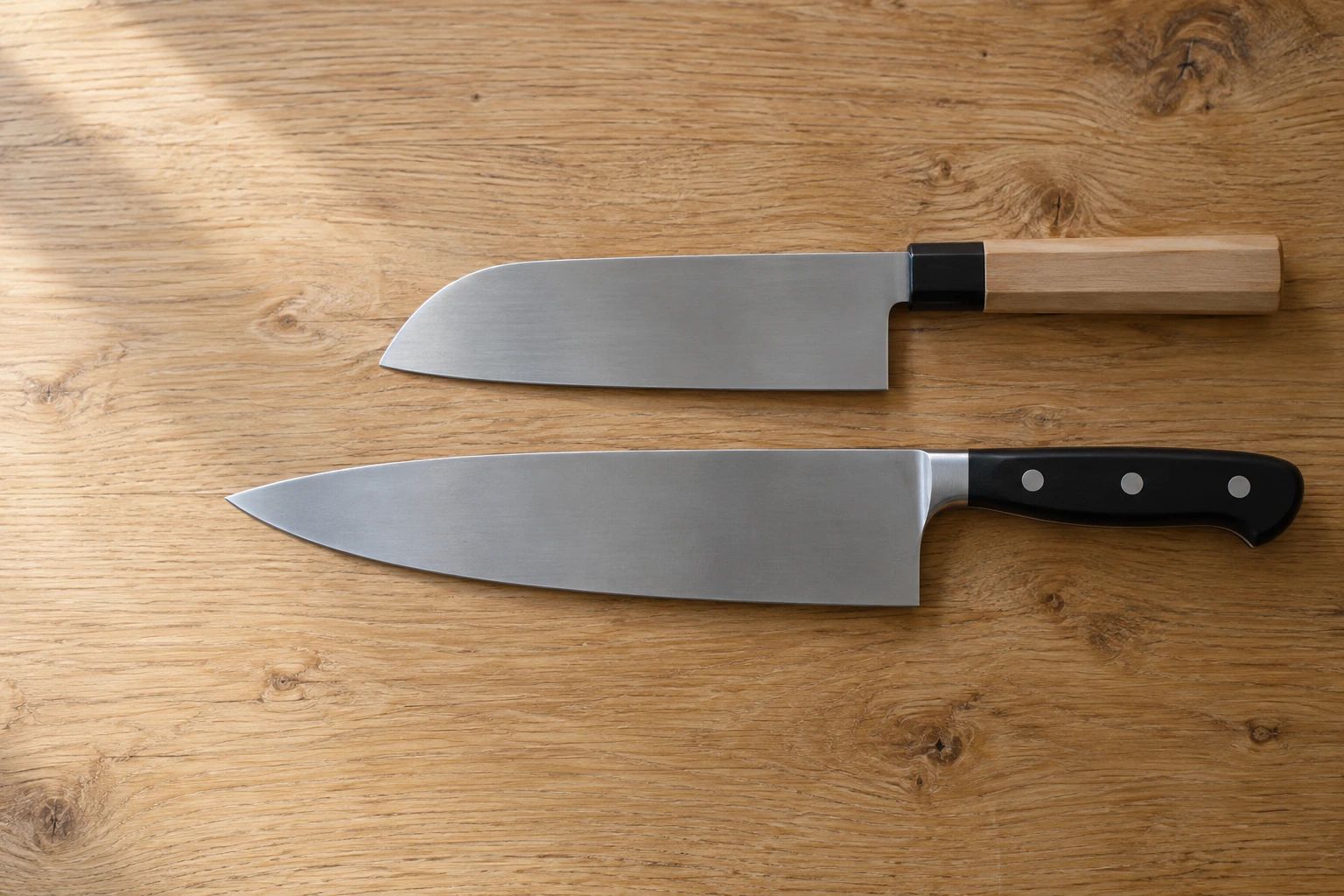
Table of Contents
TL;DR — which one to choose
Santoku and Western chef knife share a category ("kitchen all-rounder") but disagree on philosophy. Pick by cooking style, cutting motion preference, and the food you actually handle.
- Santoku — 165-180mm, flat edge, HRC 58-63, push-cut focused, excels at vegetables and thin meat slicing
- Chef knife (Western) — 200-250mm, curved edge, HRC 54-58, rock-cut focused, excels at large proteins
- Vegetable-heavy home cooking → santoku
- Meat-heavy Western cooking → chef knife
- Serious cook doing both → both knives (they complement)
- One-knife beginner → santoku 170mm (lower learning curve, easier on small boards)
Short version: "thin, hard, flat" santoku vs "thick, tough, curved" chef knife. Neither is better — they're different tools solving different problems.
Defining the two knives
Origins matter.
The santoku emerged in postwar Japanese homes as a bridge between the traditional nakiri (vegetable specialist) and the Western chef knife. "Three virtues" — vegetables, meat, fish. Length 165-180mm, mostly flat edge, rounded tip, thin spine (1.8-2.5mm), HRC 60+ steel.
The Western chef knife was standardized in 19th-century France and Germany, originally a butcher's and cook's tool. Known regionally as "chef's knife," "French knife," or "couteau de chef." Length 200-250mm, large belly curve, pointed tip, thick spine (3.0-4.0mm), HRC 56 tough steel.
The fundamental difference is the assumed cutting motion. The santoku is optimized for push-cutting; the chef knife is optimized for rock-cutting. Every spec — blade length, profile, thickness — follows from that one premise.
Blade shape and length
The most visible differences are shape and length.
- Blade length — santoku 165-180mm, chef knife 200-250mm. Chef knife is 30-70mm longer.
- Edge profile — santoku mostly flat with gentle curve at the tip. Chef knife has a clear belly curve heel-to-tip.
- Tip shape — santoku rounded, not great for precise piercing. Chef knife sharply pointed, fine for trimming and potato eyes.
- Spine thickness — santoku 1.8-2.5mm at the heel, chef knife 3.0-4.0mm. The santoku has less drag through vegetables.
- Blade height — santoku 45-50mm at the heel, chef knife 50-55mm. The chef knife gives slightly more knuckle clearance.
- Weight — santoku 140-180g, chef knife 200-280g. The chef knife uses weight to do the work; the santoku relies on sharpness.
These choices determine the "what it's for" answer: flat + thin = vegetables and thin slicing; curved + thick = large proteins and rock-mincing.
Steel and hardness
Beyond shape, the steel choices reveal the same philosophical split.
Santoku steel: VG-10, AUS-10, SG2/R2, ZDP-189, Ginsanko, Shirogami #2, Aogami #2. Hardened to HRC 58-63 — holds a fine edge long, but is less forgiving of lateral force and bone. Edge angle 15-17° per side (30-34° total) — acute.
Chef knife steel: X50CrMoV15 (German standard), X45CrMoV15, N690, AUS-8, 440C. HRC 54-58, softer than santoku but tougher. Edge angle 20-22° per side (40-44° total) — more obtuse.
The hardness gap is the "edge retention vs forgiveness" tradeoff. Santoku stays sharper longer but demands care; chef knife is forgiving and beginner-friendly but needs honing every 2-4 weeks.
Sharpening also differs. Santoku belongs on stones (#1000 + #3000); grooved steel rods will micro-chip an HRC 60+ edge. Chef knives are happy on #400-#1000 stones and stay sharp on a daily honing rod. See our sharpening guide and steel types guide.
Cutting technique — push-cut vs rock
Shape dictates how the knife is meant to be used.
Push-cutting is the santoku default. Place the edge horizontally over the food, push the knife forward and down — diagonally, not straight down — and carry the cut from heel to tip in one motion. Once the edge touches the board, lift cleanly and reset. "One motion per cut."
Rock-cutting is the chef knife default. Pin the tip to the board, pivot the heel up and down to mince. The curved belly acts as a cradle — ideal for herbs, onions, garlic. For large proteins, you use longer draw-cuts or push-pull strokes heel-to-tip.
Cross-compatibility is limited. Try rocking on a flat santoku → uncut bridges. Try pure push-cutting on a chef knife → thick spine gives heavy drag through vegetables. Each knife's strengths only emerge when used the way it was designed to be used.
Task-by-task: who wins what
Specific tasks, head to head.
| Task | Santoku | Chef knife | Winner |
|---|---|---|---|
| Cabbage julienne | Excellent — full width one motion | Good — works with rocking | Santoku |
| Onion dice | Excellent — flat edge, even cuts | Excellent — fast rocking | Tie |
| Tomato slicing | Excellent — thin edge, no crush | Fair — thick spine crushes | Santoku |
| Large protein slicing | Fair — length limits | Excellent — length pays off | Chef knife |
| Herb mince | Good — light rock at tip | Excellent — its native motion | Chef knife |
| Chicken breast slicing | Excellent — clean cuts | Excellent — single stroke | Tie |
| Bone-in chicken | Forbidden — chips edge | Limited but possible | Chef knife |
| Hard squash | Forbidden — lateral force bends | Good — thick spine handles | Chef knife |
| Fish fillet trim | Excellent — thin and precise | Good but thick | Santoku |
| Citrus slicing | Excellent — sharp tip, no crush | Good — rough cut face | Santoku |
| Heavy prep volume | Excellent — light, low fatigue | Good — weight tires hand | Santoku |
| Large cutting board | Fair — short for big boards | Excellent — full length pays | Chef knife |
Overall: santoku wins ~80% of home tasks (vegetable-centric); chef knife wins meat-heavy and rocking-heavy work.
Full spec comparison
| Spec | Santoku | Chef knife (Western) |
|---|---|---|
| Origin | Postwar Japan | 19th-century France/Germany |
| Blade length | 165-180mm | 200-250mm |
| Edge profile | Mostly flat | Large curve |
| Spine thickness | 1.8-2.5mm | 3.0-4.0mm |
| Tip | Rounded | Sharply pointed |
| Hardness (HRC) | 58-63 | 54-58 |
| Edge angle (per side) | 15-17° | 20-22° |
| Weight | 140-180g | 200-280g |
| Native motion | Push-cut | Rock-cut |
| Sharpen interval (home) | 4-8 weeks | 2-4 weeks |
| Sharpening tools | #1000+#3000 stone, ceramic rod | #400-#1000 stone, honing rod |
| Best at | Vegetables, thin slicing, julienne | Large proteins, rocking mince |
| Avoid | Bone, frozen, rocking | Delicate slicing of soft vegetables |
| Durability | 10+ years with care | Forgiving, 10-20 years |
| Price band | $60-400 | $80-500 |
Which is right for you
| Your situation | Pick | Why |
|---|---|---|
| First knife, general home cook | Santoku 170mm | Light, easy, small-board friendly |
| Japanese / Asian cooking heavy | Santoku | Thin slicing shines |
| Western / meat cooking heavy | Chef knife 210mm | Built for large proteins and rocking |
| Serious cook, budget for both | Both | Complement, don't duplicate |
| Enjoy sharpening | Santoku | Fits Japanese stone culture |
| Minimal maintenance preferred | Chef knife | Daily honing rod sufficient |
| Small cutting board | Santoku | Shorter blade, easier to wield |
| Big board, rocking preferred | Chef knife | Long blade earns its keep |
| Left-handed | Either | Both are double-bevel |
| Gift | Santoku | More distinctive, more "Japanese" |
Buyer's guide
Santoku picks (editor recommendations, USD May 2026):
- Tojiro DP Santoku 170mm (~$80) — VG-10 core, entry default.
- MAC Professional 6.5" (~$180) — proprietary high-carbon, pro standard.
- Misono UX10 Santoku 180mm (~$250) — refined Swedish stainless.
Chef knife picks:
- Wüsthof Classic 8" (~$160) — German Solingen benchmark.
- Henckels Pro 8" (~$140) — close Wüsthof alternative.
- Sabatier K Carbon 25cm (~$120) — French carbon heritage.
Hands-on: in Tokyo, Kappabashi is the best place for santokus; in most cities, a good cookware retailer carries the Western brands. See our annual picks in best Japanese knives 2026; related comparisons: santoku vs gyuto, Japanese vs German.