Japanese Vegetable Knife: Nakiri, Usuba, Santoku Compared (2026 Editor Test)
QUICK ANSWER
"Japanese vegetable knife" refers to three blade types: nakiri, usuba, and santoku — pick by skill level and cooking style.
Three options
Nakiri, Usuba, Santoku
Beginner pick
Nakiri or Santoku
Pro pick
Usuba
Edge
Push-cut flat profile
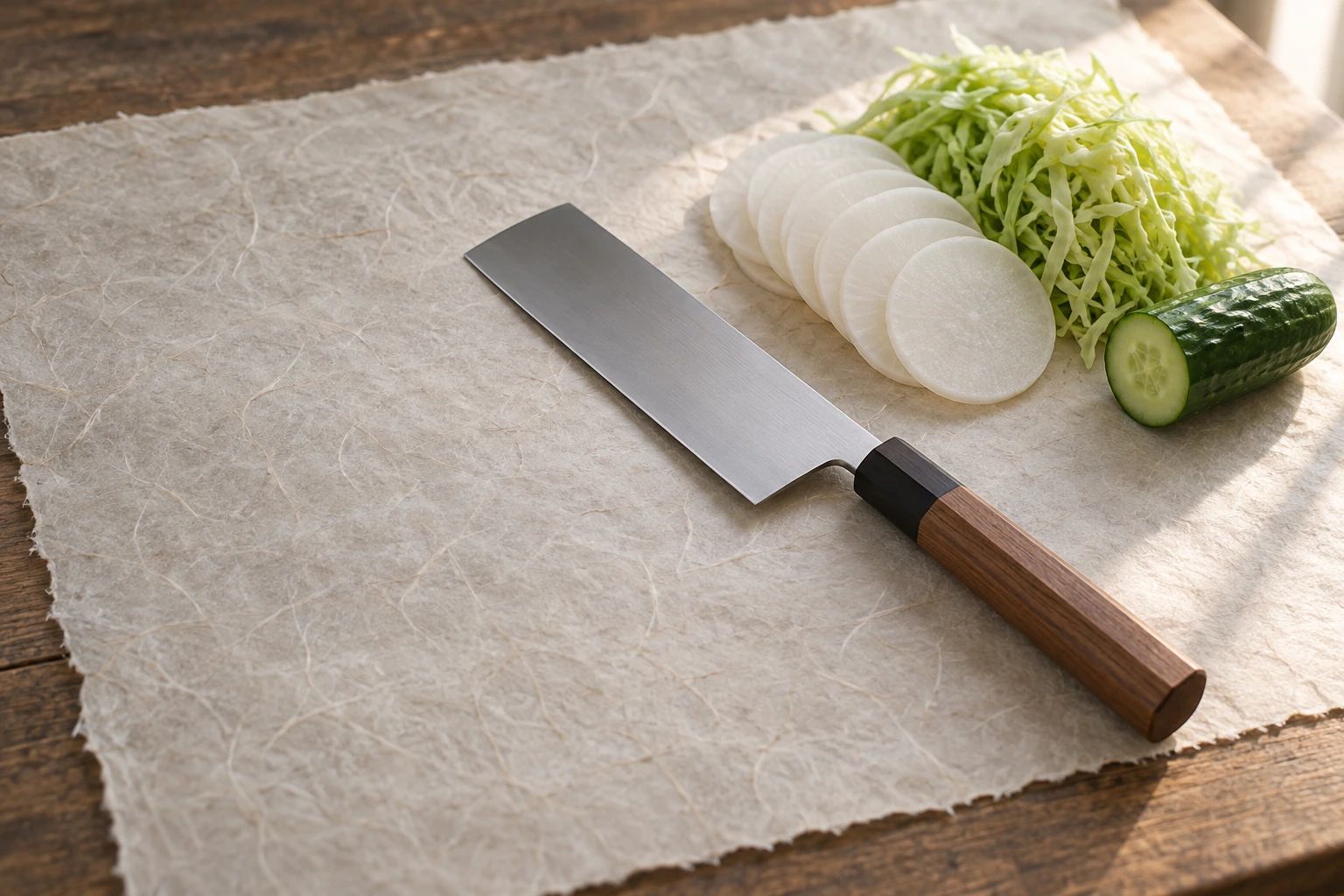
Table of Contents
TL;DR — Nakiri, Usuba, or Santoku?
"Japanese vegetable knife" is not a single blade — it refers to three distinct knives: nakiri, usuba, and santoku. Pick based on your cooking style and skill level, not on price or prestige.
- Nakiri (菜切) — Double-bevel, vegetable-dedicated, beginner-friendly. ~150-165mm. Works in either hand.
- Usuba (薄刃) — Single-bevel, professional sushi-chef tool. Asymmetric grind. ~180-225mm. Advanced sharpening required.
- Santoku (三徳) — Double-bevel all-purpose knife with vegetable-strong geometry. ~165-180mm. The default choice for most homes.
- For everyday home cooking → Santoku or Nakiri
- For traditional Japanese vegetable prep (katsuramuki, ken-zukuri) → Usuba
- For Western kitchens with rocking technique → Santoku (skip the usuba)
If you only read this far: buy a santoku for general cooking or a nakiri if you do a lot of vegetable-heavy cooking. Reserve the usuba for when you are committed to learning traditional Japanese cutting technique.
What Counts as a "Japanese Vegetable Knife"?
The phrase "Japanese vegetable knife" gets used loosely on English-language retail sites — sometimes meaning nakiri, sometimes usuba, occasionally santoku, and rarely a Chinese-style cleaver mistakenly labelled as Japanese. To cut through the confusion, our editorial definition is: a Japanese-made (or Japanese-pattern) kitchen knife whose primary design intent is cutting vegetables.
Three traits are shared across all genuine Japanese vegetable knives:
- Thin blade profile. The spine is dramatically thinner than a Western chef's knife — often under 2mm at the heel. Less metal to push through the vegetable means less wedging and a cleaner cut.
- Hard steel. Typically VG-10, VG MAX, SG2, AUS-10, or traditional white/blue paper steel, hardened to HRC 60-65. Harder steel holds a finer edge longer but is less forgiving of lateral force.
- Flat or near-flat edge profile. Designed for push-cuts — the blade meets the cutting board along its full length in a single motion. This is the opposite of a Western chef's knife, which uses a curved edge for rocking cuts.
Why does this matter? Because a vegetable's cell wall is delicate. Crush it (with a thick wedging blade) and you bruise the flesh, lose juice, and oxidise faster — a sliced tomato that "weeps" within seconds is a knife problem, not a tomato problem. A thin, hard, flat Japanese vegetable knife slices instead of crushing, which is why home cooks who switch from a Western chef's knife to a nakiri or santoku notice the difference on day one.
Nakiri — The Home Cook's Vegetable Knife
Nakiri (菜切) literally means "vegetable cutter" — and the name is honest. Nothing about this knife is compromised for other tasks. It is the Japanese answer to the question: "What if a knife only had to cut vegetables, and it had to do it brilliantly?"
- Bevel: Double-bevel, symmetric. Works identically in left or right hand.
- Edge geometry: Flat. No belly curve. Cuts via push-cuts, not rocking.
- Length: Typically 150-165mm. Some specialty makers offer 180mm for larger hands.
- Hardness: HRC 60-63 in modern stainless versions; up to HRC 64 in carbon-steel variants.
- Best for: Cabbage shredding, lettuce, onion brunoise, cucumber rounds, herb mincing, mass vegetable prep.
- Avoid for: Meat with bones, frozen food, hard squash skin, anything requiring a rocker motion.
The rectangular profile looks intimidating to Western eyes, but it is the most ergonomic shape for vegetables. When you cut a head of cabbage on a nakiri, the entire edge contacts the board simultaneously — no chasing the curve, no half-cut strips. For our editor doing 30 minutes of mass prep, the nakiri showed measurably less wrist fatigue than a gyuto on the same tasks.
For brand-level recommendations, see our deep-dive nakiri buying guide and the direct sibling comparison santoku vs nakiri.
Usuba — The Professional Tool
Usuba (薄刃) means "thin blade." This is the knife you see in professional Japanese kitchens, in the hands of itamae (sushi chefs) and kaiseki cooks. It looks superficially similar to a nakiri — both rectangular, both vegetable-only — but it is fundamentally different.
- Bevel: Single-bevel, asymmetric. Chiral — right-handed or left-handed (specify when ordering).
- Edge geometry: Flat with a slight curve at the heel on Kansai (Osaka) usuba; fully flat on Kanto (Tokyo) usuba.
- Length: 180-225mm. Longer than nakiri because katsuramuki requires blade length for continuous cuts.
- Hardness: HRC 62-65. Almost always carbon steel (white #2 or blue #2 paper steel).
- Best for: Katsuramuki (paper-thin daikon/cucumber peeling), ken-zukuri (decorative juliennes), turning vegetables, kaiseki and sushi garnish work.
- Avoid for: Anything non-vegetable, lateral force, any user who has not committed to learning kasumi/ura sharpening.
The single-bevel grind is not a "premium upgrade" of a nakiri — it is a different tool for a different technique. The flat back (ura) has a slight concave hollow that creates a release surface, allowing thin sheets of vegetable to peel away from the blade instead of sticking. Sharpening requires two distinct steps: working the front bevel (kasumi) on stones, then deburring the back (uraoshi) flat against a fine stone. Most home cooks who buy an usuba end up frustrated within a year because they don't maintain it correctly.
Honest take from our editor: don't buy an usuba as your first Japanese vegetable knife. Buy a nakiri, use it for a year, learn to sharpen it on a #1000/#3000 stone, and then if you find yourself attracted to traditional Japanese cutting techniques, graduate to an usuba. See the detailed usuba buying guide and the focused comparison usuba vs nakiri for context.
Santoku — Vegetable-Strong All-Rounder
Santoku (三徳) means "three virtues" — referring to vegetables, meat, and fish. Of the three knives in this guide, the santoku is the only one that is not strictly vegetable-dedicated, but we include it here because in actual Japanese home use, the santoku is the everyday vegetable knife. Its geometry is shifted heavily toward vegetable work compared to a Western chef's knife or a Japanese gyuto.
- Bevel: Double-bevel, symmetric.
- Edge geometry: Mostly flat with a gentle curve toward the tip. Optimised for push-cuts but allows a small amount of rocking.
- Length: 165-180mm.
- Hardness: HRC 58-63 depending on the steel.
- Best for: Roughly 80% of home cooking — vegetables, boneless meat, fish fillet, herbs.
- Avoid for: Heavy bones, frozen food, deep rocking technique (use a gyuto).
If you only own one Japanese knife, this is almost always the right one. The santoku is the workhorse: short enough to feel controllable on a small cutting board, flat enough to push-cut a head of cabbage, and curved enough to handle the occasional chicken breast or fish fillet. Our editor's most-used knife at home is a 170mm santoku, kept on the magnetic strip rather than buried in a drawer.
For brand picks and price tiers, see the dedicated santoku buying guide and compare with the closest alternative in santoku vs gyuto.
Full Comparison Table
All three Japanese vegetable knives, side by side:
| Feature | Nakiri | Usuba | Santoku |
|---|---|---|---|
| Bevel | Double | Single (chiral) | Double |
| Length | 150-165mm | 180-225mm | 165-180mm |
| Edge profile | Flat | Flat (slight curve at heel on Kansai) | Slight curve to tip |
| HRC | 60-63 | 62-65 | 58-63 |
| Hand compatibility | Both | Right OR left (specify) | Both |
| Skill required | Beginner | Advanced | Beginner |
| Best for | Vegetable prep at home | Traditional cuisine, katsuramuki | All-purpose home use |
| Avoid for | Meat with bones | Anything non-vegetable | Heavy bones |
| Sharpening | Standard stones (#1000/#3000) | Kasumi + ura technique | Standard stones (#1000/#3000) |
| Steel typically | VG-10, AUS-10, SG2 | White #2, Blue #2 carbon | VG-10, AUS-10, AUS-8 |
| Price range | $50-$250 | $120-$800+ | $50-$250 |
| Care level | Medium | High | Medium |
Which One for You? (Use-Case Picker)
Match your situation to a recommendation:
| Your situation | Recommendation | Why |
|---|---|---|
| First Japanese knife, general home cook | Santoku | Covers vegetables, meat, fish in one tool |
| Vegetarian or heavy vegetable prep | Nakiri | Purpose-built; flat edge wins on mass prep |
| Already own a santoku, want a vegetable specialist | Nakiri | Complementary, not redundant |
| Sushi chef or professional Japanese kitchen | Usuba | Required for traditional technique |
| Left-handed cook | Nakiri or Santoku | Double-bevel works in either hand; usuba needs special order |
| Western technique, lots of rocking cuts | Santoku (skip nakiri) | Nakiri's flat edge fights rocking motion |
| Shared kitchen, multiple users | Santoku | Most forgiving of mixed skill levels |
| Gift for a Japanese cuisine enthusiast | Nakiri or Usuba | Specialist tools signal intent |
| Tight budget, one knife | Santoku (around $80) | Best versatility-to-price ratio |
Care, Sharpening & Storage
All three Japanese vegetable knives reward care and punish neglect — but they punish it in different ways. Here is the editor's short rule set:
- Wash and dry immediately. Never leave a Japanese knife wet in the sink. Carbon-steel usuba will start to spot within minutes; stainless nakiri and santoku resist rust but still degrade if left wet.
- Never put any of them in the dishwasher. Heat, detergent alkalinity, and impact with other utensils all chip the thin edge.
- Use a wooden or soft-plastic cutting board. Glass, ceramic, or marble boards destroy the edge within weeks. See our cutting board guide.
- Sharpen on stones, not on rods. A #1000 / #3000 combination stone covers normal home use. Avoid grooved steel rods — at HRC 60+ they cause micro-chipping. See how to sharpen and the stone selection guide.
- Oil carbon steel. If you choose a carbon-steel usuba or carbon-steel nakiri, wipe a thin layer of food-safe mineral oil or camellia oil after every cleaning.
Usuba-specific: Single-bevel sharpening is its own skill. The front bevel (kasumi) is ground at the bevel angle on a stone; the back (ura) is laid flat against a fine finishing stone for a brief deburring pass. Get this wrong and you'll round the shinogi line or remove the concave urasuki — both expensive mistakes. Many usuba owners send their knife to a professional sharpener (a tougi-shi) every 6-12 months and only do touch-ups themselves.
Storage: A magnetic strip or wooden saya (sheath) keeps edges protected better than a drawer. For full guidance see Japanese knife storage and the block vs magnetic comparison.
Where to Buy
If you can visit Tokyo, Kappabashi (the kitchenware district near Asakusa) is the highest-value way to buy any of these knives. You'll see the steels in person, talk to staff who actually use the knives, and get on-the-spot sharpening. Several Kappabashi shops offer free engraving and ship internationally. See our Kappabashi shop map and the broader Kappabashi shopping guide.
For online shopping outside Japan, three brands offer reliable quality under $200:
- Tojiro DP series — VG-10 core, $50-$120, the standard recommendation for a first Japanese vegetable knife.
- MAC Professional / Superior — proprietary high-carbon steel, $80-$180, professional kitchens' default.
- Shun Classic — VG-MAX core, $150-$250, widest retail distribution in North America and Europe.
For curated annual picks across all price tiers, see the editor's best Japanese knives 2026 roundup and our first Japanese knife buyer's guide.